Blog
ARMIN STROM: The Science of Movement, the Art of Transparent Mechanics

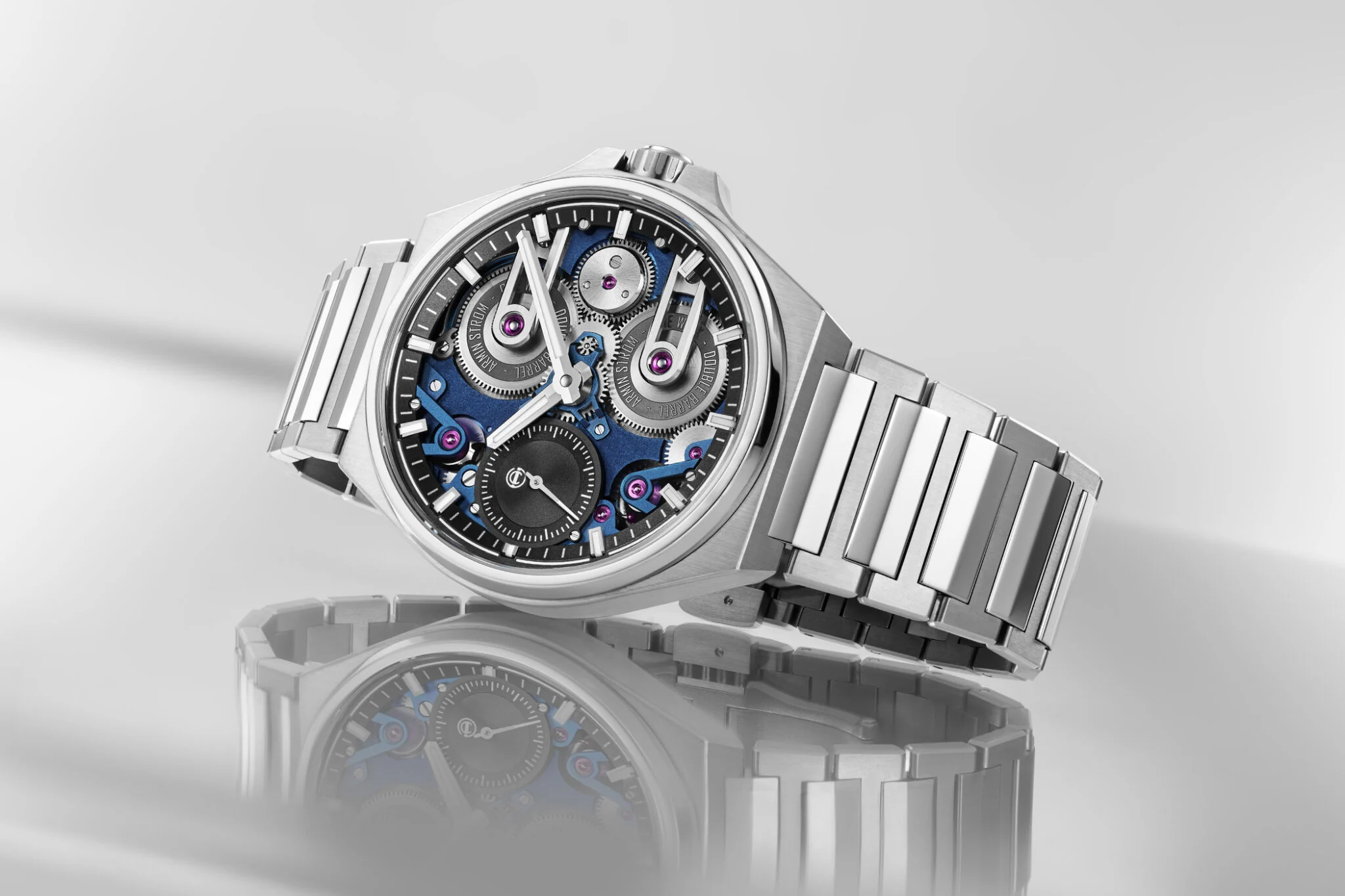
An Independent Manufacture Redefining the Architecture of Time
In contemporary haute horlogerie, transparency can mean many things. It may refer to a sapphire case, an openworked dial, or a movement revealed through the back of a watch. At Armin Strom, transparency is something more fundamental. It is a philosophy of construction, a way of thinking about mechanical watchmaking in which the movement is not concealed behind the dial but becomes the central expression of the watch itself.
The brand’s distinctive visual language is built around exposed mechanics, architectural movement design, and a commitment to making the technical substance of a timepiece visible. Yet its identity extends well beyond skeletonisation. Armin Strom has developed into an independent Swiss manufacture whose work explores some of the most demanding questions in mechanical horology: how to maintain consistent energy delivery, how to achieve stable resonance between regulating systems, how to reinterpret familiar complications, and how to combine traditional hand-finishing with contemporary engineering.
Based in Biel/Bienne, Switzerland, the manufacture operates at the intersection of science, craftsmanship, and design. Its watches are not simply objects in which mechanical complexity is displayed. They are studies in how a movement can be conceived, constructed, finished, and experienced as a complete aesthetic and technical proposition.
The result is a brand with a particular character within independent watchmaking. Armin Strom does not seek to reproduce the visual codes of classical Swiss luxury. Instead, it places the mechanism at the forefront, inviting the wearer to understand the watch through its construction.
From Armin Strom’s Personal Craft to an Independent Manufacture
The origins of the brand reach back to 1967, when Armin Strom established his watchmaking business in Burgdorf, Switzerland. He developed a reputation for hand-skeletonisation, a discipline that requires the watchmaker to remove material from movement components while preserving their structural integrity and mechanical function.
Skeletonisation is a demanding craft. The watchmaker must understand the architecture of the calibre in detail, identifying which sections of a bridge or plate can be removed without compromising rigidity, alignment, or the movement’s reliable operation. The remaining structure must be carefully shaped and finished. Every cut becomes visible, and every surface contributes to the final appearance.
Armin Strom’s work was rooted in this specialised expertise. His approach was not simply to expose a movement, but to transform its construction into an expressive form. The craft required a combination of mechanical knowledge, patience, precision, and an unusually developed sensitivity to the visual relationship between components.
His reputation grew over the following decades. In 1990, his work was recognised through a Guinness World Record associated with the creation of the smallest hand-skeletonised wristwatch for ladies. This achievement reflected the technical ambition and fine manual skill that had become central to his identity.
The next chapter began in 2006, when Serge Michel and Claude Greisler assumed responsibility for the brand and its legacy.
Their partnership brought together two complementary perspectives. Serge Michel, a watch enthusiast with a strong entrepreneurial vision, became the business force behind the company. Claude Greisler, a master watchmaker whose family background and formal education were deeply rooted in horology, brought the technical expertise required to develop a new generation of mechanical timepieces.
Greisler’s watchmaking education was extensive. It included formal training in watchmaking and restoration, followed by specialised studies in the construction of complicated timepieces. His professional experience at Christophe Claret further exposed him to the demands of high-complication watchmaking.
Together, Michel and Greisler envisioned a brand that would preserve the original spirit of Armin Strom’s skeletonisation while moving beyond the limitations of a specialist decorative workshop. Their ambition was to create a fully integrated manufacture capable of designing and producing its own movements.
The manufacture in Biel/Bienne opened in 2009. This was the decisive moment in the transformation of Armin Strom from a brand associated primarily with hand-skeletonisation into an independent manufacture with its own technical identity.
The distinction is important. The historical Armin Strom legacy provided the foundation, but the modern company developed a broader horological philosophy. Skeletonisation remained a defining visual characteristic, while movement development, engineering, and proprietary mechanical solutions became central to the brand’s future.
Transparent Mechanics: A Philosophy Rather Than a Style
Armin Strom’s expression, “transparent mechanics,” describes more than the appearance of its watches. It reflects the conviction that the mechanics of a timepiece should be understood through direct visual access.
In conventional watch design, the dial generally serves as a visual barrier between the wearer and the movement. It organises information, establishes aesthetic identity, and conceals much of the mechanism. Armin Strom reverses this relationship. The movement becomes part of the dial, while the display of time is integrated into a broader mechanical composition.
This approach changes the way the watch is experienced.
The wearer sees the barrel, gear train, bridges, balance, and regulating components not as isolated technical details, but as elements of a carefully designed structure. Their placement establishes visual rhythm. Their finishes create contrast. Their movement introduces a sense of animation that is inseparable from the passage of time.
The architecture is deliberate. Openworking is not treated as an aesthetic exercise applied after the movement has been developed. It is considered from the beginning of the design process, influencing the shape of bridges, the positioning of components, the relationship between mechanical functions, and the overall composition of the watch.
This distinction separates meaningful skeletonisation from purely decorative transparency.
At Armin Strom, the visible movement is expected to communicate something about how the watch works. The visual arrangement of components should correspond to the technical logic of the calibre. A bridge is not merely an ornamental shape. It supports a mechanism, establishes a structural relationship, and becomes part of the visual language through its form and finish.
The philosophy also introduces a particular responsibility. When a movement is exposed, the quality of its construction becomes immediately apparent. Surface finishing, symmetry, alignment, component proportions, and the precision of assembly can no longer remain hidden.
Transparency therefore becomes a demanding standard of craftsmanship.
The Manufacture in Biel/Bienne: Control Over the Entire Mechanical Process
The modern Armin Strom manufacture is built around a high degree of vertical integration. The company develops its own calibres and undertakes the production, finishing, and assembly of the majority of their components in-house. Specialist elements, such as hairsprings and jewels, are sourced from dedicated Swiss suppliers.
This model allows the manufacture to maintain close control over the architecture and execution of its movements.
The process begins with mechanical conception and calibre development. Engineers and watchmakers establish the movement’s functional requirements, energy management, dimensions, and component relationships. These decisions influence the physical architecture of the calibre and the way it will be assembled and finished.
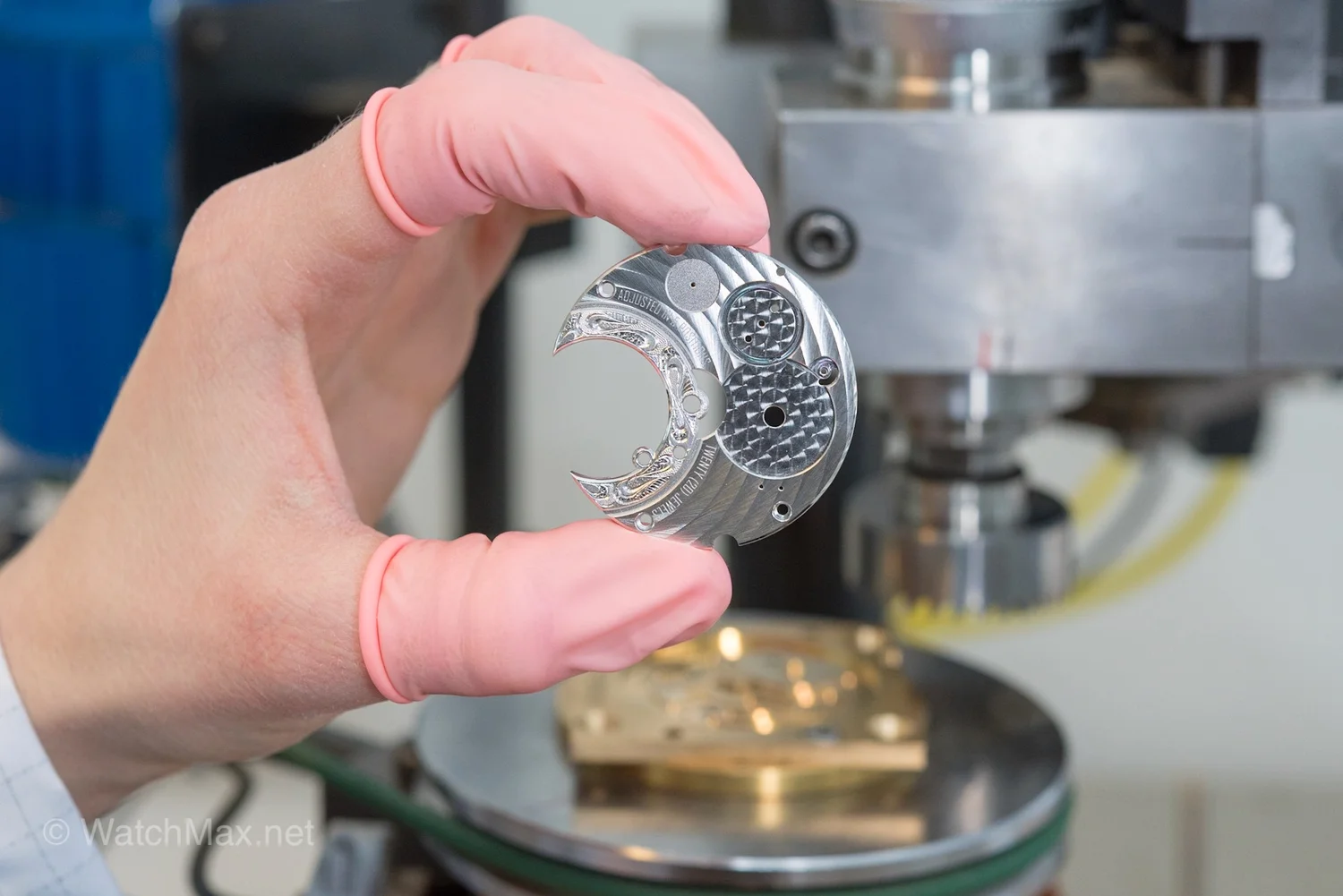
Production then involves the machining and preparation of components, followed by a series of finishing operations. The movement is decorated and assembled, tested, disassembled where necessary, and assembled again to ensure the required standards are achieved.
The manufacture’s finishing work includes traditional techniques such as:
- Côtes de Genève
- Perlage
- Circular graining
- Hand-applied bevels
- Polished and black-polished surfaces
- Carefully finished screws and jewel sinks
These techniques are not interchangeable decorative gestures. Each requires a different approach to the material, tools, pressure, and surface preparation.
Perlage produces a pattern of overlapping circular marks, generally applied to plates. Côtes de Genève creates parallel waves across bridges. Circular graining introduces a controlled texture to selected surfaces. Beveling shapes the edges of components, while polishing refines them to a reflective finish.
Hand-beveling is particularly significant. The process involves shaping and polishing the edge of a component, often requiring the watchmaker to work around curves and changes in geometry. The result is not only visual refinement but a demonstration of the precision with which the component has been prepared.
Armin Strom’s commitment to hand-finishing extends to parts that may not be immediately visible when the watch is worn. This reflects an approach in which the quality of the movement is not determined solely by what can be seen through the dial or caseback.
The manufacture’s limited production volume is closely connected to this model. Complex movement development, extensive hand-finishing, and detailed assembly require time. The brand’s output is therefore shaped by the demands of its manufacturing philosophy rather than by the pursuit of large-scale production.
Resonance: The Central Horological Ambition
Resonance is arguably the most intellectually distinctive element of Armin Strom’s contemporary identity.
The phenomenon has fascinated watchmakers for centuries. When two oscillating systems are sufficiently coupled, they can influence one another and move toward a state of synchronisation. In horology, the possibility of using resonance to improve the stability of timekeeping has long represented an ambitious technical objective.
The historical pursuit is associated with figures such as Christiaan Huygens, whose experiments with pendulum clocks in the seventeenth century helped establish the scientific understanding of resonance in horological applications. Later watchmakers, including Antide Janvier, explored the phenomenon through highly sophisticated clocks.
The challenge of applying resonance to a wristwatch is considerably more complicated than demonstrating it in a stationary clock.
A wristwatch is exposed to constant movement. Changes in position, shocks, and disturbances can affect the oscillators. Two balance wheels may briefly synchronise, only to drift apart again. For resonance to offer a meaningful chronometric benefit, the synchronisation must be stable and continuously maintained.
Armin Strom approached this challenge through a proprietary mechanism known as the Resonance Clutch Spring.
The system mechanically couples two independent regulating systems. The clutch spring transmits energy between the oscillators, encouraging them to maintain a stable resonant relationship. The mechanism is designed to make resonance more resilient to the disturbances associated with wearing a watch on the wrist.
This is not simply a visual feature. It is a mechanical solution developed to address a longstanding horological problem.
The presence of two balance wheels also creates a distinctive visual experience. Their oscillations become part of the dial-side composition, offering the wearer a direct view of the relationship between the regulating systems.
The technical principle and the aesthetic expression reinforce one another. The mechanism is visible because it is central to the watch’s purpose.
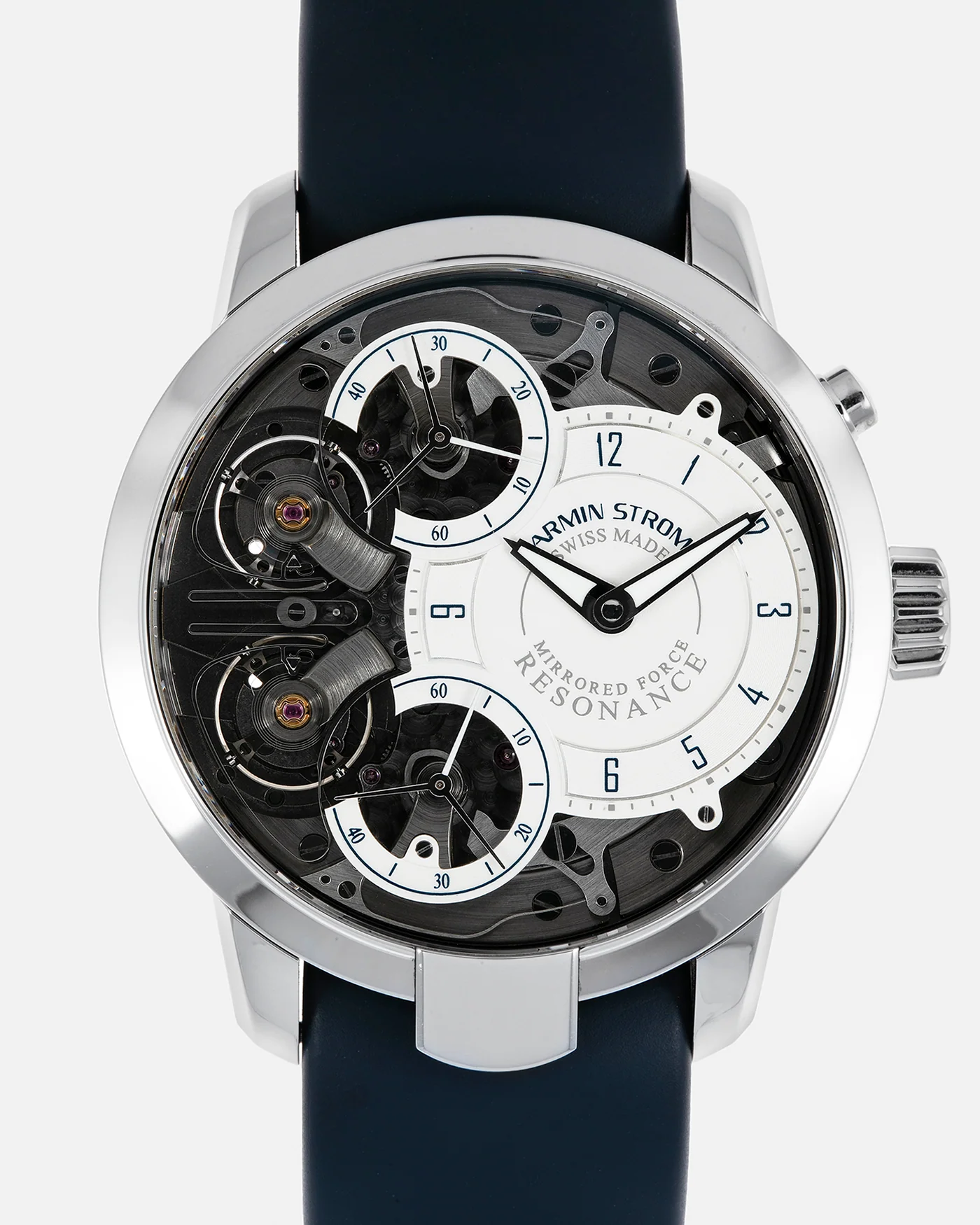
Mirrored Force Resonance: Making the Phenomenon Visible
The Mirrored Force Resonance is one of the most recognisable expressions of Armin Strom’s resonance technology.
The watch features two independent balance wheels and associated regulating systems arranged in a visually symmetrical composition. The dial-side display places the mechanism at the centre of attention, while the time indication is positioned away from the conventional central arrangement.
The design creates an immediate sense of balance and movement. The two oscillators are not merely decorative counterparts. Their relationship is the foundation of the watch’s technical proposition.
The resonance clutch is designed to maintain synchronisation between them, allowing the system to operate as a coupled pair. The manufacture’s engineering seeks to establish a stable and predictable resonant state under the conditions encountered during wrist wear.
The mirrored architecture also contributes to the watch’s visual identity. The symmetrical arrangement creates a sense of order, while the moving balance wheels introduce dynamic tension. The watch appears simultaneously controlled and alive.
The Mirrored Force Resonance demonstrates how Armin Strom’s technical and design philosophies converge. The movement is exposed because its construction is the subject of the watch. Its visual drama emerges directly from its mechanical function.
The collection has been explored through different materials, colours, and executions, including editions in stainless steel, rose gold, and more expressive contemporary treatments. These variations alter the visual character without changing the fundamental horological concept.
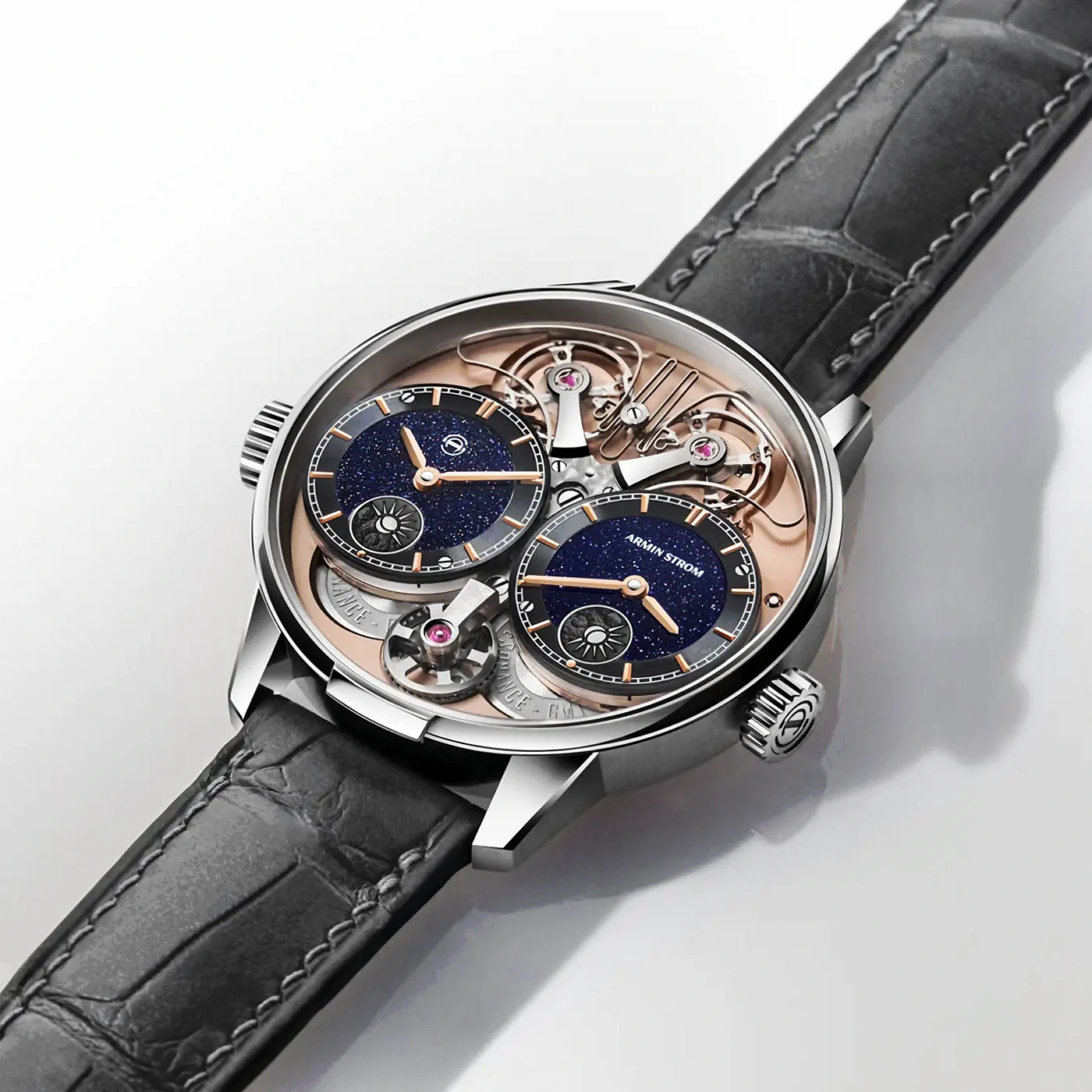
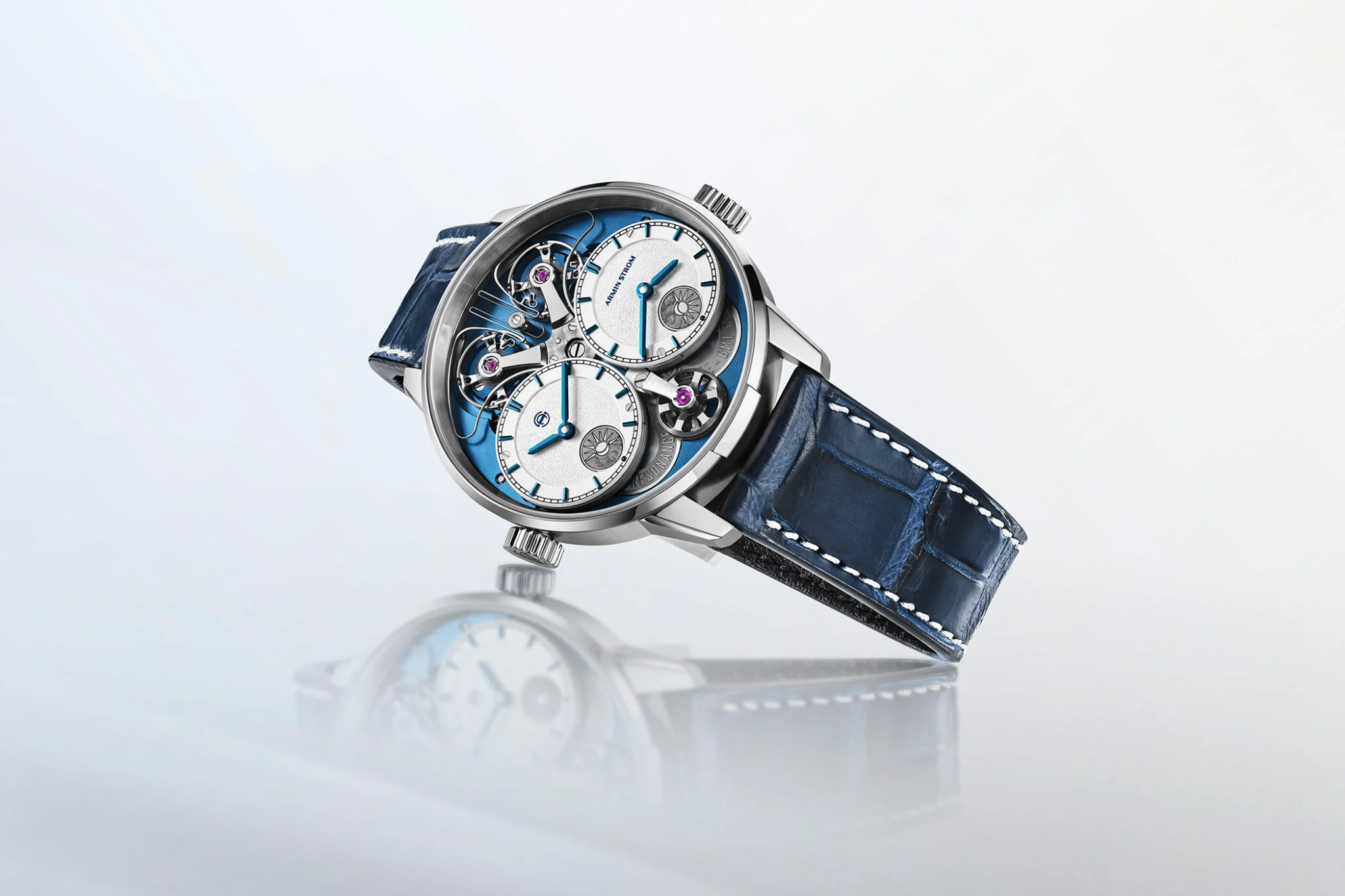
Dual Time GMT Resonance: Two Time Zones, One Mechanical Idea
The Dual Time GMT Resonance develops the resonance concept into a practical complication.
The watch incorporates two independent time displays, allowing the wearer to read two time zones simultaneously. Each display is supported by its own regulating system, while the resonance mechanism connects the two oscillators.
The arrangement is particularly interesting because the complication is not simply added to an existing movement. The dual time-zone functionality and the resonance architecture are conceived as part of the same mechanical system.
The watch addresses a familiar practical requirement, international timekeeping, through a technically unusual construction.
The two displays create a clear visual separation between the time zones. The movement remains visible, and the relationship between the oscillators is central to the composition. The result is a watch that combines functional utility with an advanced horological concept.
The Dual Time GMT Resonance also reflects the brand’s interest in the historical development of resonance. The mechanism draws upon a tradition of scientific experimentation while applying it to the requirements of a contemporary wristwatch.
For collectors, the model offers a particularly compelling intersection of complication, engineering, and visual architecture.
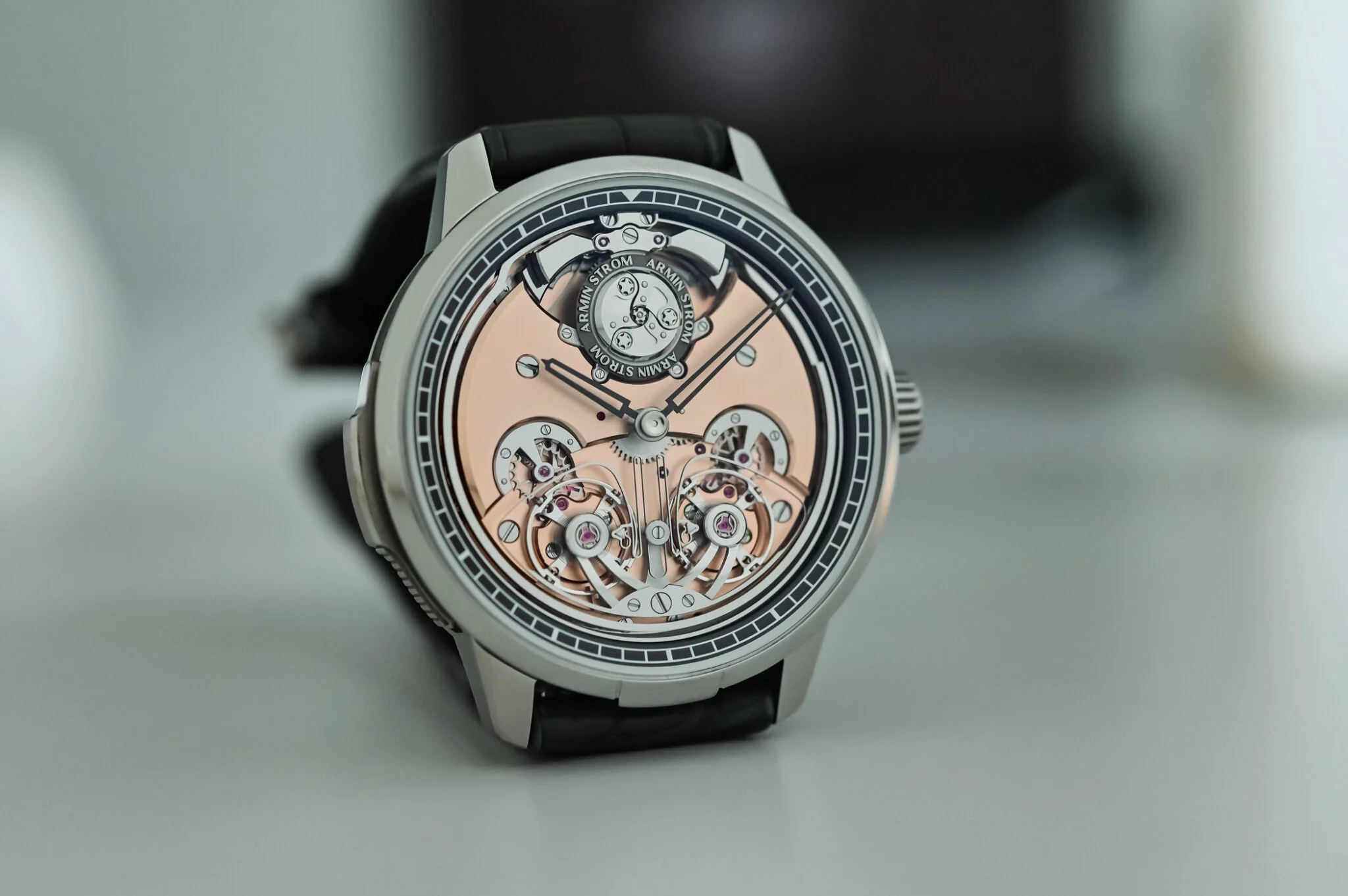
Minute Repeater Resonance 12:59: The Convergence of Sound and Synchronisation
The Minute Repeater Resonance 12:59 First Edition represents a further extension of Armin Strom’s technical ambitions.
A minute repeater is among the most demanding complications in mechanical watchmaking. It uses a striking mechanism to acoustically indicate the time, traditionally through hours, quarter-hours, and minutes. The mechanism must translate the time into a sequence of strikes, coordinating hammers, gongs, racks, snails, and other components with exceptional precision.
Armin Strom’s 12:59 First Edition combines this complexity with the resonance system.
The watch incorporates four hammers and four gongs to produce a Westminster-style striking sequence. It offers two striking modes: a conventional indication of the current time and a 12:59 sequence, which allows the wearer to activate the longest possible strike.
The 12:59 mode is particularly revealing. It transforms the minute repeater from a purely utilitarian complication into an acoustic demonstration of the mechanism’s capabilities.
The movement’s architecture is designed around the combined requirements of sound production and resonance. The construction includes a column-wheel system for selecting the striking modes, a centrifugal governor to regulate the striking mechanism, and the proprietary resonance coupling.
The significance of the watch lies in the integration of two complex horological disciplines. Resonance is concerned with the relationship between oscillating systems and the stability of timekeeping. A minute repeater is concerned with the controlled production of sound through mechanical action.
Bringing these principles together requires a carefully coordinated movement architecture.
The 12:59 First Edition illustrates the direction in which Armin Strom’s technical identity continues to evolve. The manufacture is not content to explore resonance in isolation. It is investigating how the principle can be integrated into increasingly complex mechanical expressions.
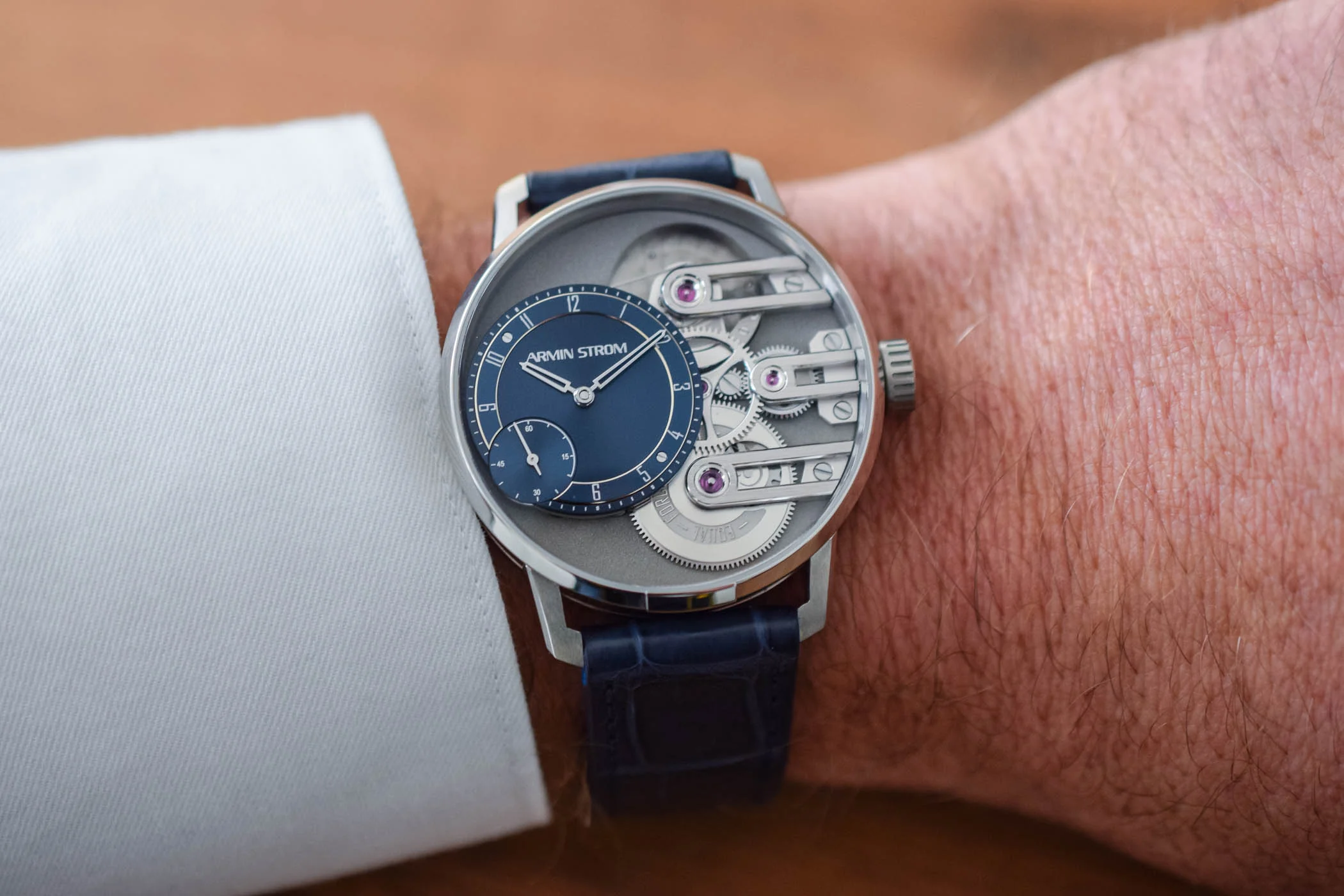
System 78: A Contemporary Foundation for Fine Watchmaking
System 78 represents a more accessible and everyday-oriented expression of Armin Strom’s philosophy, while retaining the technical and artisanal standards of the manufacture.
The collection’s name refers to 1978, the birth year shared by Serge Michel and Claude Greisler. It also reflects the founders’ personal connection to the modern identity of the brand.
System 78 is organised around fundamental horological functions and principles. Rather than beginning with an elaborate complication, its watches examine the mechanics of timekeeping, energy delivery, and display through carefully developed movements.
The collection includes the Gravity Equal Force, Orbit, Tribute 1, and One Week models. Each offers a different interpretation of the relationship between mechanical substance and visual design.
The range demonstrates that Armin Strom’s philosophy does not require every watch to be built around resonance or a grand complication. The manufacture can apply the same principles of movement architecture, transparency, and finishing to more conventional functions.
This is important to the coherence of the brand. System 78 establishes a technical foundation that allows the more ambitious Resonance and Masterpieces creations to exist within a recognisable horological identity.
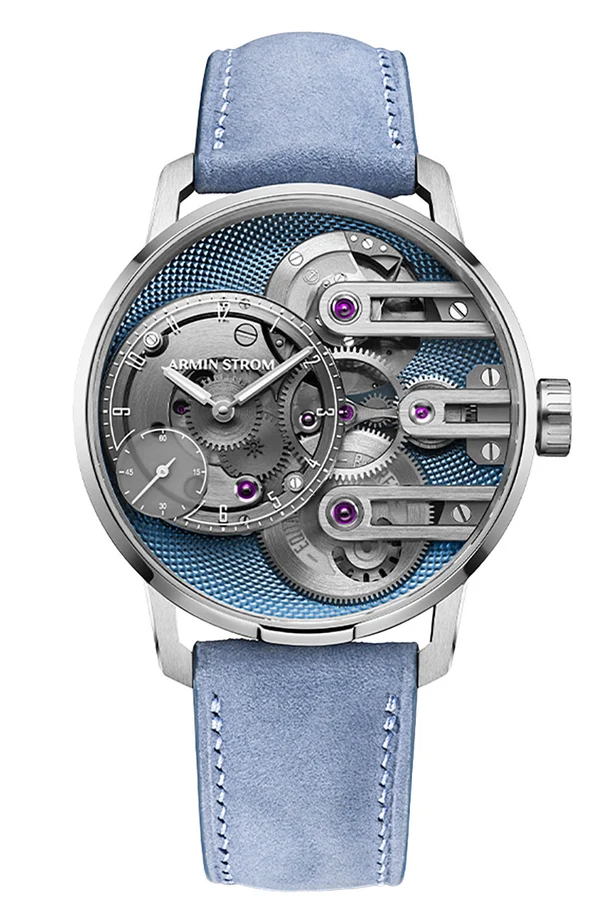
Gravity Equal Force: The Pursuit of Consistent Energy Delivery
The Gravity Equal Force is one of the most significant developments within System 78.
Its central objective is to address a fundamental issue in mechanical watchmaking: the relationship between the energy stored in the mainspring and the consistency of power delivered to the regulating system.
As a mainspring unwinds, its torque changes. This variation can influence the performance of the escapement and balance. A movement may therefore experience different operating conditions depending on the state of its power reserve.
The Gravity Equal Force introduces a mechanism designed to provide more consistent energy delivery throughout the watch’s running period.
The movement incorporates a stop-work system associated with the barrel. By limiting the usable portion of the mainspring’s unwinding cycle, the mechanism aims to avoid the less consistent energy levels that occur toward the extremes of the spring’s operating range.
The watch also uses an automatic winding system with a micro-rotor. The micro-rotor is integrated into the movement architecture rather than occupying the conventional space above the calibre, allowing the movement to remain visually open.
The combination of energy management and open architecture is characteristic of Armin Strom’s approach. The technical solution is not hidden. The barrel, winding system, and regulating components become part of the watch’s visual composition.
The Gravity Equal Force is therefore more than a skeletonised automatic watch. It is a study in the relationship between mechanical efficiency, chronometric stability, and movement design.
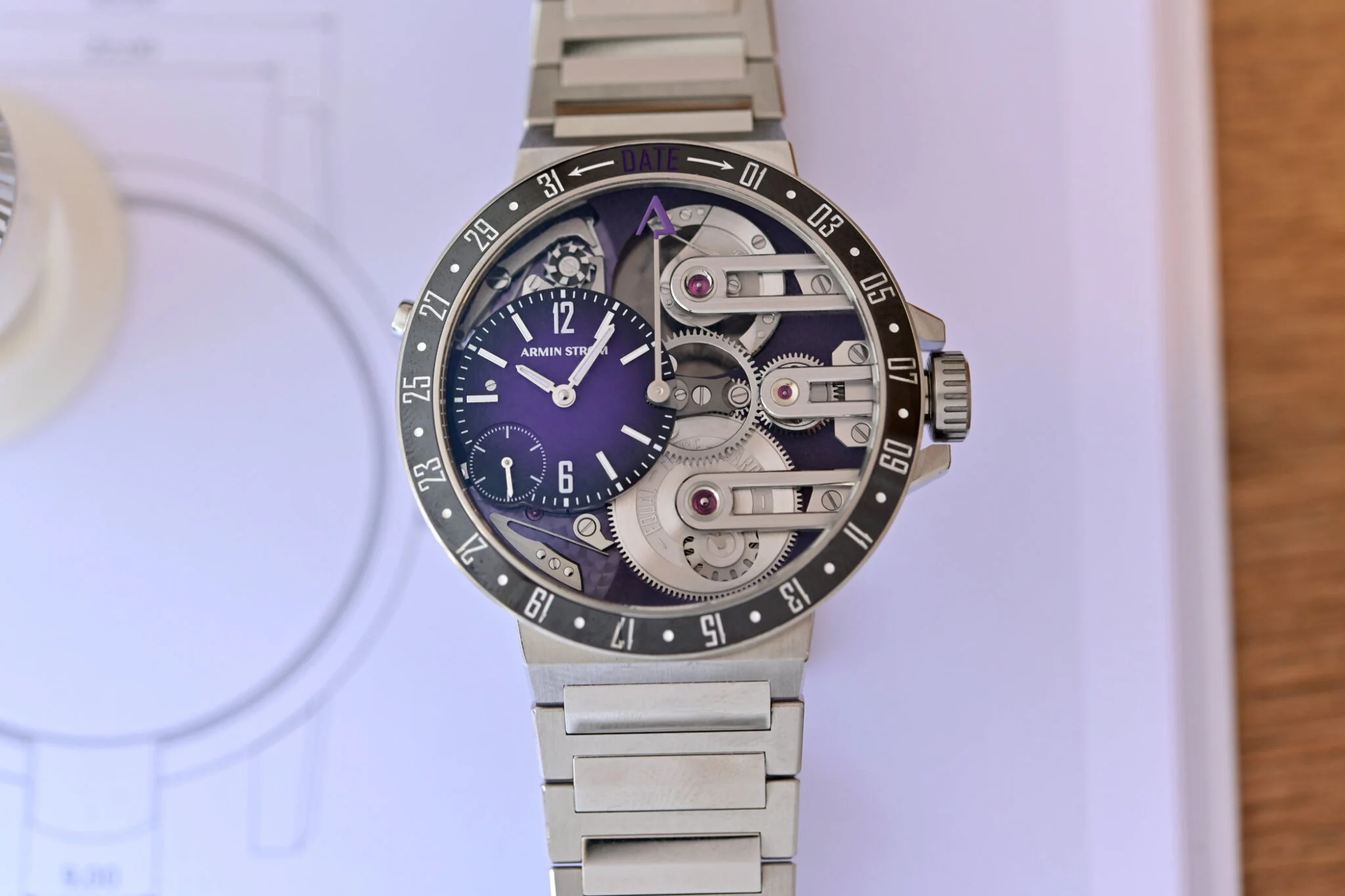
Orbit: Reimagining the Everyday Date
The Orbit offers one of Armin Strom’s most inventive reinterpretations of a familiar complication.
The date function is among the most common features in contemporary watches. Its display is usually presented through a window, an aperture, or a central hand. Orbit approaches the complication differently, placing the date indication on the bezel and making it available on demand.
The watch uses a retrograde date hand that remains in a stationary position when the date is not being displayed. A pusher activates the mechanism, allowing the hand to indicate the current date against the scale on the bezel. The date advances automatically at midnight, while the mechanism’s mechanical memory allows the hand to return to the correct date when activated again.
A column-wheel mechanism controls the date display. The use of a column wheel, commonly associated with chronograph mechanisms, gives the function a distinct mechanical architecture and a carefully coordinated switching action.
The Orbit is built around an automatic movement with a micro-rotor and an energy-management system derived from the Gravity Equal Force development.
The off-centre time display leaves a substantial portion of the movement visible. The date mechanism, micro-rotor, barrel, and bridges become part of the visual experience.
Orbit demonstrates Armin Strom’s capacity to question a familiar complication without sacrificing practical usability. The date remains functional, but its presentation and activation are rethought from the ground up.
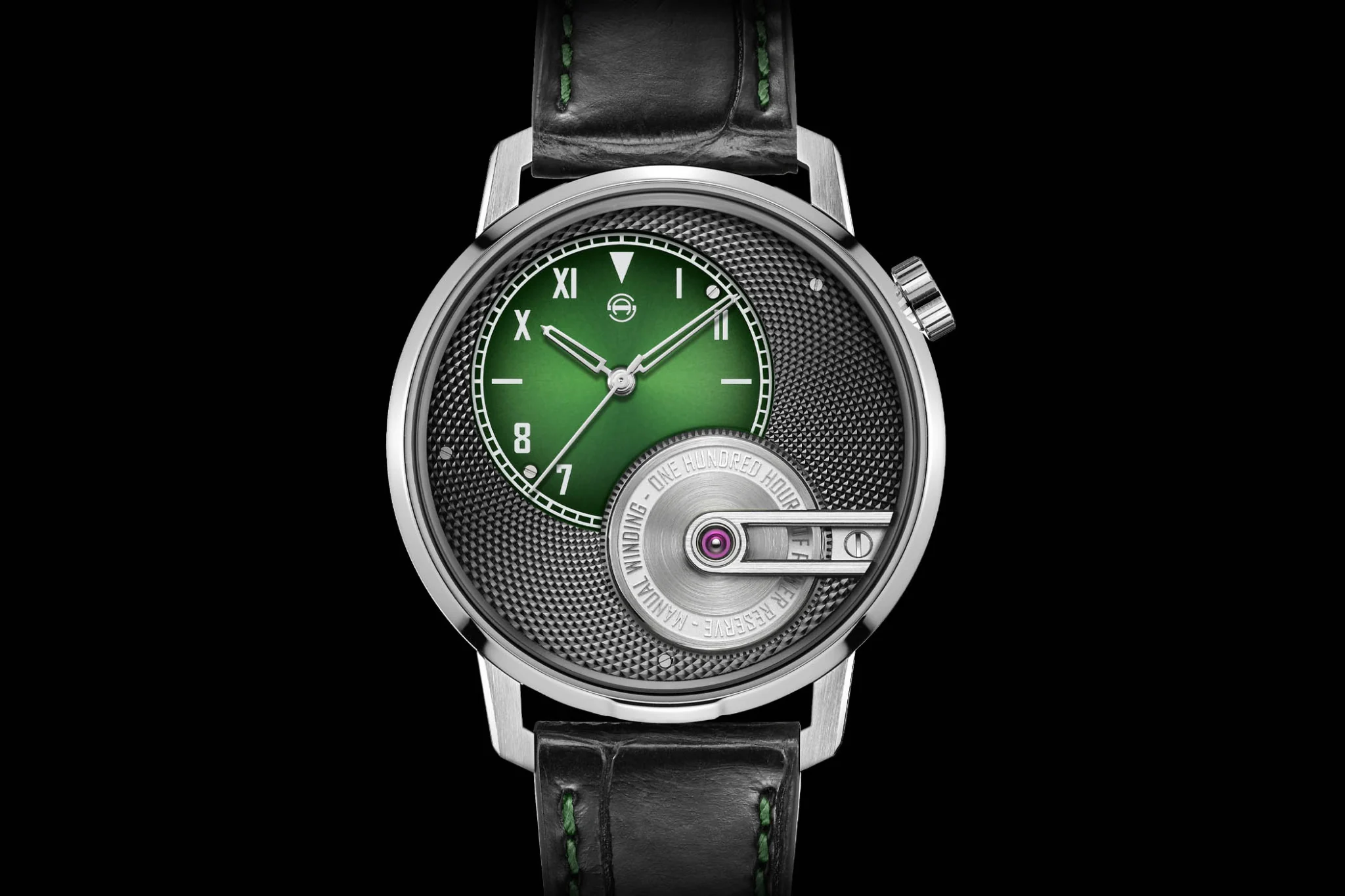
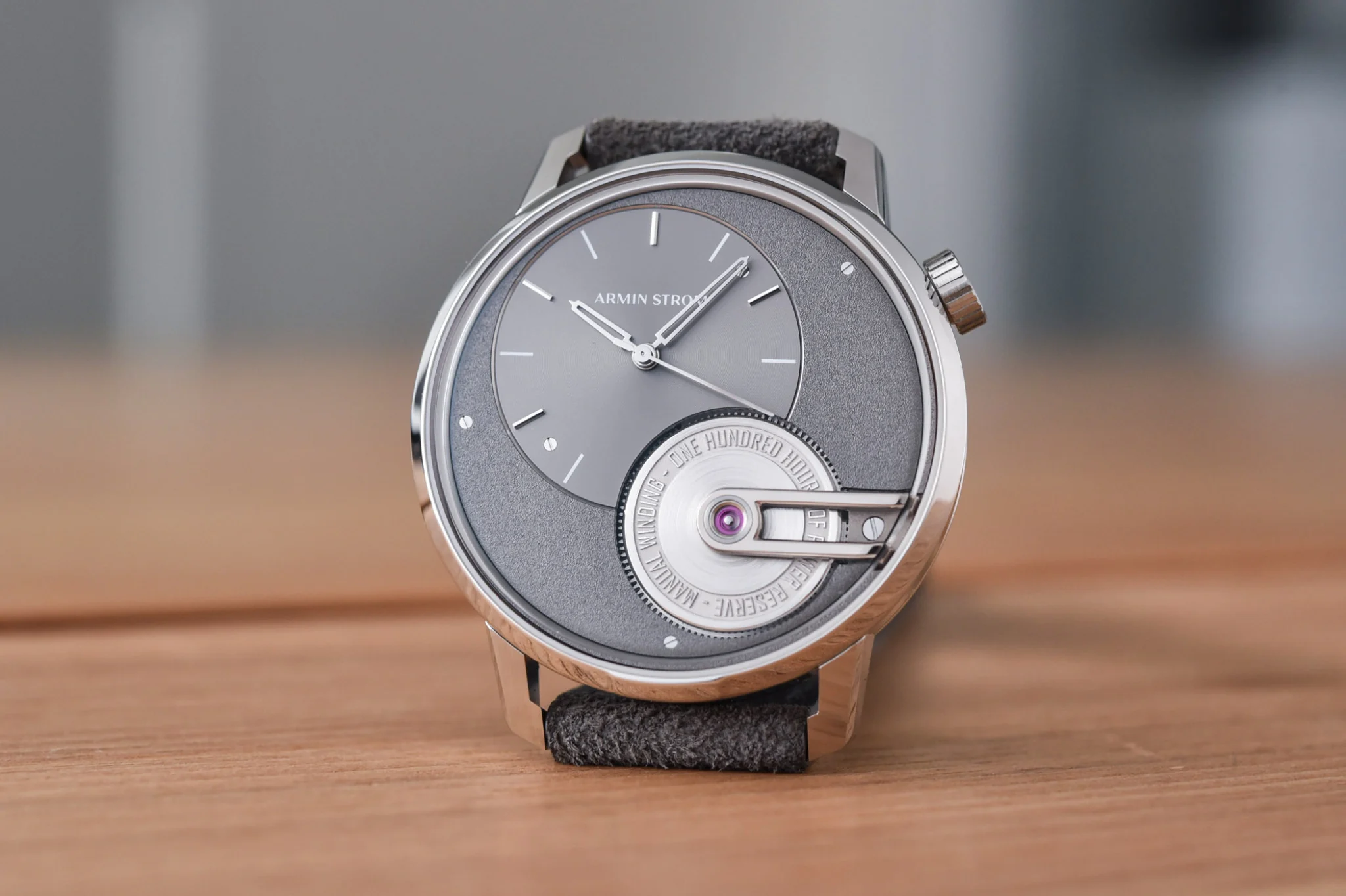
Tribute 1: The Restraint of a Classical Watch
The Tribute 1 presents a different side of the manufacture.
Where the Resonance watches emphasise technical spectacle, the Tribute 1 explores a more restrained and refined expression of contemporary watchmaking. It combines classical proportions with an off-centre time display and a visible movement architecture.
The watch is powered by the hand-wound AMW21 calibre. The movement offers a 100-hour power reserve and operates at a frequency of 25,200 vibrations per hour. It incorporates a single barrel and a variable-inertia balance wheel.
One of its distinctive features is the motor barrel architecture. The barrel arbor turns and coils the mainspring within the fixed barrel drum, creating a compact and efficient arrangement that supports the extended power reserve.
The barrel is visible from the dial side, accompanied by the off-centre display of hours, minutes, and seconds. This layout allows the movement to remain the dominant visual element while preserving a clear indication of time.
The AMW21 is finished to a high level. Its decoration includes Côtes de Genève, circular graining, polished jewel sinks, and hand-bevelled edges. The bridges and components are treated with considerable attention, including complex beveling and polishing work.
The Tribute 1 is significant because it demonstrates that Armin Strom’s identity is not dependent on maximal complexity. A relatively simple time-only watch can still express a strong horological point of view through its movement architecture, finishing, and display.
It is a watch in which restraint becomes a design decision rather than a reduction in ambition.

One Week: Skeletonisation as Mechanical Architecture
The One Week collection connects the modern manufacture to the historical craft that originally defined the Armin Strom name.
The collection is characterised by its openworked movements and extended power reserve. The exposed architecture allows the wearer to observe the barrel, gear train, bridges, and regulating components in a highly visual arrangement.
The One Week movement was an important part of the manufacture’s early development. Its introduction helped establish Armin Strom as a company capable of producing its own mechanical calibres rather than relying primarily on externally supplied movements.
Skeletonisation within the One Week family is not simply the removal of material from a conventional calibre. The movement’s architecture is designed to accommodate the openworked aesthetic, creating a balance between structural integrity and visual transparency.
The resulting watches have a distinctly architectural character. Bridges become structural lines, the barrel establishes a focal point, and the regulating system introduces movement into the composition.
Different executions in titanium, gold, and other materials demonstrate how the same mechanical concept can be expressed through changing visual treatments.
The One Week collection remains an important bridge between the brand’s origins and its contemporary manufacture identity.
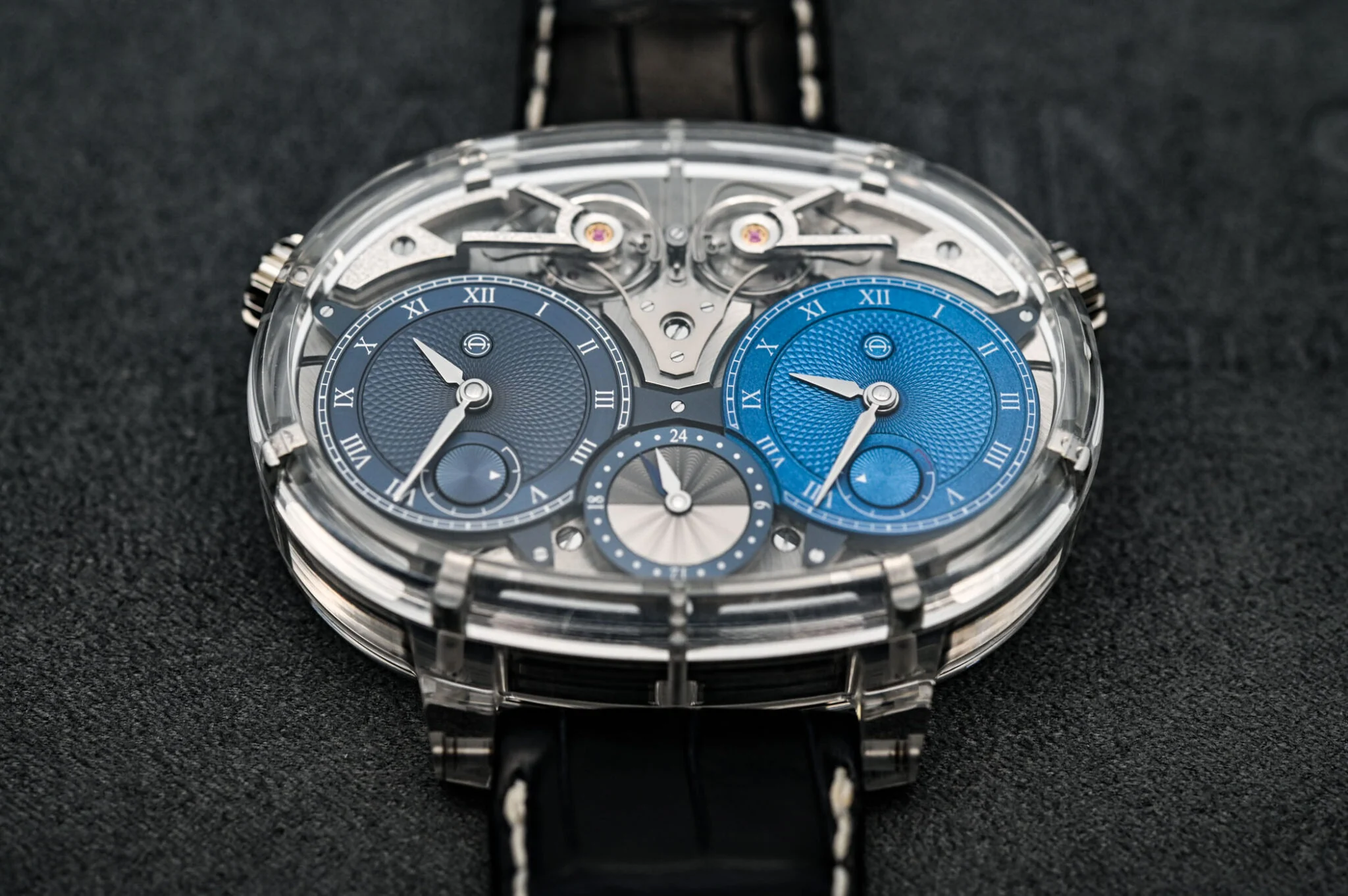
Masterpieces: A Laboratory for Horological Expression
The Masterpieces collection provides Armin Strom with a platform for exploring more ambitious and technically complex constructions.
While System 78 focuses on fundamental mechanical principles and Resonance concentrates on the coupling of regulating systems, Masterpieces allows the manufacture to pursue distinctive combinations of complications, architecture, and design.
These watches often involve more elaborate movement constructions, unusual displays, and limited production. Their purpose is not simply to extend the catalogue with increasingly complicated references. They provide an opportunity to investigate the boundaries of the manufacture’s technical capabilities.
The collection reflects a particular understanding of independent watchmaking. A manufacture’s identity is not necessarily defined by the number of complications it offers, but by the problems it chooses to address and the solutions it develops.
The Masterpieces creations demonstrate how Armin Strom can move beyond its core visual language while retaining the principles of transparent mechanics, in-house movement development, and detailed finishing.
Zeitgeist 1665: An Imagined Horological Past
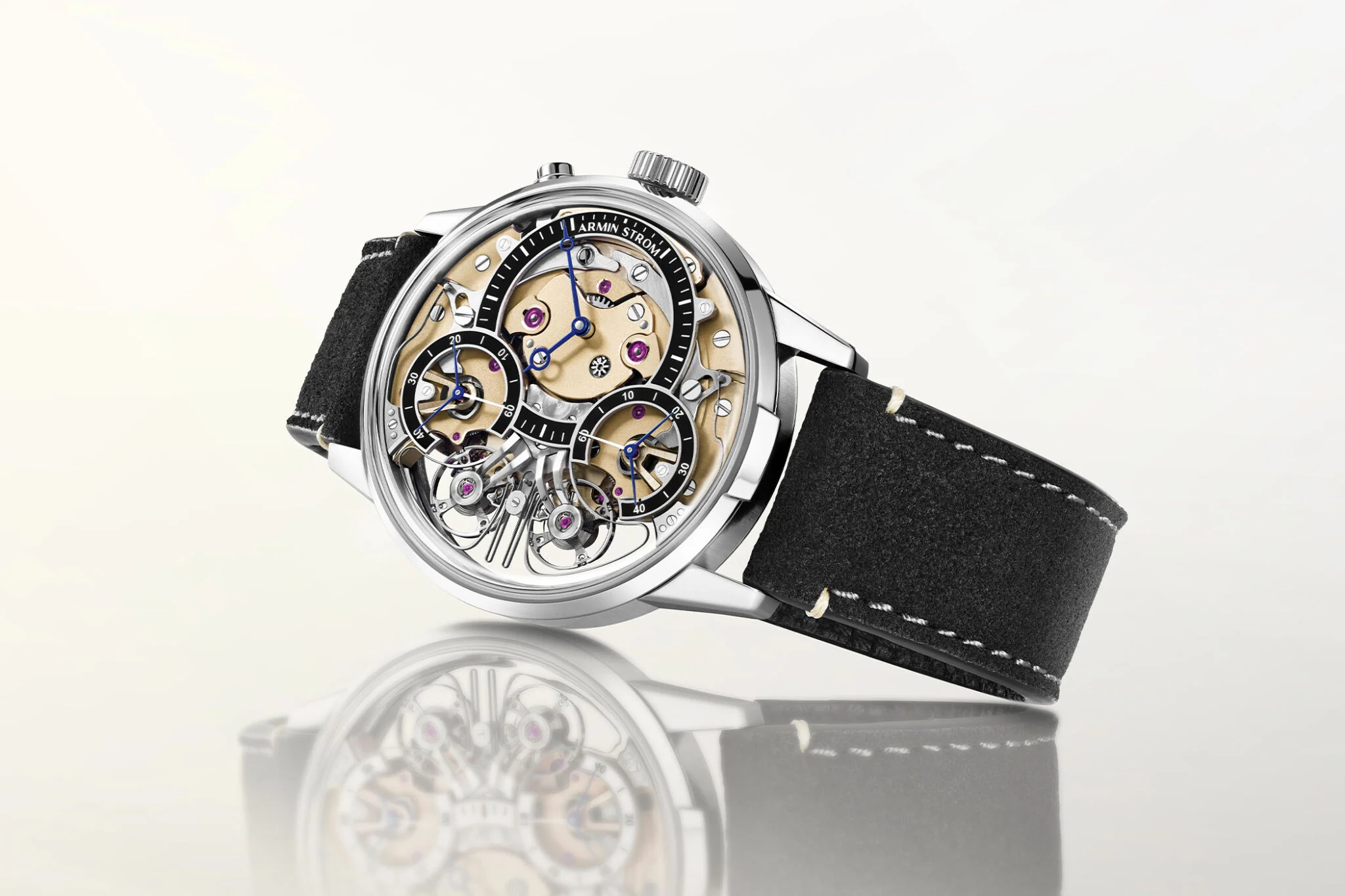
The Mirrored Force Resonance Zeitgeist 1665 introduces an unusually conceptual dimension to the Resonance collection.
The watch imagines a resonance wristwatch that might have existed centuries ago, had historical watchmakers been able to solve the technical challenges associated with stable resonance and had the wristwatch already been conceived as a form of timekeeping.
The concept is deliberately speculative. It creates an imagined horological history in which a modern mechanical achievement is interpreted through the aesthetic sensibilities of an earlier era.
The design combines the manufacture’s resonance technology with a more historically evocative visual language. The watch’s movement remains contemporary in its construction, while its aesthetic suggests an object from an alternative mechanical past.
This is an interesting departure from the brand’s otherwise engineering-led identity. Zeitgeist 1665 introduces narrative and historical imagination without abandoning the technical substance of the movement.
The result is a watch that operates on two levels. It is a demonstration of stable resonance and a conceptual exploration of how horological history might have developed differently.
The Aesthetics of Movement Finishing
At Armin Strom, finishing is integral to the visual language of the watch.
The exposed architecture places considerable emphasis on the relationship between surfaces. The contrast between brushed, polished, grained, and bevelled components establishes depth and hierarchy within the movement.
The finish of a bridge can influence how it appears against the plate beneath it. A polished bevel catches light differently from a brushed surface. Black-polished components can create a near-mirror effect that changes according to the angle of observation.
These details are particularly important in openworked movements because the architecture is visible from multiple angles. The movement must be visually coherent from the dial side as well as through the caseback.
The finishing process also reveals the distinction between industrial precision and artisanal refinement. Machining establishes the component’s geometry, but hand-finishing refines its surfaces and edges. The final result depends on the quality of both stages.
Armin Strom’s approach treats finishing as a continuation of movement design. The decoration should reinforce the architecture, rather than obscure it.
This creates a visual language that is recognisable without relying on conventional luxury motifs. The movement itself becomes the primary source of identity.
Independence and the Meaning of Manufacture
Independent watchmaking is often discussed in terms of ownership, production volume, or exclusivity. Armin Strom offers a more technically grounded interpretation.
Its independence is expressed through the ability to develop proprietary calibres, determine its own movement architecture, and pursue mechanical concepts that are not dictated by the requirements of a large-scale product portfolio.
The manufacture’s vertical integration provides a degree of control over the design and execution of its watches. It allows technical decisions to be made in close relationship with production and finishing capabilities.
This model also creates challenges. Complex movements require significant investment in research, equipment, specialised expertise, and quality control. Low production volumes limit economies of scale. The time required for hand-finishing and assembly can place constraints on output.
These constraints are part of the reality of independent haute horlogerie. They also help explain why Armin Strom’s work occupies a distinct position within the watch market.
The brand is not competing primarily through heritage recognition or broad product accessibility. Its proposition is based on mechanical differentiation, visible craftsmanship, and the development of unusual horological solutions.
For collectors, the appeal lies in the depth of the watch. The movement can be examined not only as a finished object, but as a construction whose architecture, components, and functions reveal the thinking behind it.
Armin Strom and the Contemporary Collector
The contemporary collector increasingly has access to detailed information about watch movements, manufacturing methods, and technical specifications. The visual appeal of a watch remains important, but it is often accompanied by a desire to understand what makes the movement distinctive.
Armin Strom responds directly to this interest.
The brand’s watches offer an immediate visual connection to their mechanics. Their technical features are not presented as abstract specifications. They are visible in the movement architecture and can be understood through observation.
This creates a particular kind of ownership experience. The watch becomes an object that rewards repeated attention. The wearer may discover details in the movement that were not apparent at first glance, or develop a deeper understanding of the relationship between its components.
The resonance watches are especially compelling in this respect. Their defining mechanism is not only technically unusual but visually engaging. The two oscillators create a dynamic display that remains connected to the function of the watch.
The Tribute 1 and Gravity Equal Force offer a different experience, in which the movement’s architecture and finishing become the focus of a more restrained design.
Armin Strom’s appeal is therefore not limited to collectors seeking the most complicated watch available. It also attracts those who value the clarity of a technical idea and the quality of its execution.
A Distinct Position Within Independent Haute Horlogerie
Armin Strom occupies a particular position within the landscape of independent Swiss watchmaking.
Its identity is not built around the restoration of a historical design language, nor around the replication of traditional complications in their most familiar forms. Instead, the manufacture uses the mechanics of watchmaking as the basis for both technical research and visual expression.
The resonance system is the clearest example of this approach. It represents a genuine mechanical ambition, one that connects historical scientific inquiry with contemporary movement development.
The Gravity Equal Force and Orbit demonstrate a similar willingness to revisit established functions. Energy delivery and date indication are familiar aspects of watchmaking, yet Armin Strom approaches them through distinctive mechanical solutions.
The Tribute 1 establishes that this philosophy can also be applied to a classical time-only watch. The One Week collection preserves the heritage of skeletonisation, while Masterpieces provides room for more experimental constructions.
Together, these collections create a coherent identity based on movement architecture, transparency, technical purpose, and finishing.
The brand’s visual language is strong, but its significance lies in the relationship between appearance and engineering. The exposed movement is not an aesthetic shortcut. It is the expression of a broader horological philosophy.
The Value of a Watchmaking Philosophy
Armin Strom’s work is particularly interesting because it begins with a question that is both technical and aesthetic: what happens when the movement becomes the principal design element of a watch?
The answer is not simply a more visible mechanism. It is a different approach to the entire construction of a timepiece.
The movement influences the dial, the display, the proportions, the finishing, and the experience of wearing the watch. Technical decisions become design decisions. Mechanical functions become visual elements. The architecture of the calibre becomes the identity of the object.
This philosophy requires considerable discipline. A movement must be engineered to perform reliably, yet its components must also form a coherent visual composition. The finishing must support the architecture without distracting from it. The watch must remain legible and functional even when its mechanics occupy much of the dial.
Armin Strom’s most compelling creations succeed because these considerations are treated as interconnected rather than separate.
The Resonance collection expresses the manufacture’s ambition to solve a demanding horological problem. The System 78 collection explores the mechanics of everyday timekeeping. The Masterpieces collection extends the brand’s technical and conceptual range.
Across these different expressions, the manufacture maintains a consistent point of view.
When Engineering Becomes Identity
Armin Strom offers an important case study in how a contemporary luxury watch brand can build a distinctive identity around technical substance.
Its visual language is immediately recognisable, but recognisability alone does not explain its position. The deeper value lies in the relationship between the brand’s philosophy, its manufacturing capabilities, and the products it creates.
The historical legacy of Armin Strom’s hand-skeletonisation provided a foundation. The partnership between Serge Michel and Claude Greisler transformed that foundation into an independent manufacture. The development of proprietary calibres and resonance technology established a more ambitious technical direction.
The brand’s design language is therefore not an arbitrary aesthetic choice. It is an outcome of the way the manufacture thinks about mechanical watchmaking.
This is a meaningful distinction in the luxury sector. A strong identity becomes more credible when it is supported by capabilities that are difficult to reproduce. In Armin Strom’s case, the exposed movement, the resonance system, the degree of in-house development, and the finishing standards work together to establish a coherent proposition.
The watches communicate their value through construction. Their visual appeal is connected to the technical decisions that define them.
Armin Strom does not simply reveal the mechanism of a watch. It makes the mechanism the subject of the watch.
That is the essence of its contemporary identity: a manufacture in which engineering is not hidden behind design, but becomes design itself.
At the intersection of science, craftsmanship, and visual expression, Armin Strom continues to explore a distinctive question in haute horlogerie: how can the mechanics of time be made not only precise, but visible, understandable, and compelling?
The answer is found in the architecture of its movements, the discipline of its finishing, and the persistent belief that the most interesting part of a watch is often the part that makes it work.