Blog
HALDIMANN HOROLOGY: Measuring, Feeling, and Thinking About Time The Art of Horology Beyond the Conventional Meaning of a Watch

The Art of Horology Beyond the Conventional Meaning of a Watch
In traditional watchmaking, time is something to be measured, displayed, and read. The mechanical watch is designed to translate an abstract phenomenon into a sequence of comprehensible indications: hours, minutes, seconds. Its value is commonly associated with precision, technical sophistication, craftsmanship, and the beauty of its construction.
For Beat Haldimann, however, time is a much broader subject.
It can be measured, but it can also be felt. It can be observed through the movement of a mechanical object, experienced through the rhythm of an oscillating balance, or contemplated as an abstract relationship between the past, the present, and the future. It can be represented without conventional hands, concealed beneath an opaque surface, or transformed into a sculptural object whose purpose is no longer simply to tell the time.
This is the philosophical foundation of HALDIMANN HOROLOGY.
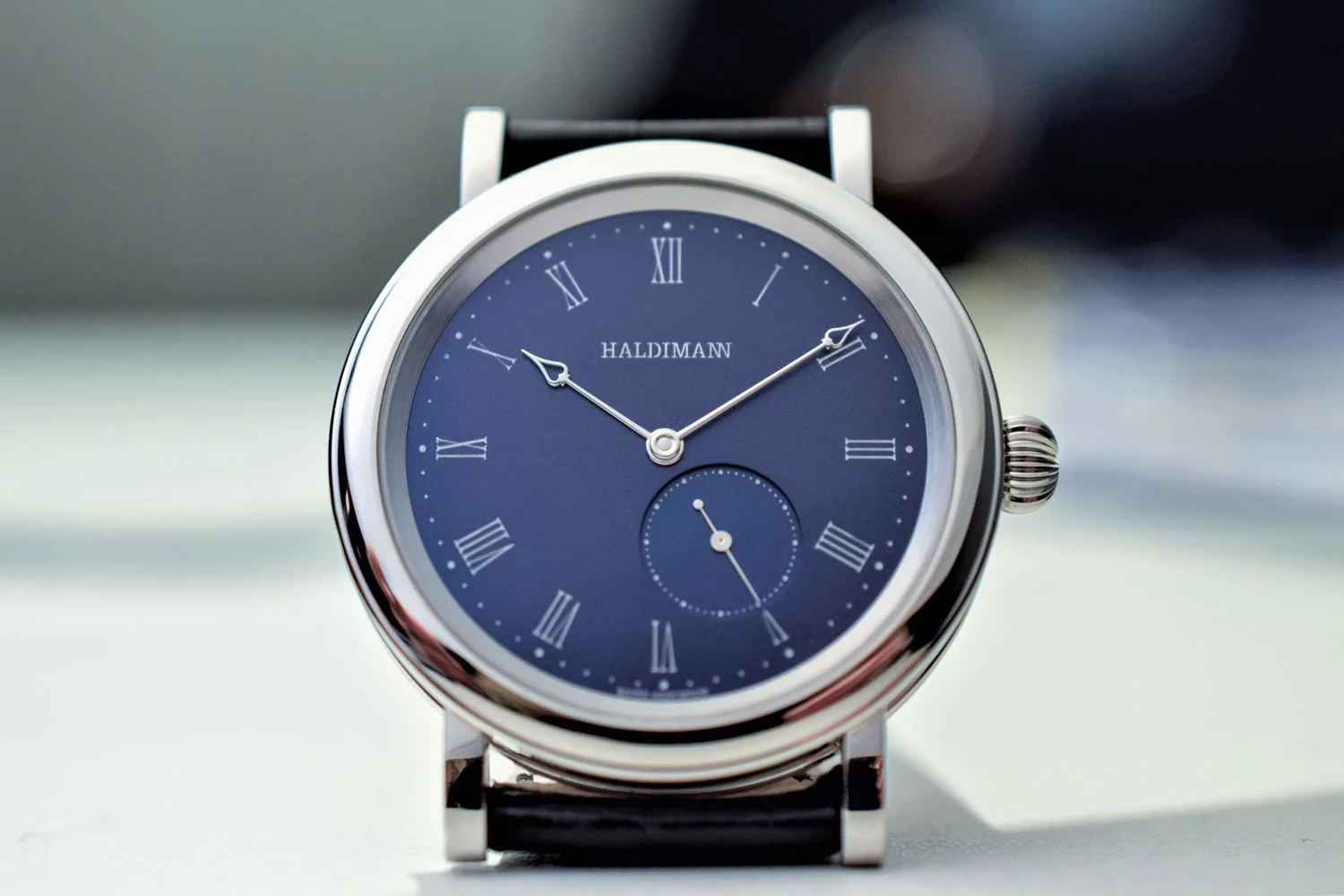
Based in Thun, Switzerland, the manufacture occupies a singular position within independent watchmaking. Its creations combine traditional Swiss craftsmanship with an unusually personal interpretation of mechanical time. Some of its watches present extraordinary technical achievements through classical exterior designs. Others deliberately abandon the conventions that define a wristwatch.
The H1 Flying Central Tourbillon places a monumental flying tourbillon at the center of the dial. The H2 Flying Resonance develops the idea through two regulating organs operating in resonance. The H8 Flying Sculpture removes the hands entirely. The H9 Reduction conceals the time display beneath a dark, opaque crystal. The H11 Central Balance returns to a more conventional visual language while placing the balance wheel at the very center of the movement. The H13 Time-Hora Wrist Edition transforms the representation of time into a visual expression of temporal perception.
These are not simply variations within a luxury watch collection.
They are different responses to a fundamental question: what is a watch capable of expressing when its maker is no longer limited by the traditional requirement to display the time?
A Family Tradition Dating Back to 1642
The Haldimann family traces its watchmaking heritage to 1642, establishing a historical identity that extends across centuries of Swiss horological development.
The manufacture presents itself as one of Switzerland’s oldest family-owned and family-led watchmaking traditions. Its heritage is not used merely as a decorative reference to the past. It forms part of the brand’s philosophy of continuity, independence, and craftsmanship.
The family tradition is rooted in the belief that the creation of a mechanical watch should remain closely connected to the person who makes it. The manufacture emphasizes the relationship between the watchmaker, the movement, and the eventual owner.
This perspective differs from the industrial model in which the design, development, production, finishing, assembly, and commercial presentation of a watch are distributed across numerous departments and suppliers.
At Haldimann, the process is understood as a more intimate relationship between creator and object.
The family’s historical continuity is particularly meaningful because the manufacture’s contemporary identity is not based on reproducing historical watches. It is based on maintaining a traditional approach to making while allowing the watchmaker to develop ideas that are distinctly personal.
Heritage, in this context, becomes a foundation for freedom rather than a limitation.
Beat Haldimann: The Watchmaker Behind the Philosophy
Beat Haldimann was born in Oberdiessbach, Switzerland, in 1964. He grew up in the Thun region, within the environment of the family’s watchmaking tradition.
He qualified as a watchmaker and watch repairer in 1985 and subsequently completed his master watchmaker qualification in 1993.
His early professional years involved research and development for other watchmaking companies. Between 1992 and 2001, he worked on technical projects that allowed him to explore mechanical systems beyond the immediate requirements of conventional commercial watches.
This period was important to the development of his independent identity.
Research and development require a particular way of thinking. A watchmaker must understand the limitations of an existing mechanism, identify the source of a problem, evaluate alternative solutions, and determine whether a new architecture can improve the system.
Beat Haldimann’s later creations reveal the influence of this technical discipline. His watches are not unconventional simply for the sake of being different. Their unusual structures are connected to a specific mechanical or philosophical objective.
In 1991, he established Haldimann Horology in Thun.
The manufacture gradually developed its own identity through the creation of resonance clocks, unconventional tourbillons, and highly individual wristwatches. The brand became particularly associated with central flying tourbillons, a complication that would eventually become one of the most recognizable expressions of Haldimann’s work.
Yet the tourbillon was only one part of a much larger investigation.
Throughout his career, Haldimann has explored the relationship between mechanical motion and human perception. The watches that followed would increasingly challenge the conventional relationship between a timepiece and its display.
The Manufacture: Independence, Handcraft, and the Human Hand
Haldimann Horology is based at Villa Nussbühl in Thun, Switzerland.
The manufacture emphasizes a production philosophy that places traditional hand-operated machinery and the capabilities of the watchmaker at the center of its work.
The brand explicitly states that it avoids computer-controlled manufacturing machinery, arguing that such equipment would prevent it from pursuing its particular understanding of craftsmanship.
This is a highly distinctive position within contemporary haute horlogerie.
Modern independent watchmaking often combines traditional finishing with advanced CNC machining, computer-aided design, and precision manufacturing technologies. These tools can provide exceptional accuracy, consistency, and repeatability.
Haldimann takes a different approach.
Its philosophy is based on the belief that the limitations and capabilities of the human hand are themselves part of the creative process. The watchmaker’s relationship with the material, the instrument, and the mechanism is considered essential to the individuality of the finished object.
The manufacture describes its watches as individual creations, with the possibility of accommodating personal ideas and requests.
This approach is particularly relevant to the brand’s technical identity. A movement developed around an unusual architecture requires a close relationship between its design and its manufacture. The watchmaker must understand how the components interact, how their surfaces are finished, how they are adjusted, and how the complete system behaves.
Haldimann’s production philosophy is therefore not simply about preserving traditional tools. It is about preserving a particular form of authorship.
The tools remain in the background. The watchmaker’s knowledge remains at the center.
A Different Philosophy of Time: Measure, Feel, Think
Haldimann’s contemporary philosophy is organized around three concepts: Measure, Feel, and Think.
These three dimensions provide a useful framework for understanding the manufacture’s collections.
Measure: Time as a Mechanical Quantity
The first dimension represents the traditional purpose of horology.
A watch measures time through a regulated mechanical system. The movement must generate, transmit, and control energy with sufficient consistency to maintain an accurate rate.
The H1 Flying Central Tourbillon, H2 Flying Resonance, and H11 Central Balance belong primarily to this dimension.
Their technical architecture is extraordinary, but their fundamental purpose remains connected to the measurement of time.
Feel: Time as an Emotional Experience
The second dimension moves beyond the direct reading of the hours and minutes.
A mechanical watch can generate an emotional response through its movement. The oscillation of a balance, the rotation of a tourbillon, the rhythm of an escapement, or the sound of a striking mechanism can create a relationship between the observer and the object.
This is the territory of the H8 Flying Sculpture, H9 Reduction, and H3 Flying Sculpture with Minute Repeater.
The wearer is invited to experience the watch rather than simply use it as an instrument.
Think: Time as an Abstract Concept
The third dimension is the most philosophical.
Human beings do not experience time exclusively through clocks. We imagine the past, anticipate the future, and understand the present as a moment within an ongoing sequence.
Haldimann’s Time-Hora creations attempt to represent this mental experience through mechanical displays.
The H51 Time-Hora clock and H13 Time-Hora Wrist Edition belong to this conceptual dimension.
Together, the three categories reveal a coherent philosophy. Haldimann does not abandon traditional watchmaking. Instead, the manufacture expands its meaning.
The Mechanical Heart at the Center of the Watch
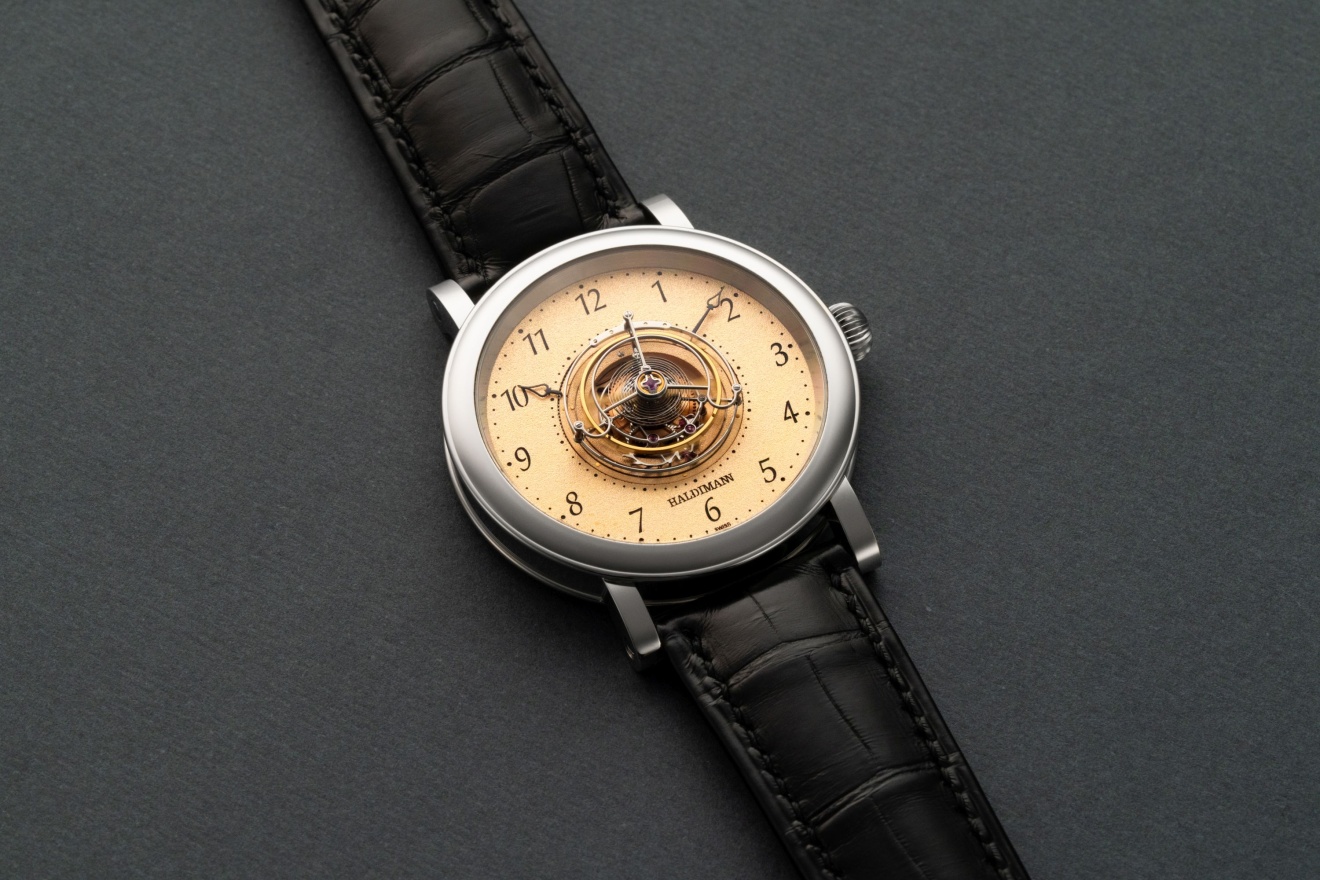
<PRIVATE_PERSON> Haldimann’s H1 Flying Central Tourbillon was introduced in 2002 and became one of the defining creations of the manufacture.
The H1 is remarkable because it appears, at first glance, to be a classical dress watch. Its exterior is restrained, its dial is elegant, and its proportions are relatively traditional.
The mechanical architecture, however, is anything but conventional.
At the center of the dial sits a large flying tourbillon. Unlike a conventional tourbillon positioned within the movement and viewed through an aperture, the H1’s tourbillon is elevated above the dial. It becomes the visual and mechanical center of the watch.
The tourbillon is constructed without the usual upper bridge, creating the impression that the mechanism is suspended in space.
The design is inspired by the work of Alfred Helwig, the German watchmaker associated with the development of the flying tourbillon. Haldimann takes this principle further by placing the mechanism centrally and making it the principal visual element of the wristwatch.
The result is a mechanical structure that appears almost sculptural.
The H1 Movement
The H1 is powered by the manually wound ZEN-H1 calibre.
Its principal specifications include:
- Flying central 60-second tourbillon
- Haldimann Swiss lever escapement
- Three mainspring barrels
- Approximately 310 components
- 32 jewels
- 18,000 vibrations per hour, or 2.5 Hz
- Approximately 38 hours of power reserve
- Movement diameter of 31.58 mm
- Movement thickness of approximately 3.7 mm before the elevated tourbillon assembly
The movement’s architecture is especially interesting because the tourbillon occupies the central axis normally associated with the hands.
This requires a different arrangement of the gear train and energy transmission system. The movement is designed to drive the central tourbillon while maintaining the traditional hour and minute display.
The three barrels provide the energy required for the movement. Their arrangement and the transmission of power to the central mechanism are part of the calibre’s unusual construction.
The H1 is not a conventional movement with a tourbillon added as a complication. Its architecture is organized around the tourbillon itself.
The Tourbillon as a Mechanical Sculpture
The H1’s tourbillon is approximately 17.3 mm in diameter, making it unusually large for a wristwatch.
Its lyre-shaped cage creates a distinctive visual identity. The cage is constructed from delicate elements, allowing the balance and escapement to remain visible.
The balance oscillates at a traditional frequency of 2.5 Hz. This relatively slow rhythm contributes to the watch’s visual character.
The movement can be observed as a living mechanism. Its motion is not merely a technical display, but a visual expression of the passage of time.
Independent reviews of the H1 have repeatedly emphasized this quality.
Deployant’s examination of the watch highlighted the ingenious movement architecture, the balanced arrangement of the gear trains, and the comfort of its classical case proportions. Quill & Pad’s detailed photography and technical discussion drew attention to the hand-built tourbillon cage and the watchmaker’s traditional manufacturing approach.
A Collected Man has also described the H1 as a particularly compelling expression of Beat Haldimann’s combination of artistic and technical ambition.
The H1 is a watch whose appeal becomes increasingly evident when viewed closely. Its restrained exterior contrasts with the extraordinary mechanism that occupies its center.
Exterior Design and Wearability
The H1 is offered in several case sizes, including 37 mm, 39 mm, and 41 mm, depending on the configuration.
The case is available in precious metals such as gold and platinum. It features Haldimann’s characteristic concave side finishing and a domed sapphire crystal that accommodates the elevated tourbillon.
The dial is available in different finishes and colors, including rhodium, midnight blue, black, salmon, and champagne.
This variety allows the watch to maintain its classical identity while offering different visual expressions.
The H1’s design is particularly effective because it avoids excessive decoration. The tourbillon is sufficiently expressive that the rest of the watch does not need to compete with it.
The exterior remains elegant, while the movement provides the spectacle.
H2: Flying Resonance
Two Regulators, One Mechanical Dialogue
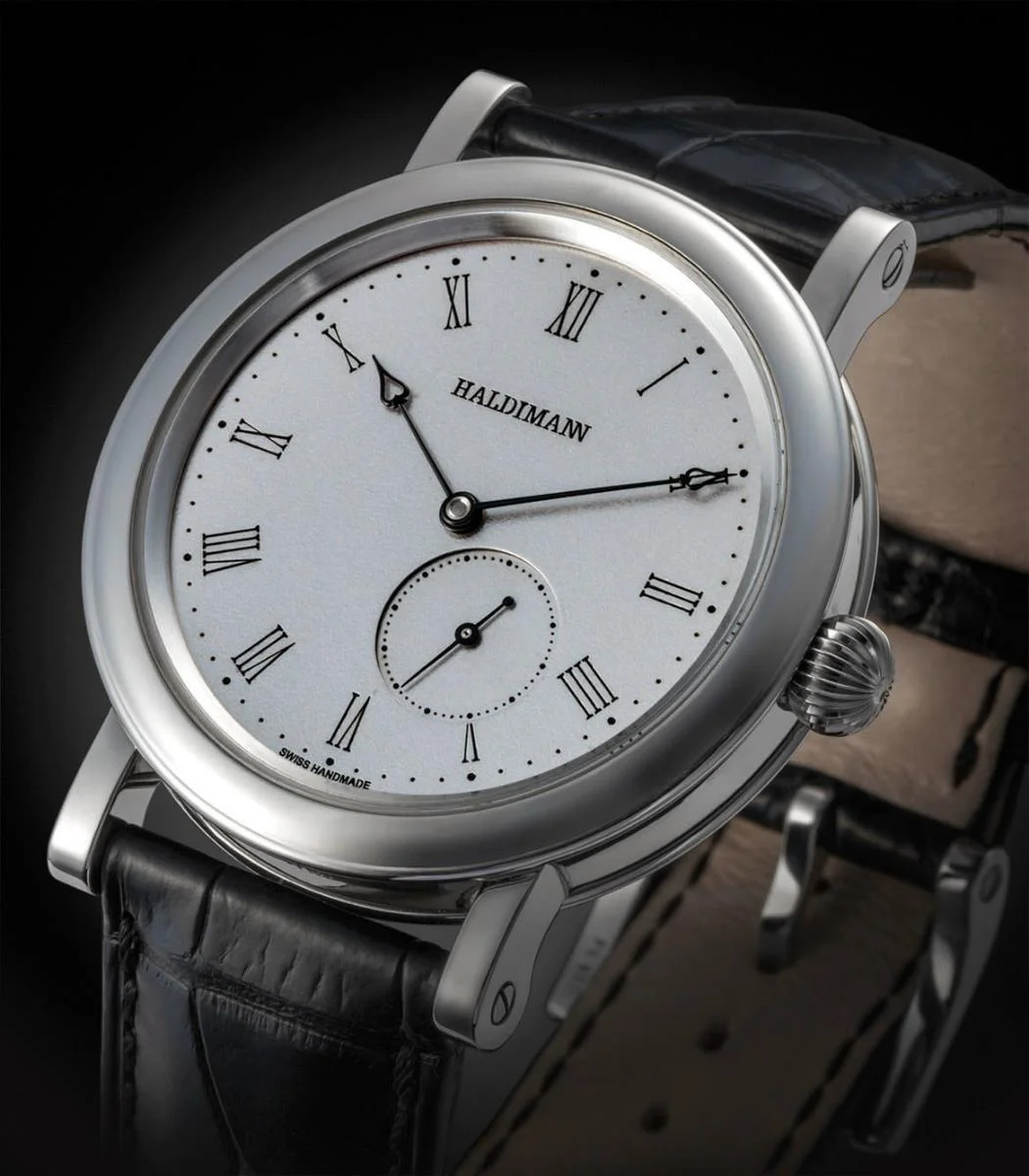
Introduced in 2005, the H2 Flying Resonance is one of the most technically and visually ambitious creations in Haldimann’s history.
The H2 combines two of Beat Haldimann’s principal areas of interest: the flying central tourbillon and the phenomenon of mechanical resonance.
The watch incorporates two regulating organs, each with its own balance and escapement. They are arranged within a central rotating structure that places both mechanisms above the dial.
The two balances are intended to operate in resonance.
This is a fascinating concept because resonance is a physical phenomenon in which oscillating systems can influence one another when they are coupled under suitable conditions.
In horology, resonance has historically been explored as a means of improving the stability of timekeeping. The phenomenon is associated with the work of Antide Janvier, Abraham-Louis Breguet, and other watchmakers who investigated the relationship between multiple oscillators.
Beat Haldimann had already explored resonance through clocks before developing the H2.
The H2 represents his attempt to translate this phenomenon into a wristwatch with an unusually expressive mechanical architecture.
The Technical Architecture
The H2 uses the manually wound ZEN-H2 calibre.
Its key specifications include:
- Two flying central 60-second tourbillons
- Two regulating organs operating in resonance
- Three mainspring barrels
- Approximately 408 components
- 35 jewels per regulating system
- Special ball bearings incorporating ruby elements
- 18,000 vibrations per hour, or 2.5 Hz
- Approximately 38 hours of power reserve
- Movement diameter of 31.58 mm
- Movement thickness of approximately 3.7 mm before the elevated mechanism
One of the important distinctions is that the H2 is not simply two independent tourbillons placed side by side.
The two regulating organs share a rotating central structure. The architecture allows the mechanisms to operate in a coordinated manner while remaining visually distinct.
This is a highly demanding construction. The watchmaker must manage the mass of the rotating system, the transmission of energy, the relationship between the two balances, and the mechanical conditions necessary for resonance.
The result is a movement whose complexity is concentrated in the central mechanism.
Resonance as a Visual and Philosophical Experience
The H2 is one of the clearest examples of Haldimann’s belief that a watch can express the passage of time rather than merely display it.
The two balances move in relation to one another. The central structure rotates, while the hour and minute hands remain relatively discreet.
The watch is therefore experienced through the movement of its regulating organs.
The Fondation Haute Horlogerie’s discussion of the H2 emphasizes that the two regulators operate in resonance and that the central rotating structure is a defining feature of the design.
Europa Star’s technical descriptions similarly highlight the twin balances, the central resonance carriage, and the three-barrel movement.
The H2’s aesthetic is particularly striking because it combines mechanical complexity with a classical exterior. Its case and dial remain recognizably traditional, while the movement creates a highly unconventional visual experience.
The H2 is not a watch that simply adds complexity to a conventional design. It transforms the mechanism into the primary expression of the object.
H3: Flying Sculpture with Minute Repeater
When Time Is No Longer Displayed, but Heard
The H3 Flying Sculpture with Minute Repeater represents another significant departure from traditional watchmaking.
The watch does not display the hours and minutes in the conventional manner. Instead, it communicates time through sound.
A minute repeater is one of the most demanding complications in mechanical watchmaking. It uses a striking mechanism to indicate the hours, quarter-hours, and minutes through a sequence of sounds.
The H3 combines this complication with Haldimann’s sculptural approach to mechanical design.
The absence of conventional hands changes the relationship between the watch and its wearer.
The object no longer provides an immediate visual indication of the time. It requires an action, an interaction, and an auditory experience.
This creates a different form of engagement.
The wearer must activate the mechanism and listen to the resulting sequence. Time becomes something experienced through sound rather than read from a dial.
The H3 is therefore not simply a minute repeater without hands. It is a conceptual statement about the different ways in which time can be perceived.
Its significance lies in the combination of a highly traditional complication with an unconventional interpretation of its purpose.
The minute repeater has historically been associated with elegance, technical sophistication, and the ability to communicate time discreetly. Haldimann takes this tradition and makes it the central sensory experience of the watch.
The H3 is among the most ambitious creations in the manufacture’s portfolio, both mechanically and conceptually.
H8: Flying Sculpture
A Watch Released from the Obligation to Tell Time
The H8 Flying Sculpture, introduced in 2008, is one of Haldimann’s most provocative creations.
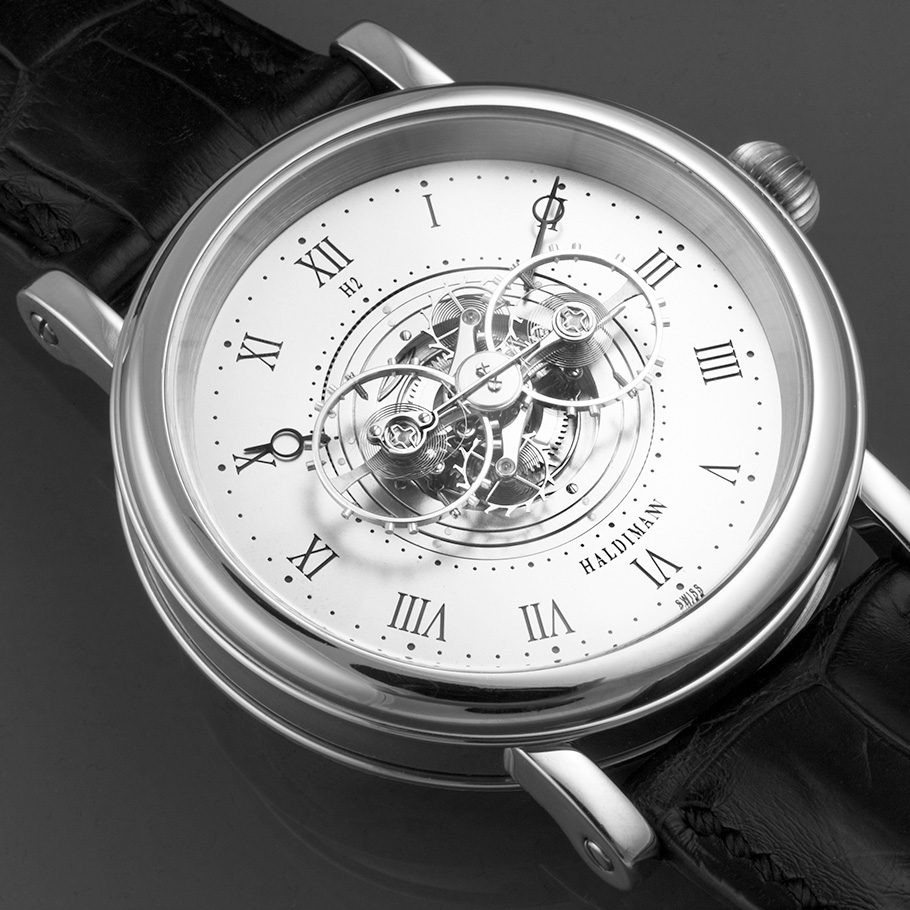
The watch contains a central flying tourbillon, but it has no hour or minute hands.
It does not provide a conventional time display.
The tourbillon remains visible, suspended above a dark dial. Its rotation creates a continuous visual experience, but the wearer cannot use the watch to read the current time.
This is a radical decision in a category whose fundamental purpose is normally defined by time indication.
The H8 challenges the assumption that a wristwatch must be a functional instrument in the conventional sense.
Haldimann describes it as a sculpture for the wrist.
The Mechanical Foundation
The H8 uses the ZEN-H8 calibre, derived from the central flying tourbillon architecture associated with the H1.
Its principal specifications include:
- Flying central 60-second tourbillon
- Haldimann Swiss lever escapement
- Three mainspring barrels
- Approximately 310 components
- 32 jewels
- 18,000 vibrations per hour, or 2.5 Hz
- Approximately 38 hours of power reserve
- Movement diameter of 31.58 mm
- Movement thickness of approximately 3.7 mm before the tourbillon assembly
The technical basis is closely related to the H1. The difference is not the fundamental movement architecture, but the way the mechanism is presented and experienced.
The H8 removes the conventional display, leaving the tourbillon as the central visual element.
The Meaning of Omission
The H8 raises an important question: what remains when the function of a watch is deliberately reduced?
The tourbillon is still measuring and regulating time mechanically. The movement continues to operate. Yet the wearer is denied the information normally provided by the watch.