
Blog
LADY BEATRICE A 60-Meter Feadship Superyacht Built for Long-Term Ownership

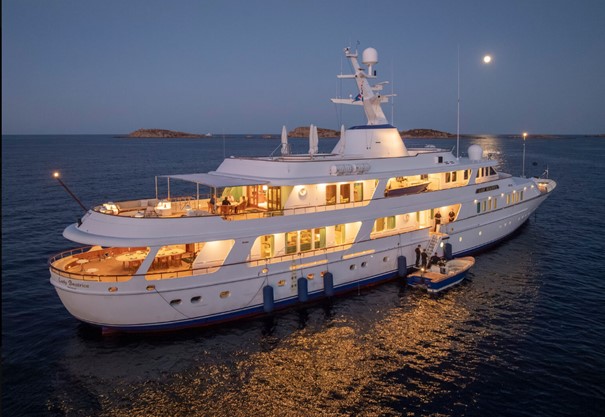
There is a category of yachts that quietly separates itself from the rest of the market.
Not through size.
Not through novelty.
But through something far less replicable: conviction at the moment of creation.
Lady Beatrice belongs to that category.
Built in 1993 by Feadship, she emerges from a period when yachts were commissioned as long-term personal assets rather than market-responsive products.
This distinction is not philosophical—it is visible in every structural and spatial decision onboard.
At 60 meters, with a gross tonnage approaching 970 GT, Lady Beatrice is engineered as a full displacement vessel, combining a steel hull with an aluminium superstructure.
The result is not simply durability, but a kind of operational confidence that defines how the yacht moves through the water: stable, composed, and entirely uninterested in speed for its own sake.
Naval architecture by De Voogt Naval Architects ensures that this confidence is not aesthetic—it is mathematical.
Range extends well beyond 3,000 nautical miles, allowing for true transoceanic capability, while twin Caterpillar engines maintain a cruising speed of approximately 14 knots.

The numbers are important, but only insofar as they reinforce a larger point: this is a yacht designed to operate without interruption.
Step inside, and the conversation shifts entirely.
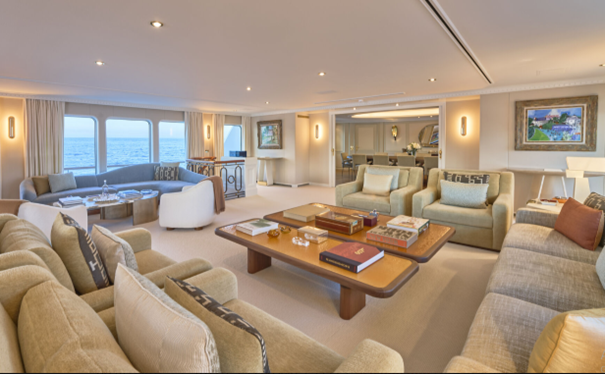
The interior, conceived by Jon Bannenberg, does not attempt neutrality.
It does not dilute itself into contemporary minimalism. Instead, it asserts a layered, distinctly European identity—one that prioritizes depth over openness, composition over simplicity.
Spaces are not designed to “flow.”
They are designed to hold presence.
A grand salon structured around formal hosting, a piano that signals intention rather than decoration, and dual master suites—an uncommon feature even within this size category—define a layout that is both functional and symbolic.
Accommodation extends to sixteen guests across eight cabins, supported by a crew of approximately seventeen, ensuring that the yacht operates at a level where service is continuous, not episodic.
This is not a casual environment.
It is a controlled one.
The ownership narrative further reinforces this positioning.
Lady Beatrice has not been a transient asset. Her history is marked by continuity, including long-term association with the Barclay family, a detail that carries weight within the superyacht world.
Provenance, in this context, is not anecdotal—it directly influences how a yacht is perceived, maintained, and valued.
Beyond this lineage, yachts of this calibre typically circulate within a very limited ownership circle—ultra-high-net-worth individuals whose assets extend across real estate, aviation, and private maritime portfolios.
Comparable ownership profiles in the Feadship world have included figures such as Bernard Arnault and David Geffen—individuals for whom a yacht is not an acquisition, but a long-term extension of lifestyle architecture.
Unlike many vessels of similar vintage, she has not been reshaped to follow shifting design trends. Instead, she has remained structurally and visually consistent, preserving a coherence that is increasingly rare.
From a market perspective, Lady Beatrice occupies a highly specific position.
With an estimated value in the range of $25–30 million, she exists at a significant distance from new-build 60-meter yachts, which now regularly exceed €50 million and extend far beyond that threshold.
Yet the comparison is not purely financial.
Acquisition at this level does not take place through open marketplaces.
Yachts such as Lady Beatrice are typically transacted through elite brokerage houses including Burgess, Edmiston, or IYC, where access is relationship-driven and inventory is often discreet rather than publicly listed.
Contemporary yachts in this segment emphasize transparency—glass-heavy architecture, open-plan interiors, and hybrid propulsion systems. Lady Beatrice offers the inverse: solidity, separation of space, and mechanical reliability rooted in proven diesel engineering.
This is not a question of better or worse.
It is a question of orientation.

Operationally, ownership of a yacht at this level is not passive.
A crew of fifteen to seventeen is required to sustain daily function, from navigation and engineering to hospitality and maintenance. Annual operating costs typically range between $2 and $3 million, reflecting fuel consumption, dockage, crew salaries, and ongoing technical upkeep.
Fuel capacity exceeding 120,000 liters and substantial onboard water storage allow for extended autonomy, enabling the yacht to move seamlessly between the Mediterranean and the Caribbean—two circuits that define the seasonal rhythm of this class of vessel.
This movement translates into a very specific lifestyle structure.
Summer seasons are typically spent along the French Riviera, Monaco, and the Amalfi Coast—anchored off Port Hercules or navigating between Cap d’Antibes and Saint-Tropez—while winter months shift toward Caribbean hubs such as Antigua Yacht Club Marina. Life onboard is not episodic; it unfolds over weeks, sometimes months, with the yacht functioning as a fully private, mobile residence.
Days are structured around complete autonomy:
morning swims off the stern platform, formal lunches prepared by onboard chefs, closed-door meetings in private salons, and evenings that transition seamlessly from deck to interior without any dependency on shore.
In ports such as Monaco, the South of France, or Antigua, yachts like Lady Beatrice are not simply seen—they are recognized.
What ultimately distinguishes Lady Beatrice is not a single feature, but a collective resistance to obsolescence.
She does not attempt to align with current design language.
She does not require reinterpretation.
Instead, she reflects a moment in yacht building when decisions were made with long-term ownership in mind—when design, engineering, and identity were aligned from the outset.
That alignment remains intact.
