
Blog
The Geometry of Endurance: Unpacking the Complete History of Cartier Watches , How Cartier’s Radical Form Defined 175 Years of Watchmaking

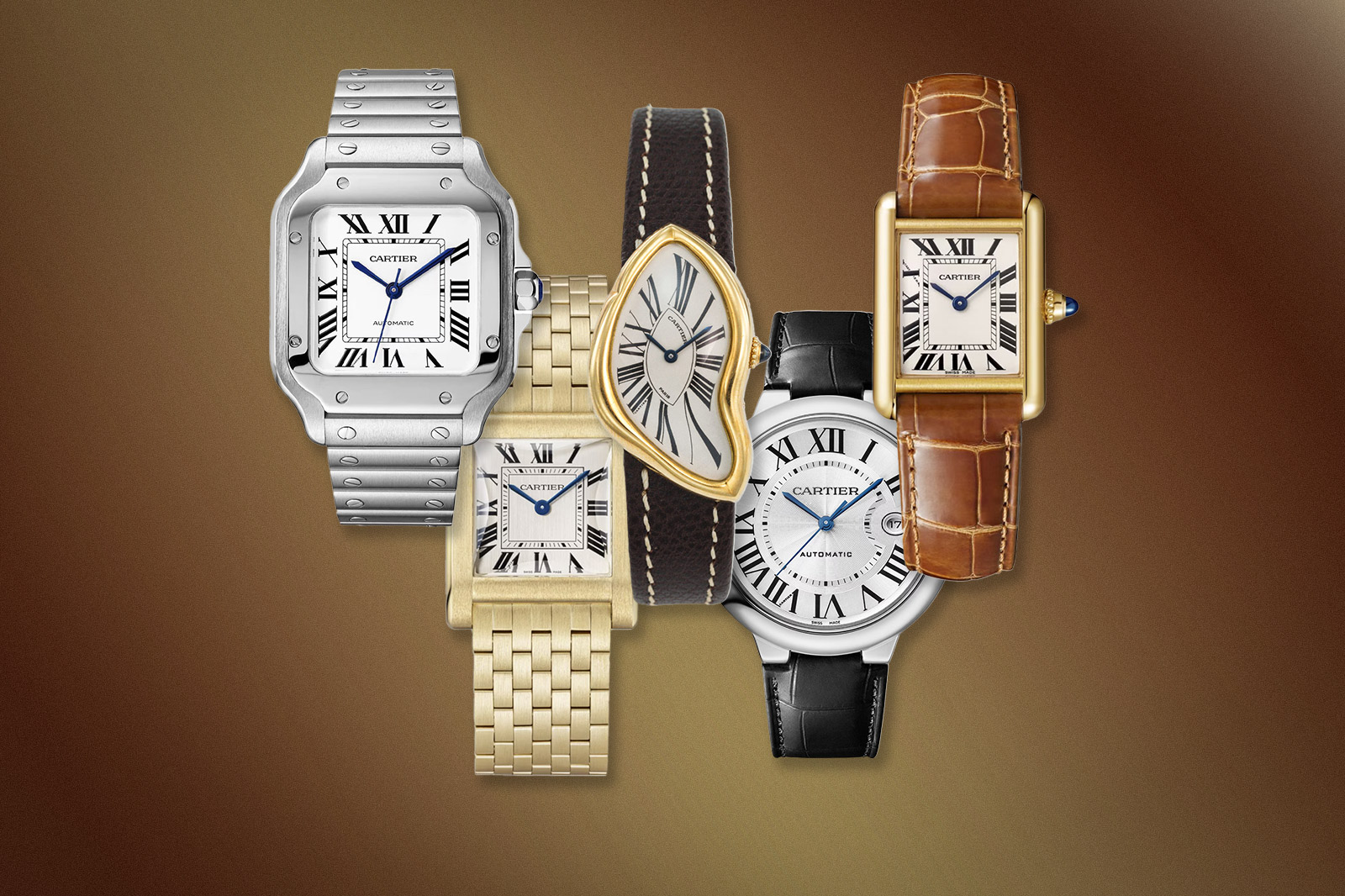
Endurance is not a matter of resisting change — it is the art of shaping change without losing oneself.
Since Louis-François Cartier established his Parisian workshop in 1847, and especially under Louis Cartier’s direction, the Maison has transformed watchmaking from a craft of technical complexity into an art of architectural perfection.
The true legacy of Cartier lies in its Savoir-Faire: the relentless pursuit of radical form, which often demanded that the mechanical heart (the movement) be custom-made or specially refined.
A watch is not merely an instrument; it is a profound object of transmission.
Every curve, tilt, and angle is a testament to the pursuit of enduring elegance, proving that what endures is the most coherent design.
The Cartesian Canon—A Deep Dive into Cartier’s Perpetual Evolution: A History of Form, Function, and Custom Calibre
The Cartier story is a tapestry of perfect shapes, all stemming from Louis Cartier’s Art Deco obsession.
Here, we delve into the comprehensive history, design, technical ingenuity, and context of every single model.
I-The Pioneer Squares and The Genesis of Geometry
Cartier’s non-round case obsession began with the practical needs of the modern man, forcing the development of specialized movements for non-circular cases.
Cartier Santos-Dumont (1904): Considered the world’s first modern men’s wristwatch, its square case with exposed screws was created for aviator Alberto Santos-Dumont.
The story is one of utility and friendship.
While operating his airships (like the famous Number 6) and early airplanes, Santos-Dumont found it dangerous and impractical to fumble with a pocket watch to time his performance. Accurate timekeeping was essential for navigation and breaking flight records (such as the 1901 Deutsch Prize attempt).
Louis Cartier designed a solution in 1904: a sleek, flat watch secured to the wrist with a leather strap. This made it the first purpose-designed men’s wristwatch and, arguably, the world’s first pilot’s watch.
(1911): After Santos-Dumont proudly wore the bespoke piece on his daring flights, public demand skyrocketed. Cartier officially commercialized the watch in 1911, marking a monumental shift from the pocket to the wrist for men’s timekeeping.
This revolutionary form demanded specialized, thin movements.
The Santos-Dumont is a beautiful expression of the Cartier design language.
The majority of current small and large models are powered by a high-efficiency Quartz movement. This is a deliberate choice to achieve the watch’s ultra-slim profile and provide a six-year battery life, prioritizing convenience and form factor over mechanical complexity.
The unconventional square case with softened corners (a “carrée” shape) was revolutionary against the round pocket watches of the era. Its form is perfectly symmetrical and geometric, a hallmark of Cartier’s design philosophy.
The Cartier Santos Dumont is both elegant, timeless and whilst minimalistic, still exudes little details.
Cartier Santos (Modern Collection): The broader Santos collection, formalized in the 1970s (starting with the Santos de Cartier), took the original form and gave it a bold, sportier presence with a distinctive integrated bracelet.
Between the 1970s to the present day, there have been many references and variations, but the latest update came in 2018. Cartier replaced the outgoing Santos 100, initially launched in 2004, with a whole new collection.
The Cartier Santos has a long, rich history and ever since its initial public release in 1911, the design has remained intact.
It has always been considered a more formal, square watch; however, with the latest update to the collection in 2018 that has started to shift.

📐 The Cartier Santos Octagon: An Architectural Departure (1980s); was introduced in the 1980s (appearing around 1984), a time when luxury sports watches with integrated bracelets—like the Audemars Piguet Royal Oak and Patek Philippe Nautilus—were dominating the high-end market.
Cartier had already successfully modernized the Santos in 1978 with the Santos de Cartier (the Carrée), introducing the steel/gold two-tone bracelet and integrated bracelet design. The Octagon was a further design experiment within this newly popular Santos family.
The watch’s core design—specifically the octagonal bezel with exposed screws and its integrated bracelet—is widely seen as Cartier’s direct contribution to (or competitive response against) the popular octagonal aesthetic championed by Gérald Genta’s designs (like the Royal Oak).
The Octagon is defined by its unique geometry, which sets it apart from the classic square Santos and the round Santos Ronde (which also appeared around the same time).
The Santos Octagon was produced through the late 1980s and early 1990s but was eventually discontinued as Cartier consolidated its line with the more curvaceous Santos Galbée and later the Santos 100.
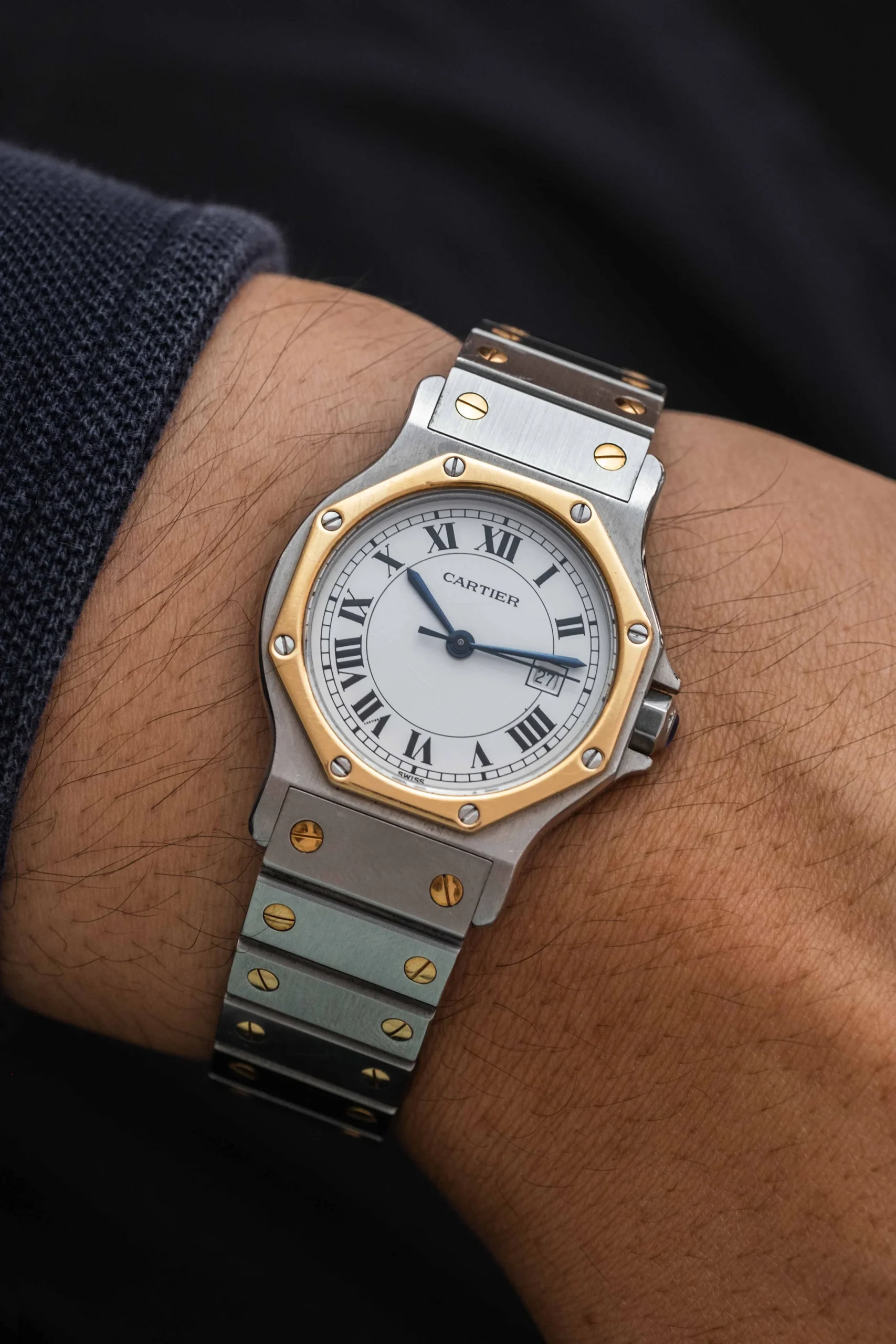
🌊 The Santos Galbée: Introducing Comfort and Contours (c. Late 1980s – 2000s); Following the successful 1978 relaunch of the Santos (the Carrée), wearers noted that the flat, boxy case and lug design could sometimes feel rigid and uncomfortable on the wrist. Cartier’s response was a swift and essential ergonomic update.
Introduced in the late 1980s (circa 1987), the Santos Galbée completely replaced the original Carrée design, becoming the main pillar of the Santos line for the next two decades.
The French term “Galbée” translates to “curved” or “contoured.” This name directly signals the watch’s most important physical change.
The Galbée design successfully married the Santos DNA with contemporary comfort.
It retained the classic square case, Roman numerals, and integrated bracelet with visible screws, but maintained a relatively thin profile, reinforcing its position as an elegant luxury watch.
Early and smaller models primarily used reliable Quartz movements to maintain thinness; Later, the larger Galbée XL models introduced automatic mechanical movements (e.g., Cartier Caliber 049, often ETA-based) to appeal to watch purists.
Today, the Galbée is highly valued as a vintage piece for its perfectly balanced, comfortable proportions and its quintessential 90s/early 2000s Cartier aesthetic, serving as an elegant alternative to the bolder contemporary models.
The Contoured Case: The back of the case and the integrated lugs were subtly yet significantly curved. This contour allowed the watch to sit naturally on the wrist’s curvature, improving wearability and wrist presence immensely.
Slim Profile: Maintaining the elegant focus of the Santos line, the Galbée kept a relatively thin profile compared to later models, reinforcing its position as a versatile, everyday luxury watch.
The Galbée spanned the transition period where luxury brands were re-embracing mechanical movements.

💪 The Santos 100: The Centennial Statement (2004 – 2018); was Cartier’s robust, contemporary reimagining of the Santos line, launched to mark the watch’s centenary and cater to the 2000s trend for larger timepieces; It was introduced in 2004 to celebrate the 100th anniversary of Louis Cartier creating the original wristwatch for Alberto Santos-Dumont.
A Century Old Design Still Turning Heads.
The watch adopted a significantly oversized and bolder aesthetic (with large models around $41\text{mm}$ to $42\text{mm}$ wide), making it a masculine and immediate statement on the wrist; Its case profile was thick, robust, and more angular than the preceding, contoured Galbée, paying homage to the original 1904 model’s flat geometry but on a massive scale.
This iteration paid homage to its predecessor while boldly reimagining the iconic design for the 21st century.
The Santos 100 retained the distinctive square case and exposed screws that made the original so recognizable, but amplified these elements with larger proportions and more robust construction.
This modern interpretation successfully bridged the gap between the Santos’ rich heritage and contemporary watch design trends, appealing to both longtime Cartier enthusiasts and a new generation of watch lovers.
Despite its minimalist approach, the Santos 100 boasts key features that enhance its functionality and appeal, including its distinctive square case, exposed screws, and robust construction.
One of the most notable features of this watch is its square-shaped square dial. The square case gives it a unique and bold look.
The Cartier Santos 100 watch is a well-known part of the Santos line.
Its unique history and shape make it a popular option for many people. Its most notable feature is its square case, but many owners compliment its comfortable wear.

The CARTIER, CEINTURE MODEL (1970s), named after the belt buckle that inspired its unique octagonal shape and integrated crown, was a further development on the integrated lug concept.
The first Ceinture watch dates back to 1927. And in 1973-1974 the model was re-released in two different case sizes, 25 mm and 27 mm. The following year a new 31 mm version came out.
The Ceinture was so named because the case is shaped like a belt’s buckle (ceinture is the French word for belt) with a very interesting square case featuring corners that appear to be “cut.
” The winding crown, usually quite prominent and set with a blue sapphire – Cartier’s signature element – is completely flat here, residing in a slot in the watch bezel without its usual sapphire cabochon.
This unique feature is one that Cartier calls its remontoir imperdable (“captive winding”).

II- The Revolutionary Rectangle: The Mechanical Ingenuity of the Tank Universe
The Tank, born in 1917, is a study in geometric adaptation, where its brancards demanded specialized, often tonneau-shaped, movements.
The Cartier Tank watch, created by Louis Cartier in 1917, is one of the most recognizable and enduring designs in watchmaking history.
Its entire existence is a study in taking a utilitarian, mechanically ingenious military concept and refining it into pure Art Deco elegance.
The design was a direct tribute to the Renault FT-17 light tank used by the French in World War I. Louis Cartier was reportedly struck by the geometric simplicity of the tank when viewed from above.
The Cartier Tank is the perfect embodiment of your initial sentence: it turned a piece of Mechanical Ingenuity (the military tank) into a Revolutionary Rectangle (the wristwatch), proving that function and fashion can be one and the same.
The “Revolutionary Rectangle” of the Cartier Tank was a radical departure from the round watches and pocket watches that dominated the market in the early 20th century
Andy Warhol who famously said, “I don’t wear a Tank to tell the time. I wear a Tank because it is the watch to wear.”
The CARTIER, TANK NORMALE MODEL(1917) , created by Louis Cartier in 1917 and released to the public in 1919, is the foundational design that inspired every Tank model that followed.
Its name, “Normale,” simply means it was the “regular” or “standard” model before other variations were introduced.
Due to its limited initial production and historical significance, the original Tank Normale is extremely rare and highly sought after.
Cartier honored this foundational design by reintroducing it as part of its exclusive Cartier Privé collection (a series dedicated to reinterpreting mythical historic designs) in 2023.
New versions with complicated movements, including a striking skeletonized 24-hour day/night complication.
The Cartier Tank Normale is the watch that demonstrated a wristwatch didn’t have to be round to be elegant; it proved that the geometric design of the “Revolutionary Rectangle” could become a timeless piece of art.

The Curvaceous and Elongated: The Cartier Tank Cintrée (1921) was a masterpiece of ergonomics, dramatically curving the case.
That’s the ultimate Tank for the purist and the connoisseur.
The Cartier Tank Cintrée (pronounced san-tray) is arguably the most elegant and architecturally daring member of the entire Tank family.
While the Tank Normale was the first “Revolutionary Rectangle,” the Tank Cintrée (introduced in 1921) was the watch that truly adapted that rectangle to the human form.
The name “Cintrée” is French for “curved” or “cambered,” which is the single, most defining feature of the watch and what makes it a design masterpiece.
The Cintrée is beloved by serious collectors because it embodies the highest level of Cartier’s design philosophy.
The Tank Cintrée was the Art Deco refinement, proving that the “Revolutionary Rectangle” could be both geometric and highly sensual.

The Cartier Tank Louis Cartier (Tank LC), introduced in 1922, is the perfect balance between the industrial severity of the original Tank Normale and the high-fashion curve of the Tank Cintrée.
It is the model that truly cemented the “Revolutionary Rectangle” as a timeless symbol of elegance.
While it shares the fundamental rectangular structure, the Tank LC refined the geometry to usher the watch from the stark utility of World War I into the sophistication of the Art Deco era.
The Tank Louis Cartier is not just a model; it is the aesthetic blueprint for the entire Tank universe.
When someone pictures a classic Cartier Tank, they are almost certainly picturing the Louis Cartier.
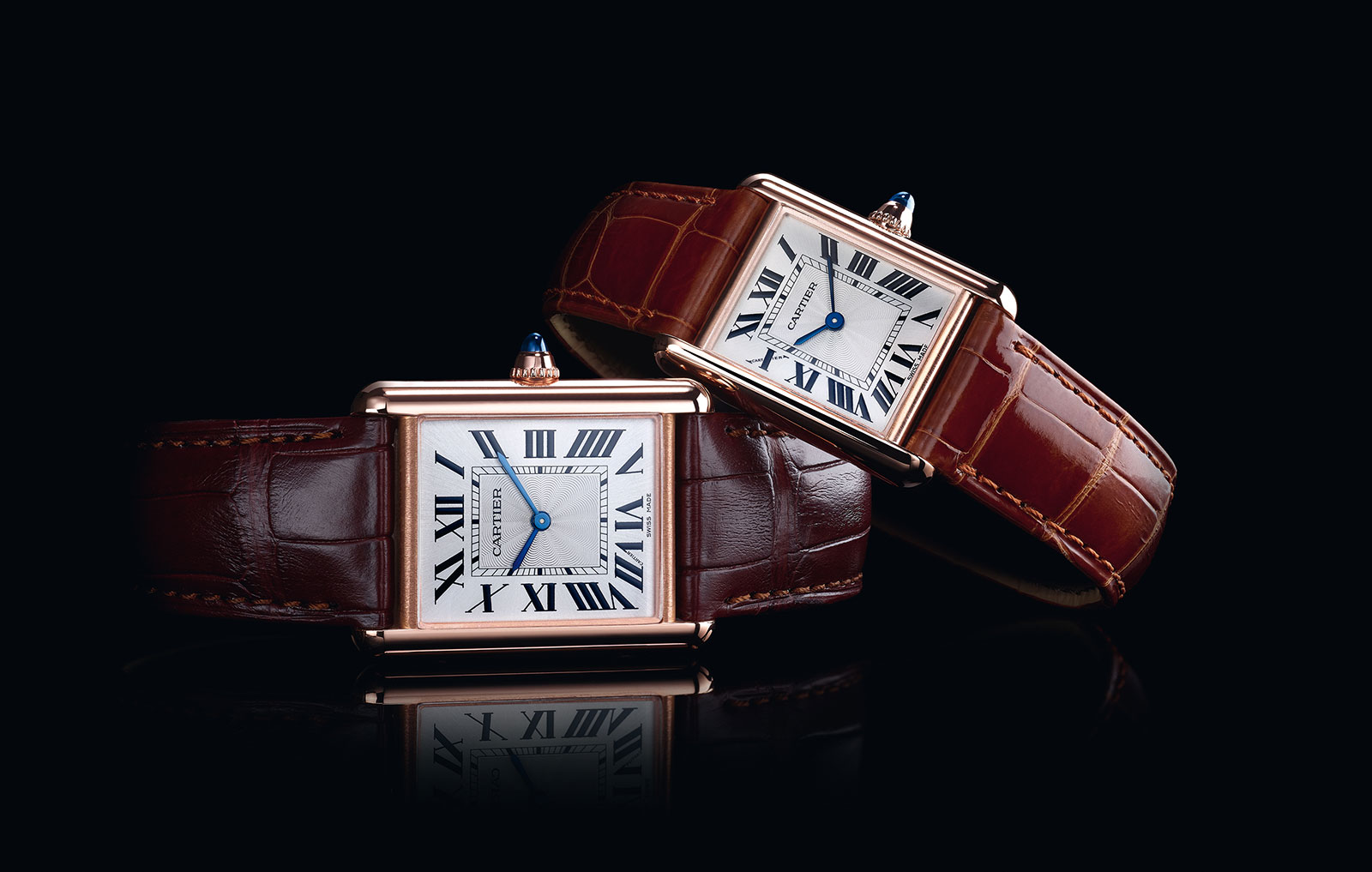
The Cartier Tank Allongée(1922) (French for “elongated”) is a fascinating example of how the early Tank design diversified immediately after its introduction.
It is important to clarify its relationship with the Tank Cintrée, as the names both mean “long/elongated” and the terms are often conflated, especially in vintage watch records.
The Tank Allongée was introduced in the 1920s (some sources suggest 1922, the same year as the Tank Louis Cartier), alongside the Tank Cintrée, as Cartier explored different ways to adapt the revolutionary rectangular design.
Tank Cintrée vs Tank Allongée
The key distinction comes down to the case construction:
- Allongée: Elongated and Flat (or near-flat) case back. Focus on a decorative, slender form.
- Cintrée: Elongated and Deeply Curved (cambered) case back. Focus on an ergonomic, body-hugging form that required a specialized ultra-thin, curved movement.
The Tank Allongée is the ultimate expression of the “Revolutionary Rectangle” stretched to its aesthetic limit while remaining flat—a perfect geometric bar of precious metal and timekeeping.
the Tank Allongée was a quiet symbol of wealth and true connoisseurship—it was the watch worn by the person who wanted a Tank, but not the same Tank everyone else had.

⛩️ The Tank Chinoise (1922), French for “Chinese”) is one of the most distinctive and architecturally specific Tank models.
It was born out of the Art Deco period’s fascination with Chinoiserie—the European interpretation of Chinese and East Asian decorative arts.
Unlike the earlier Tanks inspired by the Renault military vehicle, the Chinoise draws its form directly from traditional Chinese temple architecture, specifically the entrances or porticos.
The Chinoise was part of a larger resurgence of interest in Europe in East Asian decorative arts, and the collective term for decorative objects and other artworks produced with East Asian and Chinese aesthetics was chinoiserie, which peaked during the Rococo movement in the mid-18th century.
The Tank Chinoise proved that the “Revolutionary Rectangle” could be adapted not just by stretching or rounding its edges, but by adding new, bold geometric layers onto its base structure, each with a profound cultural reference.
In 2022, to mark the 100th anniversary of the Tank Chinoise, Cartier chose it as the subject for its exclusive Cartier Privé collection—a series dedicated to the highest expression and most faithful re-creations of their historical icons.
The 2022 Tank Chinoise confirmed the model’s status as a quintessential Art Deco piece, a true “Revolutionary Rectangle” that combines architectural strength with mechanical delicacy.
Paul Mescal (known for Normal People and Aftersun) wore the Tank Chinoise (specifically a platinum model from the 2022 Cartier Privé collection) on the red carpet at the 2022 Cannes Film Festival.

💣 The Tank Obus (1923): The Bullet and the Square; takes its name from the French word for “shell” or “bullet.” It is one of the most distinctive and conceptually unique Tanks, fundamentally altering the relationship between the case and the strap.
The Tank Obus has always been a limited-production rarity within the Tank family, often appearing in very small batches, making it highly prized by collectors.
The Tank Obus is significant because it is the model that deconstructs the defining feature of the original Tank—the brancards that seamlessly integrate the strap.
The Tank Obus is a masterpiece of geometric tension—a simple rectangular or square case punctuated by the dramatic, circular forms of the bullet-like lugs, proving that the “Revolutionary Rectangle” could be re-imagined through its points of connection rather than just its face.
Its rarity and unique design elements have always made it a collector’s piece.

⏳ The Tank à Guichets (1928): The Mechanical Digital Watch, The name à Guichets (pronounced ah gee-shay) is French for “with windows” or “with apertures.” This watch represents Louis Cartier’s quest for extreme aesthetic refinement by eliminating the traditional dial and hands entirely.
The pursuit of extreme Art Deco minimalism and the growing interest in digital time displays (via mechanical jumping hour systems) that had been developing since the late 19th century (e.g., IWC Pallweber).
Very few originals were made between 1928 and the 1930s (likely less than two dozen).
It was strictly a special order model for VVIP clientele, making it one of the most coveted vintage Tanks.
Revived only in very limited editions: 1996 (6 pieces for auction), 1997 (150 pieces for 150th Anniversary), 2005 (100 pieces CPCP), and most recently, a new release in 2025 (as part of the Cartier Privé collection).
The ingenious aspect of the Tank à Guichets is that its design serves its mechanical complexity, rather than the other way around.
Duke Ellington: The legendary jazz composer and bandleader was a noted wearer of the Tank à Guichets in the 1930s.
His choice perfectly aligned with his image as a stylish, progressive figure whose work revolved around precision and timing.
The Tank à Guichets is the philosophical pinnacle of the “Revolutionary Rectangle”: it took the rectangular case and used it to conceal nearly everything, transforming the act of time-telling into a dramatic, high-precision mechanical event visible only through two tiny windows.

📐 The Tank Asymétrique (1936): The Oblique Driver’s Watch, Originally named the “Parallélogramme” or “Losange” (Diamond), the Tank Asymétrique (French for “asymmetrical”) was the last truly distinct Tank model to be launched before the tumultuous period of World War II and the death of Louis Cartier in 1942.
A Driver’s Watch. The design was intended to enhance legibility.
When a driver’s hands were placed on a steering wheel (at roughly the “10 and 2” position), the skewed dial would be oriented upright, allowing the time to be read effortlessly without moving the hands.
The design transforms the rectangle into a parallelogram or lozenge (diamond), with the entire dial and case structure rotated approximately 30 degrees off its central axis.
The original 1936 models are among the rarest Tanks ever made.
It has only been re-issued in very small, highly limited batches (e.g., 1996, 2006, and the major Cartier Privé re-issue in 2020).
The genius of the Asymétrique lies in the complex structural engineering required to make a watch that is so visually “off-kilter” function perfectly.
The Asymétrique is less about mass appeal and more about an intellectual, artistic, and avant-garde choice in watch collecting.
The Tank Asymétrique is the ultimate proof that the “Revolutionary Rectangle” is a concept, not a constraint.
By breaking its own rules, Cartier delivered a design that remains fresh, playful, and completely unique nearly a century later.

🚀 The Tank Must (1977): Democratizing the Rectangle;(later simply Tank Must) was introduced in 1977 as part of the broader Les Must de Cartier product line. It was designed to maintain the iconic look of the Tank while making it accessible to a much wider, younger audience.
The Quartz Crisis. By the 1970s, affordable, highly accurate Japanese quartz watches were devastating the Swiss luxury watch industry. Cartier, dealing exclusively in expensive precious-metal watches, needed a lifeline.
Les Must de Cartier (French for “The Must-Haves of Cartier”). The concept, driven by Robert Hocq and Alain-Dominique Perrin, was to create a range of desirable, entry-level luxury items that one “must” have.
Cartier’s watch sales allegedly skyrocketed from around 3,000 per year to 160,000 by the late 1970s following this launch, proving the immense demand for the Cartier aesthetic.
The Tank Must’s technical ingenuity lay in achieving the look and feel of a luxury item while lowering the manufacturing cost.
Yves Saint Laurent: The iconic French fashion designer was famously photographed wearing a Must de Cartier Tank, lending immense credibility and cool factor to the “affordable” line.
The Tank Must name was revived in 2021 as a modern, permanent collection.
The Tank Must proved that the genius of the Tank was in its design geometry—the “Revolutionary Rectangle”—which could be maintained across different metals and movement types without sacrificing its iconic status.

The Tank Américaine (1989): The Bold Curve; was introduced in 1989 and serves as the modern, more substantial successor to the ultra-slim and highly collectible Tank Cintrée (1921). It was a key release designed to appeal to the tastes of a more robust, contemporary watch market.
(Launched during a period of renewed focus on mechanical watchmaking after the Quartz Crisis).
The name is an homage to the historical Cartier New York branch, which had a significant influence on design and was often the source of unique, one-off Tank variations throughout the 20th century.
Takes the curved geometry of the Cintrée but gives it more volume and thickness, making it more of a modern statement piece while retaining the elegance of the curve.
It was one of the first Tank models to be frequently released with an automatic (self-winding) movement, marking a shift from the hand-wound movements typical of the original Tanks.
The Américaine popularized the Tank with an integrated metal bracelet, especially in its gold variations.
The links of this bracelet are often curved to match the case, creating a flowing, sculpted piece that is highly luxurious and comfortable.
The Tank Américaine successfully translated the highly exclusive, specialized geometry of the Tank Cintrée into a durable, mainstream classic, proving that the “Revolutionary Rectangle” could evolve to meet the demands of modern watchmaking and fashion.

🔗 The Tank Française (1996): The Integrated Rectangle; was introduced in 1996 and stands as the first Tank model explicitly designed as an integrated bracelet watch. It was conceived to give the Tank a bolder, sportier, and more modern presence, suited to the dynamic fashion of the late 20th century.
While it retains the Tank legacy, the Française is less about historical reference and more about modern geometry and ergonomics. Its bracelet links are often said to reference the treads of a tank more directly than the sleek leather straps of earlier models.
The fusion of the case and bracelet into a single monobloc piece of metal, creating a fluid line and a substantial feel on the wrist.
It was an immediate, massive commercial hit, proving that the iconic rectangular design could be updated for a new, metal-bracelet-focused market.
The mechanical ingenuity of the Tank Française is centered on the unique relationship between the case and the bracelet.
The Française quickly became an “It Watch” of the late 1990s and early 2000s, balancing royalty with contemporary culture.
Princess Diana: She famously wore a yellow gold Tank Française in the late 1990s, cementing its status as a timeless piece of luxury and high-society style.
Michelle Obama: The former First Lady wore a steel Tank Française for her official White House portrait, giving the watch a prominent place in American political history and symbolizing modern, professional elegance.
Modern Cultural Icons: The watch has recently seen a renaissance on the wrists of figures like actor Rami Malek (in the 2023 campaign) and figures like Donald Glover, highlighting its unisex appeal and versatility.
In 2023, Cartier released a major, highly celebrated redesign of the Tank Française, further radicalizing the integrated aesthetic.
The Tank Française successfully proved that the “Revolutionary Rectangle” could embrace modern demands for integrated design and mass appeal, all while retaining the strict geometry and elegance established a century earlier.

🇬🇧 The Tank Anglaise (2012): The Integrated Crown; (French for “English Tank”) was introduced in 2012 as the third model in the “geographic trinity” that pays tribute to Cartier’s three historical pillars: Paris (Française), New York (Américaine), and London (Anglaise).
This model’s design is all about volume, concentration, and the radical streamlining of the “Revolutionary Rectangle.”(Unveiled at the Salon International de la Haute Horlogerie, SIHH).
The Cartier London branch (Cartier UK). The watch evokes the refinement and slightly bolder, often more whimsical aesthetic associated with the independent creations of the London branch in the mid-20th century.
A concentrated, curved, and robust rectangular form where the winding crown is entirely integrated into the vertical side rail (brancard), making it a visually pure rectangle.
The Large Model was the first of the broader Tank portfolio to be powered by Cartier’s own in-house, Manufacture Automatic Caliber 1904 MC, signaling a major commitment to technical independence.
The Tank Anglaise achieves its streamlined look through a highly unusual and ingenious re-engineering of the watch’s most common functional protrusion: the crown.
Figures in fashion and British society, such as Poppy Delevingne, were noted to wear the Anglaise at its launch events, aligning it with a stylish, modern British sensibility.
The Tank Anglaise stands as the 21st-century triumph of the “Revolutionary Rectangle” by achieving the ultimate streamlined elegance: making a functional element—the winding crown—visually disappear without compromising the core geometric form.

🤸 The Tank Basculante (1932): The Tilting Rectangle; (French for “Tilting Tank”) perfectly describes its function: a case that pivots within its outer frame. It is a stunning example of complex engineering applied to the simple “Revolutionary Rectangle.”
Often originally called the “Tank Cabriolet Réversible”).
The reversing mechanism was developed by Spécialités Horlogères SA (a LeCoultre subsidiary), highlighting the deep, historic cooperation between Cartier and Jaeger-LeCoultre.
The rise of recreational sports in the 1930s (especially polo). Gentlemen of leisure needed a luxury watch that could survive the impacts of a mallet swing or a fall, protecting the fragile glass crystals of the time.
The design retains the rectangular Tank aesthetic but houses the main case within a separate, vertical outer frame.
The original 1930s production was very limited. The model was re-introduced in limited editions in the 1990s and early 2000s (under the Collection Privée Cartier Paris and Millennium collections) and is highly sought after by collectors.
Gary Cooper: The suave, debonair American actor, known for his style and sophistication, was a noted wearer of the Tank Basculante in the mid-20th century. His choice cemented the watch’s status as a piece of quiet elegance and function.
The Tank Basculante is a true horological achievement. It maintained the purity of the “Revolutionary Rectangle” while adding a complex, articulated mechanism, proving that design ingenuity could serve both extreme elegance and practical utility.

🥚 The “Tank Fabergé” (Circa 1970s): The Incurved Rectangle;s a highly rare and unique model produced during a period in the 1970s when Cartier was exploring many variations of its classic rectangular and square lines, often under the Cartier Paris signature.
The name “Fabergé” is a nod to the soft, rounded, and almost egg-like shape of the case. Unlike the rigid, straight lines of most Tanks, this model features an unusual, flowing geometry reminiscent of the artistic, decorative objects created by the famous Russian jeweler Peter Carl Fabergé.
It was part of a major expansion of the Cartier watch line, which included models like the Gondole, Ceinture, and Cristallor, all playing with geometric deviations from the classic Tank.
The core ingenuity of this piece is how it maintains the Tank’s essential rectangular identity while radically softening the geometry.
The “Tank Fabergé” is a subtle but powerful example of the “Revolutionary Rectangle” becoming a sculptural object. It demonstrates Cartier’s constant desire to push the boundaries of its iconic shape, proving that severe geometry can be translated into soft, sensual forms inspired by the world’s great decorative artists.

🛋️ The Tank Divan (2002): The Lateral Rectangle; (French for “Sofa” or “Couch”) was introduced in 2002 and completely flips the established vertical orientation of the Tank case onto its side, creating a unique and bold horizontal rectangle.
The Cartier design team, seeking to re-interpret the rectangular legacy in a new, modern, and fun way.
The shape of a luxurious divan or sofa. The wide, low, comfortable rectangular profile is directly referenced in the watch’s design.
The most significant feature is the horizontal orientation. All previous Tanks were “portrait” (longer vertically); the Divan is “landscape” (longer horizontally).
A limited production model that was discontinued after only a few years. While not as rare as the 1920s special commissions, it is highly collectible due to its unique shape.
The genius of the Tank Divan is in taking the strict vertical architecture of the Tank (parallel vertical brancards) and maintaining its visual logic while rotating the entire structure 90 degrees.
This thematic approach perfectly illustrates how Louis Cartier and his successors continuously revisited the simple concept of the “Revolutionary Rectangle” to create wildly different, yet universally identifiable, masterpieces.

💎 The Tank Enlacée (2010s): The Knotted Rectangle; (often released as part of the Cartier Libre collection or similar limited series) takes the rectangular form and, through diamond setting and sculptural design, transforms it into a piece of fine art.
The softness of fabric or ribbon being knotted and wrapped around a rigid form. It is a stunning visual contrast between the Tank’s geometric rigidity and the perceived fluid movement of the diamonds.
The rectangular case appears to be cinched, squeezed, or tied at its center by a prominent, looping structure entirely paved with diamonds.
These are always very limited editions (sometimes as few as 50 or 100 pieces) reserved for high-end collectors, placing it in a different league from the regular production Tanks.
The Tank Enlacée is a showcase of Cartier’s mastery over both watchmaking and high jewelry craftsmanship.
The entire case and “knot” structure are typically paved with diamonds using meticulous techniques like pavé or snow setting, demanding the highest level of jewelry craftsmanship.

🌞 The Tank Must SolarBeat (2021): The Eco-Conscious Rectangle; is a regular production model that achieved immense press coverage and commercial success by introducing a revolutionary photovoltaic (solar-powered) movement that maintains the classic Tank aesthetic without the need for regular battery changes.
The goal was to create a modern, reliable, and environmentally responsible watch by eliminating the need for frequent battery replacement.
It sits within the Tank Must collection, inheriting its clean lines, streamlined case, and accessible positioning (steel case), while pushing technical boundaries.
To perfectly integrate photovoltaic technology without altering the classic, white-dial Roman numeral aesthetic of the Tank Louis Cartier.
The genius of the SolarBeat movement is the clever technique used to route light to the cell without making the solar panel visible.
Cartier applied the micro-perforation to the entire dial surface, allowing more light to be captured and significantly increasing charging efficiency and reliability.

⏱️ The Tank Monopoussoir Carrée (c. 2000): The Technical Apex; (Square Single-Pusher) is a highly collectible masterpiece, defined by its complex single-button chronograph mechanism housed within the classic, square-cased Tank Obus profile.
Circa 2000 (Released as part of the Collection Privée Cartier Paris – CPCP).
The Caliber 045 MC movement was developed by THA Ébauche, a firm co-founded by future independent watchmaking stars François-Paul Journe, Denis Flageollet, and Vianney Halter.
Released alongside the Tortue Monopoussoir in the CPCP line, it marked Cartier’s return to high-end, mechanical haute horlogerie after the quartz crisis.
It is considered one of the most important and technically sophisticated Tank models ever made, revered for its legendary movement pedigree.
The Monopoussoir Carrée’s ingenuity is almost entirely centered on its exceptional movement, which integrates complex functions into a small, elegant space and offers an exquisite user experience.
Highly valued, with prices consistently commanding strong premiums due to the Caliber 045 MC’s provenance (F.P. Journe/De Bethune connection) and the watch’s status as a CPCP chronograph.
The Tank Monopoussoir Carrée proved that Cartier was not only a master of aesthetic design but also a serious player in high-complication mechanical watchmaking, laying the groundwork for its modern Manufacture status.

💎 The Cristallor (c. 1973): The Triple-Stepped Octagon; is a highly exclusive and rare timepiece that perfectly embodies the geometric architectural experimentation of the 1970s.Its defining feature is its striking, layered case construction, which gives it a powerful, dimensional presence.
Circa 1973 (Part of the original twelve models of the Louis Cartier Collection).
Launched during the 1970s resurgence, alongside other uniquely shaped watches like the Ceinture and Gondole, confirming Cartier’s aggressive approach to geometric novelty.
Cristallor (A portmanteau referencing the crystal or the multi-faceted, layered structure of the case).
A blend of the classic Tank verticality with a renewed interest in Art Deco’s stepped architecture and a desire for bold, sculptural geometry.
Extreme Rarity. Believed to have been produced in very limited numbers—estimates suggest fewer than 1,000 units across all sizes, making it highly exclusive.
The Cristallor’s technical ingenuity is its complex, layered case construction, which utilizes multiple tiers of gold to create a stunning optical effect.
Due to its extreme rarity and short production window, the Cristallor was a watch for connoisseurs and advanced collectors of vintage, high-concept Cartier design.
It stands as a powerful example of Cartier’s creative freedom in the 1970s, proving that even a simple time-only dress watch could be elevated to a piece of sculptural, geometric art simply by mastering depth and layering
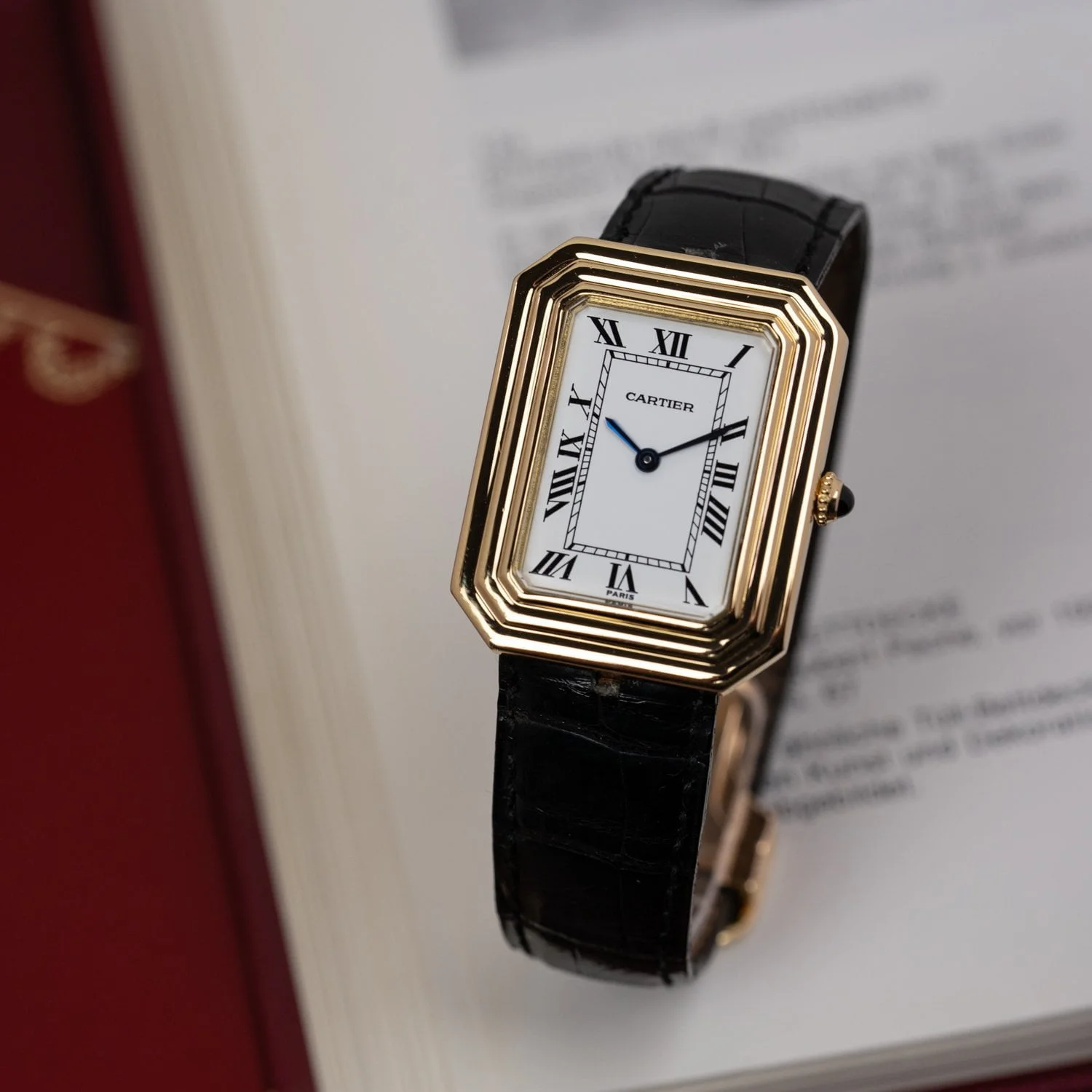
📺 The Gondole Horizontale (c. 1972): The Architectural TV Screen; is a rare and highly sought-after timepiece, representing Cartier’s foray into the large, geometric, and “funky” case shapes popular in the 1970s, defined by its wide, stepped, horizontal profile.
Circa 1972/1973 (A core part of the Louis Cartier Collection re-launch).
Gondole (Gondola/Boat). The name references the long, gently curved sides of the case. Horizontale indicates its wide, landscape orientation.
“Grand TV” or “TV Screen” due to its distinctive wide, almost rectangular but soft-cornered profile, reminiscent of 1970s television screens.
High Rarity. The “Jumbo” or “Grand” versions, especially the Horizontal, were produced in very limited numbers, making them collector favorites today.
The Gondole Horizontale’s technical ingenuity lies in its layered, architectural case, combining the bold size of the era with classic Cartier elegance.
Typically housed the reliable, manually-wound Cartier Caliber 78-1 (an ETA-based movement signed for Cartier), allowing the case to remain relatively slim and elegant despite its physical size.
Highly sought-after examples feature the “Paris” signature at 6 o’clock, denoting they were sold through the historic Place Vendôme flagship boutique.
Worn by vintage Cartier connoisseurs who appreciate the experimental design period of the 1970s and seek out models with distinct personalities that stand apart from the main Tank collection.
Due to its low production numbers and desirability among shape-watch collectors, the Gondole Horizontale commands premium prices at auction, often significantly higher than standard Tanks of the same era.
The Gondole Horizontale stands as one of the most successful examples of Cartier’s commitment to the bold, geometric luxury aesthetic of the 1970s, successfully merging its classic dial codes with a truly avant-garde case shape.

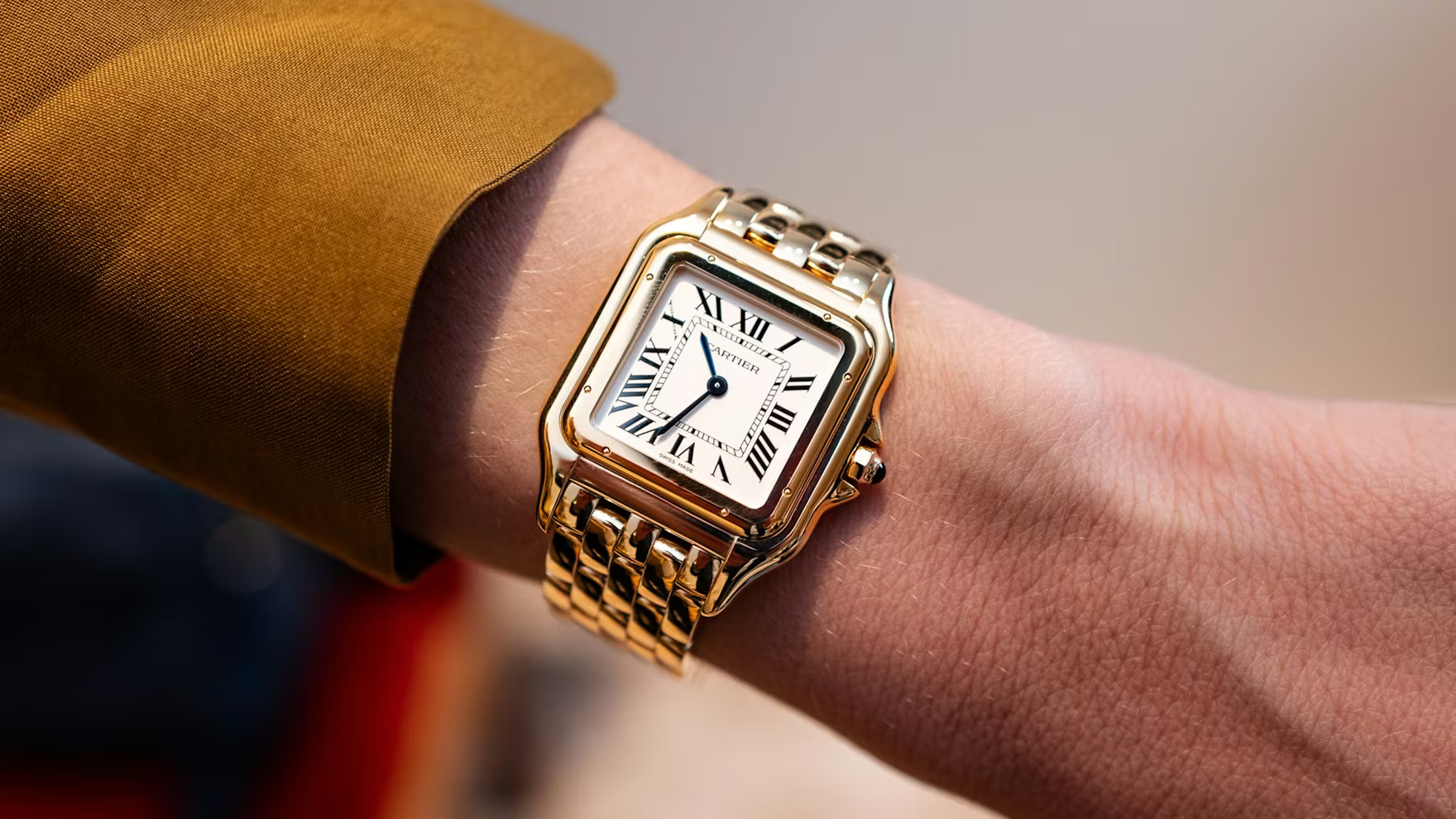
🐆 The Panthère de Cartier 1914: The Fluid Jewel; is arguably the most famous and defining symbol of the Maison after the Tank. Launched as a watch collection in 1983, it is celebrated for its distinctive square case and ultra-flexible, five-row bracelet engineered to move with the grace of its namesake feline, firmly establishing it as the quintessential jewelry watch.
1914 (The abstract panther pattern first appeared on a Cartier ladies’ wristwatch).
1983 (The structured watch line, Panthère de Cartier, was launched commercially).
2017 (Successfully revived after a brief production hiatus, cementing its place as a modern icon).
Jeanne Toussaint (Creative Director of High Jewelry, 1933–1970s). Louis Cartier nicknamed her “La Panthère,” and her preference for sculptural, feline-inspired designs made the animal the core emblem.
The grace, fluid movement, and spinal suppleness of the panther. The watch takes its name from the bracelet, which mimics the way the animal moves.
It was the ultimate status symbol of the 1980s and 1990s, known for its effortless glamour and defining the category of a timepiece that is first a piece of fine jewelry.
The Panthère’s engineering brilliance lies almost entirely in the bracelet, which turns rigid gold or steel into a textile-like drape.
Primarily powered by highly reliable Swiss Quartz movements. This choice is deliberate, ensuring the watch remains thin, lightweight, and prioritized as a jewelry item.
Worn by influential figures across decades, underscoring its broad appeal: Madonna, Jane Fonda, Gwyneth Paltrow, Pierce Brosnan, and rock legend Keith Richards (proving its unisex appeal in larger sizes). Modern fans include Dua Lipa and Anne Hathaway.
In 2021, the founder of Dimepiece, Brynn Wallner, christened the Panthère the ultimate “it girl” watch in an article for Harper’s Bazaar. It was titled “Why Are All the It Girls Obsessed With This Watch?”
The Panthère de Cartier exists as a leading staple in the pantheon of women’s watch design. It doesn’t quite have the cultural cachet of a Tank, but you still recognize it as an important piece of watch design history, lusted after by many.
The Panthère transcended fashion trends and the Quartz crisis. Its 2017 relaunch proved its design is truly timeless, making it one of the most recognizable and enduring symbols of Cartier’s commitment to sculptural, high-glamour timepieces.
III. The Masters of Curves, Circles, and Surrealism.
These pieces represent the technical apex of Cartier’s design freedom, often resulting in extremely collectible models due to the custom calibres required.
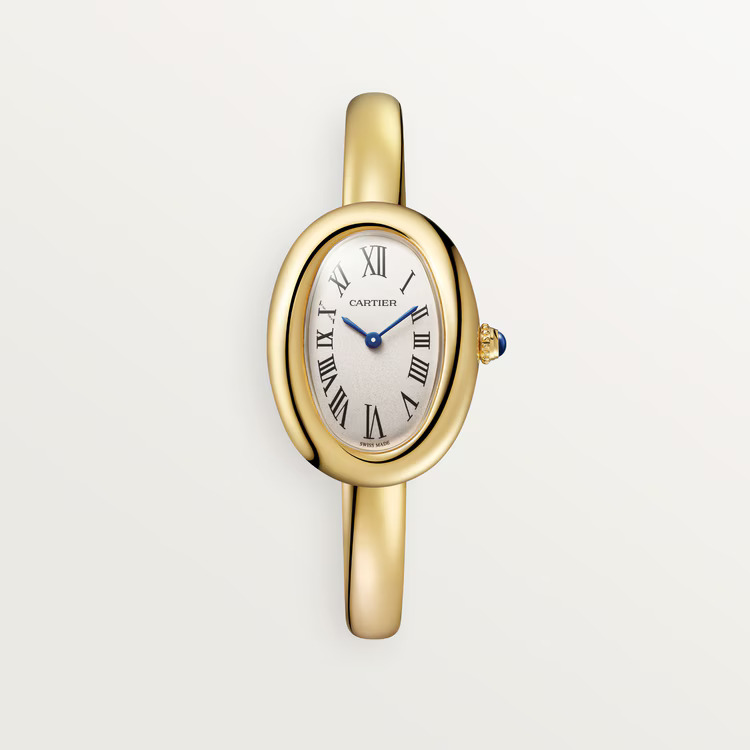
🛁 The Baignoire (1912): The Perfect Curve; (French for “bathtub” or “casing”) is one of Cartier’s earliest and most enduring creations. It is the ultimate expression of the Maison’s philosophy that a timepiece should be a piece of jewelry first and a timekeeper second.
The name was adopted later, referring to the long, oval, slightly curved shape of the bezel, which resembles a classic roll-top bathtub.
The transition from the round pocket watch to the rectangular wrist watch. The Baignoire offered a beautiful, fluid compromise between the two, maximizing wrist presence and comfort.
It has been continuously produced in various forms for over a century, cementing its place as Cartier’s definitive curved watch, often referred to as the “Curved Rectangle” due to its stretched oval shape.
The Baignoire’s ingenuity is hidden within its geometry: it is a complex shape that requires immense precision to fit the crystal and movement perfectly.
The Baignoire has been favored by women who embody timeless, understated elegance: Jeanne Moreau (French New Wave icon) and Catherine Deneuve.
The Original Baignoire (1912)
The Baignoire Allongée (1960s)

The Baignoire “Vachette” or “Ceinture” (1970s)

The Baignoire Maxi and Mini (1990s – 2000s)

The Baignoire Cadran Dame (Modern Revival)(2010-)

✨ The Baignoire Hypnose (2016): The Optical Illusion ; launched in 2016, is a jewelry timepiece that completely transforms the classic oval Baignoire into a piece of kinetic art using concentric circles and diamonds to create a mesmerizing optical illusion.
Developed during a period when Cartier was actively re-inventing its historical feminine icons (like the Baignoire and Panthère) for the 21st-century collector, placing emphasis on bold volume and geometry.
Hypnose (Hypnosis). The name is a direct reference to the dizzying, spiral-like optical effect created by the concentric rings of diamonds and black lacquer.
A blend of the Baignoire’s classic oval with the Op Art movement (Optical Art), using repetitive geometric structures to manipulate perception and create depth.
Limited Production. While not a single-digit rarity like the Cheich, the Hypnose is a highly exclusive model, made only in precious metals and utilizing high-quality diamond pavé.
The Hypnose’s technical ingenuity is entirely focused on its three-dimensional, concentric structure and the masterful transition from the central oval to the outer circle.
The Hypnose proved that the 1912 Baignoire shape is a timeless canvas. It successfully brought the abstract principles of Op Art and modern sculptural jewelry into the world of traditional watchmaking, securing the Baignoire’s future relevance.

💥 The Crash (1967): Surrealism and Iconoclasm; conceived at the height of the “Swinging Sixties” in London, is the ultimate expression of artistic rebellion and geometric distortion, looking famously like a watch that has melted or been violently deformed.
The Cartier Crash is arguably the single most collectible and unique watch in Cartier’s entire history, looking famously like a watch that has melted or been violently deformed. It is the ultimate expression of taking a classic shape (the Baignoire) and pushing it to the extreme of artistic distortion.
The warped, pinched, and melted appearance evokes the surrealist art movement, specifically referencing Salvador Dalí’s famous melting clocks and the anti-establishment sentiment of 1960s London.
The “Warped Oval” of the Cartier Crash was a radical departure, embracing asymmetry and defying the traditional watch shape established by its predecessors.
The Crash has achieved a unique status, transcending horology to become an ultimate piece of exclusive high-fashion and cultural currency, largely due to its extreme scarcity.
Original Crash (1967): The highly rare London version, the blueprint for all others.
Paris Re-issues (1991): The first major, small-batch re-release, confirming the watch’s legendary status.
Crash Skeleton (2015): A technical marvel where the custom-shaped Caliber 9618 MC is openworked, with the movement bridges themselves forming the warped Roman numerals, merging mechanics and surreal design.

🐪 The Cheich (1926): The Asymmetric Turban; is arguably the rarest and most legendary of all Cartier creations. Created for a specific competition, its asymmetric, three-sided geometric case broke all design conventions and achieved an unparalleled level of exclusivity.
The name refers to the Arabic word for “sheik” and evokes the headscarf or turban worn in the Middle East, which the watch’s dramatic, curving asymmetric shape visually resembles.
The watch was created as the grand prize for the winner of the Challenge Européen, a grueling two-year, 16,000-kilometer endurance rally across Europe and Africa, sponsored by Jacques Cartier.
Only three were ever known to have been made: one for the winner, one for the winner’s son (who won the next event), and one kept by Cartier. Only one has survived to be authenticated today.
The Cheich is a technical marvel due to its radical, non-traditional case shape and its integrated strap design.
The sole verified wearer was Bernard de Lassée, the winner of the 1926 Challenge Européen rally. The watch was supposed to be the prize for every future winner.
The Cheich is considered the Holy Grail of Cartier collecting. The last public knowledge of the surviving piece’s existence was when it was placed on exhibition, but it has never been publicly sold at auction. Experts estimate its value would exceed $10 million if it ever came to market.

🐢 The Tortue (1912): The Curved Complication Canvas; French for “tortoise”) is one of Cartier’s earliest designs, cementing its role as a master of shaped watches. It is often overshadowed by the Tank, but it holds a uniquely prestigious place due to its consistent use as a platform for high mechanical complications.
It is Cartier’s third wristwatch design, following the Santos-Dumont (1904) and the Tonneau (1906), and predates the Tank by five years.
The name is a literal reference to the case’s curved, barrel-like silhouette and its distinct, short lugs (“turtle on legs”).
Unlike most early shaped watches (which were time-only), the Tortue’s more substantial case lent itself naturally to sophisticated mechanics, making it Cartier’s historical vehicle for high horology.
The Tortue’s ingenuity lies in its unique barrel shape (tonneau shape) that is wider and rounder than the preceding Tonneau model, offering more space for complex mechanical movements.
Tortue Monopoussoir1928 / 1999 (CPCP)Cartier’s first ever chronograph. Monopoussoir means a single pusher integrated into the crown controls all start, stop, and reset functions.
Minute Repeater1928 / 2000s (CPCP)Cartier’s first ever striking watch produced in series. This required a highly miniaturized striking mechanism to fit the shaped case.
CPCP Monopoussoir (1999)CPCP RevivalHoused the famous Caliber 045 MC developed by THA Èbauche, a collaboration between three independent masters: Vianney Halter, Denis Flageollet (De Bethune), and François-Paul Journe.
Cartier Privé (2024)Modern High HorologyRe-issued the Monopoussoir with the new, shaped Manufacture Caliber 1928 MC, ensuring the movement physically follows the curves of the case.
The Tortue has always been produced in small, exclusive batches, often only in precious metals. The vintage 1920s complication models are exceedingly rare (fewer than 15 Monopoussoirs are known to have survived).
It is one of the most collectible models from the Collection Privée Cartier Paris (CPCP) era (1998-2008), confirming its status as a cornerstone of Cartier’s Haute Horlogerie history.

🥃 The Tonneau (1906): The Barrel of Elegance; (French for “barrel”), introduced in 1906, defined the elegance of the “shaped watch” and set the stage for the dramatic geometric designs that would follow. It is famous for its intricate, compound curvature designed for maximum wrist comfort.
It is Cartier’s second men’s wristwatch design, following the square Santos-Dumont (1904).
The name refers to the case’s convex, rounded vertical sides which, combined with the elongated shape, evoke a wooden barrel laid on its side.
The need for an elegant, ergonomically curved watch that was distinctly modern and moved away from the simple roundness of the pocket watch.
Has always been a low-production model, reserved for highly exclusive editions (like the CPCP re-issues) due to the complexity of the case and movement.
The Tonneau’s technical ingenuity lies in its bi-axial curvature—it curves along its length (ergonomics) and along its width (the barrel shape)—making it one of the most complex cases to execute perfectly.
Tonneau Dual TimeVintage (Early 20th C) / 2019 (Cartier Privé)The signature complication for the Tonneau. It displays two time zones (Home Time and Local Time) independently on a single dial.
Modern Dual Time (2019 Privé)Modern IngenuityHoused the Cartier Manufacture Caliber 9919 MC. This is a shaped automatic movement where the entire gear train is aligned vertically (12 to 6 o’clock) and curved to fit the case, demanding exceptional mechanical precision.

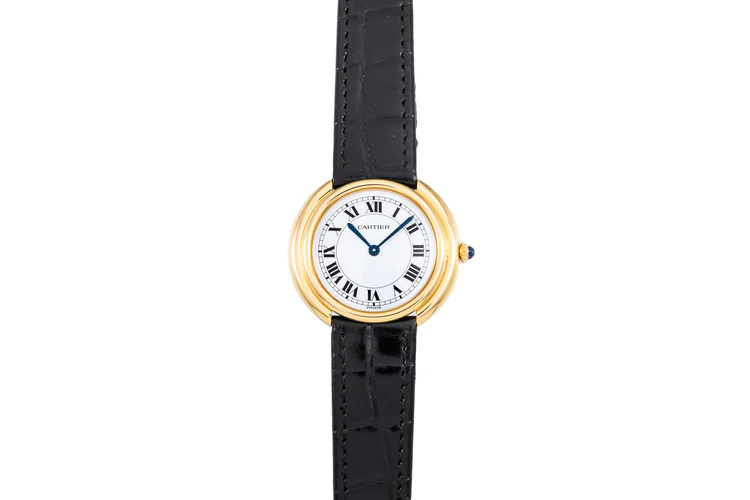
⭕ The Vendôme (1930): The Elegant Attachment ; introduced in 1930, is a sophisticated dress watch named after Paris’s iconic Place Vendôme. Its defining feature is the unique lug design that separates it from all other Cartier models, creating the illusion of a floating case.
Introduced in 1930, is a sophisticated dress watch named after Paris’s iconic Place Vendôme.
Its defining feature is the unique lug design that separates it from all other Cartier models, creating the illusion of a floating case.
Louis Cartier was reportedly inspired by the shape of a carriage hitch or the streets leading into the Place Vendôme (Rue de la Paix and Rue de Castiglione), leading to the unique, two-point strap attachment.
The original 1930s precious metal versions (Vendôme Louis Cartier) are rare; the Must de Vendôme (1970s-80s) was mass-produced and is common
The Vendôme’s genius is the deconstruction of the traditional lug. The strap attachment system, patented in 1934, is designed to minimize the visual interruption of the perfect circle.
Vendôme Louis Cartier (VLC)1930s ; The original model, made in 18K gold and powered by manual-winding movements. The ultimate expression of the design.
Must de Vendôme1973 – Mid-2000s; Mass-market re-launch that saved the brand. Made in Vermeil (gold-plated silver) and primarily using Quartz movements. Known for its variety of colorful dials (vermilion, navy, black).
Vendôme Panthère1980s; A fusion model combining the Vendôme case geometry with the flexible Panthère brick-link bracelet, creating a distinct sports-luxury look.
🟠 The Ellipse (c. 1973): The Squared Oval; is an often-overlooked yet highly coveted model that showcases Cartier’s absolute mastery of the non-traditional case shape. Its elongated oval, often squared off at the top and bottom, makes it a unique and distinctly Art Deco-inspired piece.
Circa 1973 (Launched as part of the re-vamped Louis Cartier Collection).
Released alongside other uniquely shaped watches like the Gondole and Cristallor during a major expansion of the brand’s catalog.
Ellipse. The name directly refers to the elliptical, elongated, horizontal-oriented oval shape of the case.
Often confused with the earlier, more pure oval of the Baignoire, the Ellipse is typically characterized by a more flattened or squared-off profile at the 12 and 6 o’clock ends.
Medium Rarity. While not a limited edition rarity, it was produced for a shorter period and in smaller quantities than the Tank, making vintage examples highly desirable today.
The Ellipse’s ingenuity is its sophisticated blend of a delicate, elongated shape with the robust design codes of the 1970s, making it suitable for both men and women.
The Ellipse was primarily fitted with the ultra-thin, reliable Manual-Winding Caliber 78-1 (an ETA-based movement signed for Cartier), allowing the watch to maintain its slim, elegant profile.
Some specific references were named the Gondole Ellipse, linking it to the wider Gondole (boat-shaped) family of that era, particularly those with more flattened sides.
Its primary vintage appeal is its lesser production quantity compared to the Tank, making it a sophisticated, “if you know, you know” choice for collectors of shaped watches.
The Ellipse solidified Cartier’s commitment to exploring every conceivable geometric shape in the 20th century, proving that even a subtle shift in the oval form (compared to the Baignoire) could create an entirely new, iconic aesthetic.

⚾ The Pebble (1972): The Square in the Circle ; (sometimes nicknamed the “Baseball” in the US) is a masterpiece of geometric juxtaposition created by the independent Cartier London workshop.
It takes two of the purest shapes—the circle and the square—and merges them in a visually powerful, unexpected way.
Developed five years after the highly surreal Crash (1967), the Pebble continued the London workshop’s tradition of creating radical, abstract shapes during the “Swinging Sixties” and early Seventies.
Pebble (or Pebble-Shaped Watch). The name refers to the case’s smooth, lugless, rounded profile that resembles a beach pebble or a highly polished stone.
The central design challenge: creating harmony and tension by setting a square dial at a 45-degree rotation (lozenge) within a perfectly circular case.
Ultimate Rarity. It is one of the rarest Cartier watches ever made. Research suggests fewer than a dozen originals were produced in the larger size (including yellow and one white gold example).
The Pebble’s technical ingenuity is its deceptively complex case construction that must seamlessly accommodate the two clashing geometries without visible lugs.
The original Pebble housed a simple, ultra-thin manual-winding movement (like the Caliber P383), which was necessary to maintain the case’s desired slimness and elegance.
The 2022 Cartier Privé 50th Anniversary re-issue featured the Manufacture Calibre 430 MC, an ultra-thin, hand-wound movement based on the Piaget 430P, maintaining the watch’s original thinness (approx. 6.3mm total height).
The Pebble is now one of the highest-performing vintage Cartier pieces at auction, rivaling the Crash in value. A 1972 example sold at Phillips in 2021 for over CHF 400,000 (~$450,000 USD), massively exceeding its estimate.
The Pebble is a monument to the unfettered creativity of Cartier London. Its re-issue in 2022 confirmed its status as a critical, non-conformist pillar in Cartier’s design history.

🛋️ The Coussin de Cartier (2022): The Flexible Cushion; launched at Watches and Wonders 2022, is a completely new collection that showcases Cartier’s blend of high jewelry and advanced technical innovation.
It is defined by its supple, voluminous cushion shape and its unique, flexible case architecture in limited editions.
While the cushion shape (coussin in French) has been used historically (e.g., in the Drive de Cartier), this collection is a modern, high-jewelry reinterpretation, focusing on softness and fluidity.
The name refers to the case’s soft, rounded-square, pillow-like profile, inspired by the cushion cut of a diamond.
The central idea was to innovate on the typically rigid watch case, creating a design that is “soft to the touch” and has the voluptuous quality of a plush cushion or soft leather handbag.
The launch of the flexible case models was such a breakthrough that the design has since been extended to a companion Coussin de Cartier Fine Jewellery collection (bracelets and rings).
The Coussin’s ingenuity is twofold: the use of dazzling spiral diamond setting in the standard models and the groundbreaking flexible gold mesh technology in the limited editions.
The most radical innovation. Limited edition models (often fewer than 20 pieces) feature a case made of woven gold links (a 3D-printed gold mesh) that allows the entire case to be flexible and deformable when pressed, before it retracts to its original shape.
The Coussin collection is typically powered by a high-quality Quartz movement to allow maximum space for the complex, sculptural case architecture and diamond setting.
The round brilliant cut was invented by Marcel Tolkowsky, in 1919, and was the first modern cut scientifically calculated to maximize the return of light from the stone.
Designed explicitly as a feminine evening watch—a luxurious, tactile piece of jewelry that creates a sensation, attracting fashion icons and high-jewelry collectors.
The core diamond and gold models are exclusive. The flexible case variants are ultra-rare, limited to a handful of pieces worldwide.
The Coussin de Cartier redefined the boundaries of watch design by introducing the concept of a “tactile” or “soft” case made of precious metal. It is the ultimate modern expression of Cartier’s commitment to shaped watches.

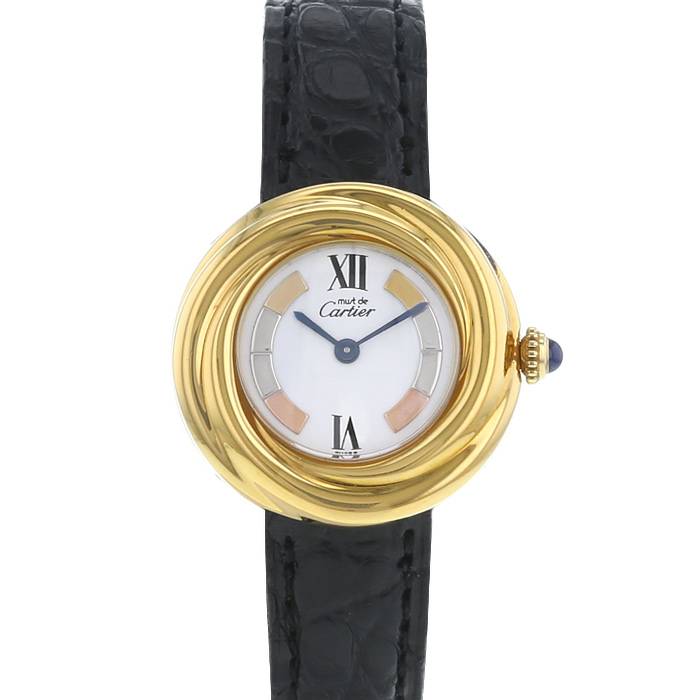
🔗 The Trinity Watch (c. 1970s): The Symbol of Unity; translates the world-famous Trinity ring’s design—three interlocking bands of gold—from a piece of hand jewelry into a defining feature of a round watch case.
Circa 1970s-1980s (Released as part of the accessible Must de Cartier and later in precious metal collections).
The French poet and artist Jean Cocteau is famously credited with inspiring the initial ring design, asking for a ring that represented the interconnectedness of human relationships.
The Trinity design is one of the Maison’s core pillars, celebrating its centenary in 2024, and is one of the few designs that successfully spans both watchmaking and high jewelry collections.
The Trinity Watch’s ingenuity lies in adapting the fluid, three-dimensional geometry of the interlocking ring—a soft, jewelry element—into the rigid structure of a watch bezel.’
Early precious metal versions housed ultra-thin manual-winding movements. The mass-market Must de Cartier versions (common in the 1980s/90s) were predominantly powered by Quartz movements to maintain affordability and thinness.
The Trinity ring was famously worn by icons like Grace Kelly, Jean Cocteau, and the Duke of Windsor. The watch version inherited this glamorous legacy, appealing to those who valued the design’s history and symbolism.
Varies. The original 18K gold versions with mechanical movements are highly sought-after. The Must de Cartier (gold-plated silver) quartz versions are generally common but still highly collectible.
The Trinity Watch is a critical example of Cartier’s genius in trans-collection design, proving that its core jewelry motifs can be flawlessly integrated into its watchmaking portfolio, creating a timepiece that is deeply personal and universally recognizable.
🐴 The Calandre (1970s): The Asymmetric Stirrup; is a rare and highly unconventional timepiece, renowned for its strong, asymmetric case that defies standard watch geometry.
It is often referred to as the “Stirrup” watch due to its equestrian-inspired profile.
Circa 1970s (A critical part of the revived Louis Cartier Collection).
Developed during the period of radical geometric experimentation that also produced the Cristallor, Ellipse, and Gondole.
Calandre (French for “grille,” often referring to a car grille, possibly a Bugatti, which some sources suggest was an early inspiration). It is also known as the “Étrier” (Stirrup).
The most consistent source suggests inspiration from a horse stirrup.
The design’s top lug is integrated differently than the bottom, giving it an equestrian sensibility.
High Rarity. The Calandre was produced in very limited numbers over a short period, especially the manual-wind versions from the 1970s, making it a true collector’s model.’
The Calandre’s ingenuity lies entirely in its asymmetric case construction, which forces a complex, sculptural profile around a central, usually round, dial.
Vintage 1970s models primarily used the reliable, ultra-thin Manual-Winding Caliber 78-1 (an ETA-based movement signed for Cartier). Later 1980s/90s re-issues often switched to Quartz movements.
Like many rare 1970s pieces, the Calandre sold through the flagship boutique often bears the highly collectible “Paris” signature below 6 o’clock.
Due to its extreme rarity and unique design—sitting outside the core Tank/Santos family—the Calandre is a highly valued and coveted model at auction.
The Calandre stands as a crucial chapter in Cartier’s history of asymmetry (alongside the Crash and Cheich), proving that the brand was willing to subvert traditional case structures for bold, equestrian-inspired elegance.

⚪ The Ballon Blanc (2012): The Diamond Aura; is a spin-off of the highly successful Ballon Bleu line, but it redefines the concept for the jewelry-watch segment.
It is characterized by its perfectly smooth, gem-set circular case and the iconic solitary diamond placed at 4 o’clock.
2012 (Launched as an ultra-feminine evolution of the Ballon Bleu).
Developed after the immense success of the Ballon Bleu (2007), which pioneered the distinctive domed case and integrated crown.
The Ballon Blanc strips away the crown guard for a smoother jewelry focus.
Ballon Blanc (White Balloon). The “Blanc” refers to the diamond that replaces the blue sapphire cabochon and crown guard, giving the watch a dazzling “white” brilliance.
To create a piece that functions less as a traditional watch and more as an integrated jewelry bracelet that happens to tell the time, prioritizing seamless curves and gem setting.
It is the quintessential example of a modern Cartier jewelry watch, continuing the tradition of the Baignoire but in a contemporary, volumetric form.
The Ballon Blanc’s ingenuity lies in the subtle but radical design change from its predecessor: the removal of the winding crown and its protective arch, making space for the diamond.
The core models are generally available, but the high-end versions in full gold with the five-row diamond-set bracelets are highly exclusive and costly.
The Ballon Blanc successfully demonstrates Cartier’s ability to evolve its most successful modern designs. It took the most recognizable trait of the Ballon Bleu (the integrated crown) and subtly subverted it to create a new, distinct icon rooted in jewelry design principles.

👑 The Pasha de Cartier (1985): The Chained Icon; is defined by its bold, round case, its unique screw-down crown cap attached by a small chain, and the combination of a circular case with a prominent square minute track on the dial. It stands as Cartier’s most successful modern sports watch (alongside the Santos).
1931/1932 (According to legend, a unique water-resistant watch was commissioned by the Pasha of Marrakesh, Thami El Glaoui).
Gérald Genta (The legendary designer of the Audemars Piguet Royal Oak and Patek Philippe Nautilus, commissioned to create a modern, waterproof Cartier).
The need for an elegant but durable, water-resistant gold watch for the Pasha’s active lifestyle, challenging the rectangular and oval-dominated Cartier catalog.
A defining watch of the 1980s era, symbolizing bold, maximalist luxury and standing out with its large 38mm size (for the time).
The Pasha’s ingenuity is a masterful combination of functionality (water resistance) and signature elegance, using bold, contrasting geometric shapes.
Features a prominent square minute track set right in the center of the circular dial. This “square in a circle” motif is a signature of the Pasha and is highly recognizable.
Features Arabic numerals (12, 3, 6, 9) rather than the Roman numerals typical of other Cartier lines, reinforcing its sporty, legible aesthetic.
The modern 2020 re-launch models feature the in-house Manufacture automatic Caliber 1847 MC movement, a robust and reliable engine. Earlier models (like the Pasha C of 1995) often used high-quality ETA-based movements (Caliber 047/048).
The Pasha has been embraced by cultural figures and celebrities since the 1980s, including Sammy Davis Jr., Pierce Brosnan, and many modern style icons.
The Pasha platform has been used for incredible complications in the CPCP era, including the highly desirable Perpetual Calendar and Tourbillon models, often limited to just 10–20 pieces.
The Pasha successfully positioned Cartier in the modern era as a maker of high-end, sporty automatic watches. It is an enduring classic that is constantly re-interpreted, proving that a round case can be just as iconic as a Tank or Santos.

🏎️ The Roadster (2001–2012): The Automotive Tonneau; is a modern classic defined by its aerodynamic tonneau (barrel) case, bold proportions, and design cues inspired by classic 1950s and 1960s sports cars, blending Cartier’s elegance with pure motorsports aesthetics.
Launched in the early 2000s, it successfully capitalized on the market’s demand for bold, large, and sporty luxury watches, cementing Cartier’s modern relevance beyond the Tank and Santos.
Roadster. A direct homage to two-seater convertible sports cars, emphasizing freedom, speed, and elegance.
Classic automobiles like the Porsche 356. Design elements mimic car parts: the crown evokes a wheel hub, and the date cyclops is likened to a windscreen.
Discontinued in 2012. Its relatively short production run (about 11 years) and unique aesthetic make pre-owned models highly desirable and increasingly collectible.
The Roadster’s ingenuity is found in its aerodynamic geometry, functional details, and a revolutionary feature for its time: the quick-release strap system.
Primarily powered by reliable, ETA-based Swiss automatic movements (e.g., Caliber 3110 or Caliber 8510 for chronographs), renowned for their accuracy and 100-meter water resistance. Smaller ladies’ versions used Quartz movements.
The most innovative feature: The Roadster was one of the first luxury watches with a full-fledged integrated quick-release strap system. The bracelet or strap could be swapped without tools, making it incredibly versatile.
Extremely rare limited editions (e.g., a 42mm XL version) featured genuine walnut burlwood dials, directly referencing the dashboards of classic luxury cars.
Popular with celebrities and public figures of the 2000s, including Jon Bon Jovi and others who favored its bold, masculine blend of luxury and sport.
While mass-produced during its run, its discontinuation means it is now only available on the pre-owned market. The Chronographs, GMTs, and limited editions are highly sought after by collectors.
The Roadster is a unique design outlier for Cartier. It proved the Maison could successfully design an overtly motorsports-themed watch while staying true to its codes of elegance, leaving behind a distinctive and highly recognized design.

🔔 The Cartier Cloche (1920); The Bell of Asymmetry (French for “bell”), first introduced in 1920 as a brooch watch, is celebrated for its highly unusual and distinctive shape, setting it apart as one of Cartier’s rarest and most eccentric designs.
It is one of Cartier’s iconic “shaped watches”, following designs like the Santos-Dumont (1904) and the Tank (1917).
The name refers to the case’s outline, which is shaped like a bell (cloche) and is reminiscent of a counter-top service bell when placed horizontally on a desk.
The need for a truly unique, asymmetrical design allowed for its dual function: a comfortable wristwatch and a practical desk clock, thanks to the reoriented dial.
Has always been a rare and exclusive model, often reserved for limited re-issues in the prestigious Cartier Privé collection due to its exceptional form.
The Cloche’s ingenious design lies in its 90° rotation of the dial—the Roman numerals are rotated so the XII sits where the III usually would (adjacent to the crown), allowing the time to be read when the wrist is slightly extended or when the watch is placed flat as a clock.
Housed the Cartier Manufacture Caliber 1917 MC. This is a shaped, manually-wound mechanical movement designed to be compact (only $2.9\text{ mm}$ thick) to fit the slim, asymmetric dimensions of the bell-shaped case while ensuring high-quality precision.
The cloche shape (French for “bell”) made its first appearance in the house of Cartier as a diamond and onyx watch-brooch in 1920 and was so named because, when placed horizontally, its outline was reminiscent of a service bell one might find in a hotel lobby.
The first cloche wristwatch, a diamond-set reference in platinum, was released in 1921. Between 1921 and 1970, Cartier created several Cloche models, but the Cloche remained a low-volume piece until it was relaunched as part of the Louis Cartier collection in 1984, this time as a quartz watch.
The Cloche de Cartier made its next appearance in 1995 as a limited run of 200 pieces in yellow gold, with Arabic numerals, pomme hands, and a mechanical movement.
These were the first Cloche de Cartier watches that could be both worn on the wrist and placed on a table for use as a desk clock.
The last modern incarnation of the Cloche de Cartier was released in 2007, in a limited run of 100 pieces in yellow gold in the CPCP.
The pomme hands from the last iteration were carried over, but the Arabic numerals of the previous iteration were swapped for Roman numerals, which are more closely associated with Cartier’s design language.

🎈 Ballon Bleu de Cartier (2007): The Floating Sphere, launched in 2007, quickly became a global phenomenon.
It represents a deliberate evolution from Cartier’s historic flat, geometric cases (like the Tank and Santos), focusing on spherical volume and a unique, integrated crown design.
Cartier Design Studio (Tasked with creating a watch that brought volume and fluidity to the classic round watch).
Its immense commercial success positioned it as a third pillar of the brand alongside the Tank and Santos, proving Cartier’s continued relevance in contemporary luxury.
Ballon Bleu (Blue Balloon). Refers to the watch’s spherical, airy feel and the blue sapphire cabochon integrated into the crown.
The graceful, aerodynamic shapes of early air travel and the delicate form of a balloon floating in the air.
Has achieved iconic status, being worn by figures ranging from royalty (e.g., Kate Middleton) to celebrities, making it instantly recognizable globally.
The Ballon Bleu’s ingenuity lies in its three-dimensional case architecture and the integration of the winding crown, which creates a mesmerizing visual dynamic on the dial.
Core modern models are powered by the Manufacture Automatic Calibre 1847 MC, a robust, contemporary in-house movement. Smaller models often use high-quality Quartz.
Classic Cartier aesthetic: A silvered guilloché dial (often with a subtle flinqué pattern), Roman numerals, and the inner chemin de fer minute track.
The platform is versatile, hosting models with Chronograph functions, Moon Phases, and even the highly complex Flying Tourbillon (certified with the Poinçon de Genève).
Core models are standard production. The high-complication models (Tourbillon) and full diamond-pavé versions are produced in extremely limited quantities and command high prices.
The Ballon Bleu successfully carved out a new aesthetic territory for Cartier in the modern era. It proved that the Maison could innovate upon the classic round case, ensuring its place as a leader in both design and commercial success into the 21st century.

🔑 The Clé de Cartier (2015): The Streamlined Key; (French for “key”), launched in 2015, is defined by its smooth, perfect circular case and its distinctive, rectangular key-shaped winding crown. It was the primary platform for introducing Cartier’s new wave of in-house automatic movements.
Developed after the success of the Ballon Bleu, the Clé offered a sleek, minimalist, and more classic aesthetic, bridging the gap between the vintage Tank’s elegance and the modern complexity of the Rotonde.
Clé (Key). The name refers directly to the rectangular, elongated shape of the winding crown which resembles an antique key used to wind pocket watches and clocks.
Simplicity and precision. The design focuses on the essential—a perfect circle—and elevates the everyday function of winding/setting into a defining aesthetic feature.
The Clé collection was the primary launch vehicle for the Cartier Calibre 1847 MC, marking a significant milestone in the brand’s shift to equipping core production models with in-house movements.
The Clé’s ingenuity lies in the meticulous balance between its perfectly round, flowing case and the sharp, architectural lines of its signature winding mechanism.
Core models are powered by the Manufacture Automatic Calibre 1847 MC, a reliable, time-and-date movement introduced in 2014 and central to Cartier’s modern strategy.
Features a simple, elegant dial with a subtle trapezoidal shape at the center (guilloché), framed by Roman numerals and the chemin de fer minute track.
The platform has hosted several high-complication models, most notably the Flying Tourbillon (certified with the Poinçon de Genève), proving its potential as a high-horology base.
The case is thicker at the center and tapers toward the edges, enhancing its streamlined, ergonomic fit on the wrist.
Appealed to both men and women seeking a sophisticated, understated dress watch that was distinctly modern and possessed a unique design signature without the volume of the Ballon Bleu.
Core models were mass-produced. The high-complication versions (Tourbillon) and full-gold models are highly exclusive and rare.
The Clé is significant because it was the watch that truly launched the Calibre 1847 MC and showed the world that Cartier could create a totally new, signature case shape in the modern era that honored its history of geometric elegance while maintaining contemporary minimalism.

🏛️ The Rotonde de Cartier (c. 2006): The High Horology Platform; is defined by its classical, pure round case and balanced proportions. It was specifically conceived as the elegant, sophisticated stage for Cartier’s most complex and technically ambitious movements and complications, marking the brand’s 21st-century mechanical renaissance.
The contemporary home for Cartier’s most complex Manufacture movements and mechanical ingenuity.
Circa 2006 (First introduced at SIHH, notably with the Grande Date model).
Cartier’s Fine Watchmaking Division (The dedicated team established to drive the brand’s return to haute horlogerie).
It replaced the Collection Privée Cartier Paris (CPCP) line as the primary home for complicated models, serving as the clean canvas for Cartier’s newly developed in-house movements.
Rotonde (Rotunda/Round Building). References the classical architectural form, symbolizing the collection’s role as the foundation for mechanical artistry.
To provide a clean, symmetrical, and restrained round case that would not compete with the technical complexity of the movements housed within.
The Rotonde is the collection where Cartier truly established its credibility as a Manufacture, showcasing complex calibers developed entirely in-house.
The Rotonde’s ingenuity is found in its perfect visual balance, designed to elevate the complication, and in its strategic use of complex, in-house calibers.
Home to the spectacular Astrotourbillon (where the tourbillon orbits the dial) and the Mysterious Double Tourbillon (appears to float in a sapphire aperture, echoing Cartier’s historic mystery clocks).
Showcased in ultra-complex pieces like the Minute Repeater Mysterious Double Tourbillon.
Models featuring Perpetual Calendars, Annual Calendars, and Retrograde GMT (Second Time Zone/Day-Night indicators).
Houses a wide range of Manufacture Calibers (e.g., 9406 MC, 9462 MC, 9907 MC), with some of the highest complications receiving the prestigious Poinçon de Genève certification.
Collectors of high-horology, complicated watches, and enthusiasts who appreciate technical innovation blended with restrained, classical elegance.
Models with Grande Complications (Minute Repeater, Perpetual Calendar, Tourbillon) are produced in extremely limited quantities (often 20–50 pieces globally) and are among the most expensive watches the Maison produces.
The Rotonde single-handedly redefined Cartier’s image in the 21st century, establishing it as a credible, innovative Manufacture capable of creating some of the world’s most inventive and mechanically complex timepieces, rivaling the Swiss masters.

⭕ The Cartier Ronde (Historic): The Pure Circle; (French for “round”) is a pillar of the Maison’s classic repertoire, predating the Rotonde collection. It is defined by its clean, simple, and flat circular case and signature straight lugs, embodying restrained, time-only elegance.
Early 20th Century (The round watch has always been a staple, but the specific Ronde collection solidified in the mid-20th century).
Developed as the simple, classic, and elegant alternative to the shaped watches (Tank, Tonneau), providing a perfect example of timeless Parisian chic.
Ronde (Round). The name emphasizes the collection’s devotion to the most pure and simple geometric form.
The Ronde is characterized by its simple, straight, often short lugs and focus on time-only elegance. The Rotonde has longer, more robust lugs and is the platform for high complications.
The Ronde’s ingenuity lies in its minimalist construction, where simplicity and perfect proportions are paramount, requiring high precision to achieve flawless symmetry.
Historically, it housed ultra-thin Manual-Winding movements. Modern models (such as the Ronde Solo or Ronde Must) often use reliable Automatic movements (like the 1847 MC) or Quartz calibers in smaller sizes.
Standard Production. The basic time-only models are widely available and represent the entry point to Cartier’s core mechanical collections. However, unique gold-cased vintage examples are highly prized.
The Ronde proves that Cartier’s design genius extends beyond its famous shaped watches. It is the definitive expression of the pure, classical round watch in the Maison’s catalog, emphasizing balance, proportion, and minimalist elegance.
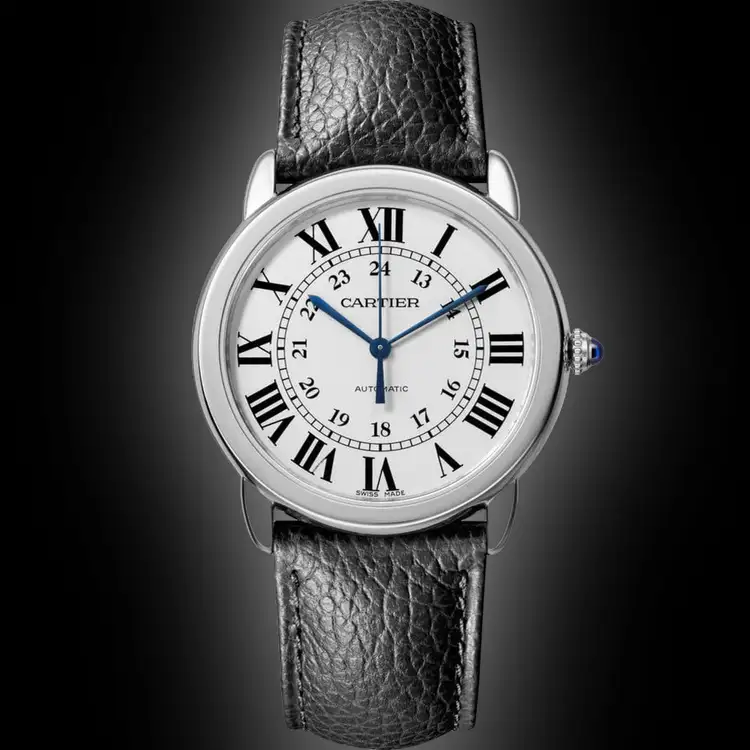
🐊 The La Doña de Cartier (2006): The Reptilian Odel; The Cartier La Doña is an asymmetrical, bold women’s watch defined by its striking trapezoidal case and articulated, high-jewelry bracelet links. It was created as a direct tribute to the legendary Mexican actress and patron of Cartier, María Félix.
María Félix (1914-2002), a Mexican film icon known by the nickname “La Doña” for her fierce, glamorous personality. She was one of Cartier’s most extravagant clients.
Félix’s commissioned high-jewelry pieces, specifically the legendary Crocodile Necklace (1975) and the Snake Necklace (1968).
The watch’s design is inspired by the crocodile, which Félix famously brought to Cartier’s workshop for jewelers to replicate. The watch is a subtle, stylized tribute to the reptile’s form.
The La Doña’s ingenuity lies in the seamless integration of the trapezoidal case with the fluid, highly articulated bracelet, evoking the powerful image of a reptile.
The La Doña is primarily powered by a highly reliable Quartz movement. This choice prioritizes the watch’s slim profile and jewelry-like function over mechanical complexity.
Produced in several sizes .
Exclusively a feminine timepiece, appealing to collectors of bold jewelry watches and those who admire María Félix’s legacy.
The core models were produced in high numbers during its run (2006–2010s). However, the full gold, diamond-set bracelet versions are highly sought after in the secondary market.
The La Doña successfully tied Cartier’s legacy in high-jewelry and bespoke commissions directly to a modern watch collection, continuing the brand’s tradition of creating sculptural, narrative timepieces.
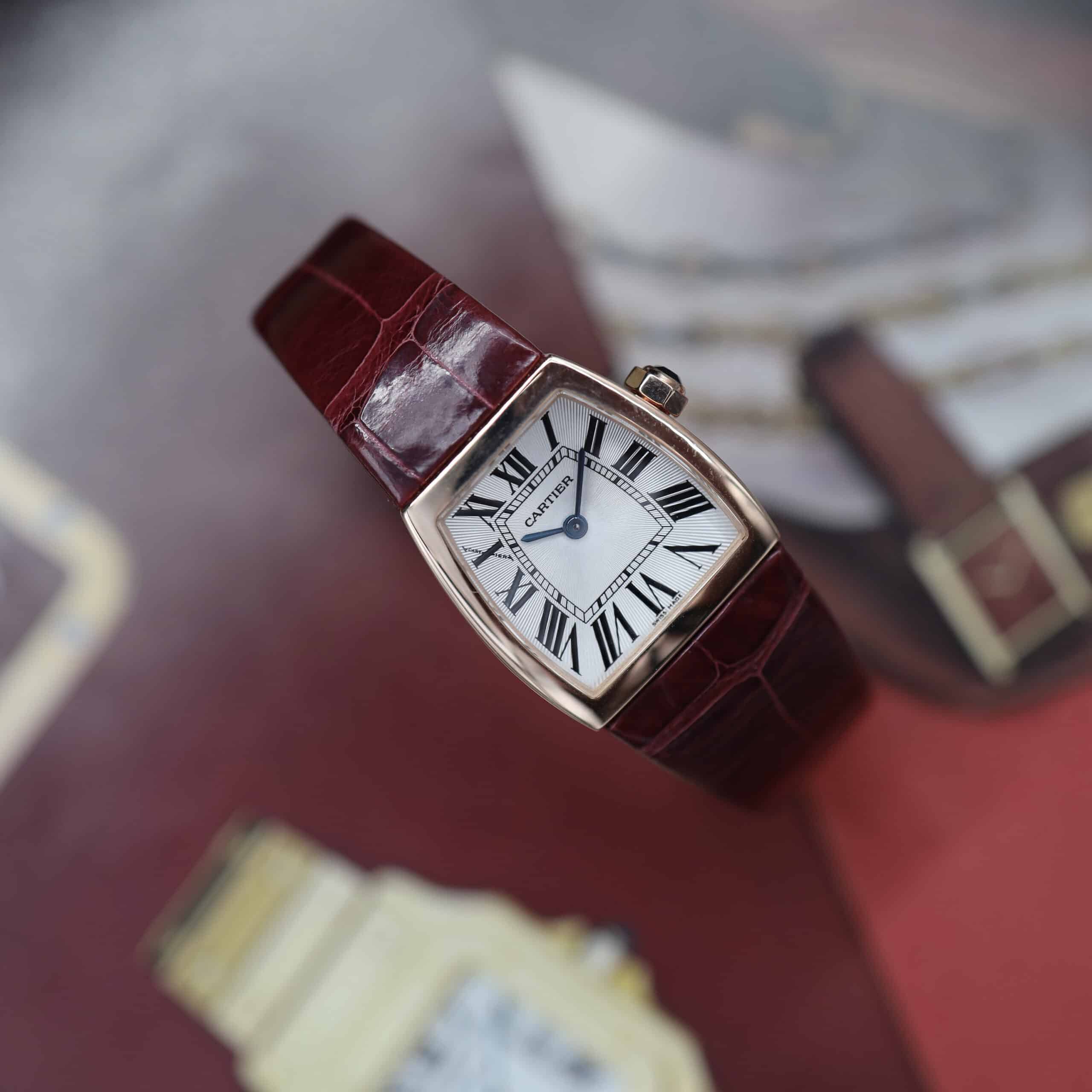
⚙️ The Calibre de Cartier (2010): The Manufacture Pillar; launched in 2010, was a watershed moment for the brand. It was the first mass-production line to be powered by the 1904 MC—Cartier’s first in-house automatic base caliber—and was designed with a distinctly masculine, robust aesthetic to compete in the luxury sports watch segment.
Preceded by the 2008 high-horology tourbillons (like the Ballon Bleu Flying Tourbillon), which showed Cartier could make in-house movements. The Calibre line demonstrated that Cartier would make them for its core market.
Calibre de Cartier (Caliber of Cartier). A clear, bold statement that the watch’s identity is centered on its self-made mechanical movement.
The need for a large, contemporary, and masculine round watch that offered technical credibility to match the high aesthetic quality of the Maison.
It marks the most significant step in Cartier’s transition from an établisher (using externally sourced movements) to a fully integrated Manufacture.
The collection was surprisingly discontinued around 2020, making it a sought-after piece in the secondary market.
The Calibre’s ingenuity is a combination of traditional Cartier codes (Roman numerals, cabochon) with modern, aggressive styling (oversized crown guard, large XII numeral) and a highly technical, modern movement.
1904-PS MC (Base time/date/small seconds) caliber.
Double Barrel (Ensures more stable torque delivery), Bi-directional Winding with ceramic ball bearings for efficiency and durability, Stop-Seconds (Hacking).
While mass-produced, its discontinuation has led to increasing collector interest, especially for the Chronograph and the highly respected Diver models.
Features Côtes de Genève decoration on the rotor and bridges.
The Calibre de Cartier is fundamental to the modern brand story. It was the essential bridge that established Cartier’s reputation for manufacturing high-quality, in-house movements (1904 MC and later the 1847 MC and others) across its broader collection.

🖤 The Must de Cartier 21 (c. 1990s): The Sports Dress Watch;(or simply Must 21) is a highly recognizable timepiece defined by its smooth, round case, integrated bracelet, and distinctive engraved bezel featuring large Roman numerals. It represented the accessible, sporty side of the Cartier brand in the late 20th century.
Developed during a period when luxury brands were creating more robust, integrated, and accessibly priced models to compete with the rise of modern sports watches.
Must de Cartier (A must-have of Cartier). The original line was launched in the 1970s to democratize the brand. The “21” designation refers to its modern, 21st-century aesthetic and often size in the smaller versions.
A blend of the classic Tank/Ronde aesthetics with the integrated bracelet style popularized by designers like Gérald Genta, but executed with Cartier’s signature elegance.
It became a symbol of the 1990s, known for its distinctive two-tone styling and being a fashionable entry point to the brand.
The Must 21’s ingenuity lies in its bold, layered bezel design—a departure from the smooth bezels of the Ronde and Rotonde—and its seamless, sporty integration.
Primarily powered by highly reliable Swiss Quartz movements. This choice allowed the watch to be thin, affordable, and accurate, aligning with the model’s accessible luxury goal.
Features a highly integrated bracelet often composed of polished and brushed links, designed to flow directly from the case without visible lugs, enhancing its sporty appeal.
Widely Produced. While generally available on the pre-owned market, the specific Chronoscaph and Autoscaph models (sportier, rubber-strapped versions) are popular among collectors looking for 1990s/2000s vintage.
The Must 21 successfully served as the gateway watch for an entire generation of collectors. It proved that Cartier’s core design DNA (Roman numerals, cabochon) could be adapted into a modern, sporty, and highly effective commercial package.
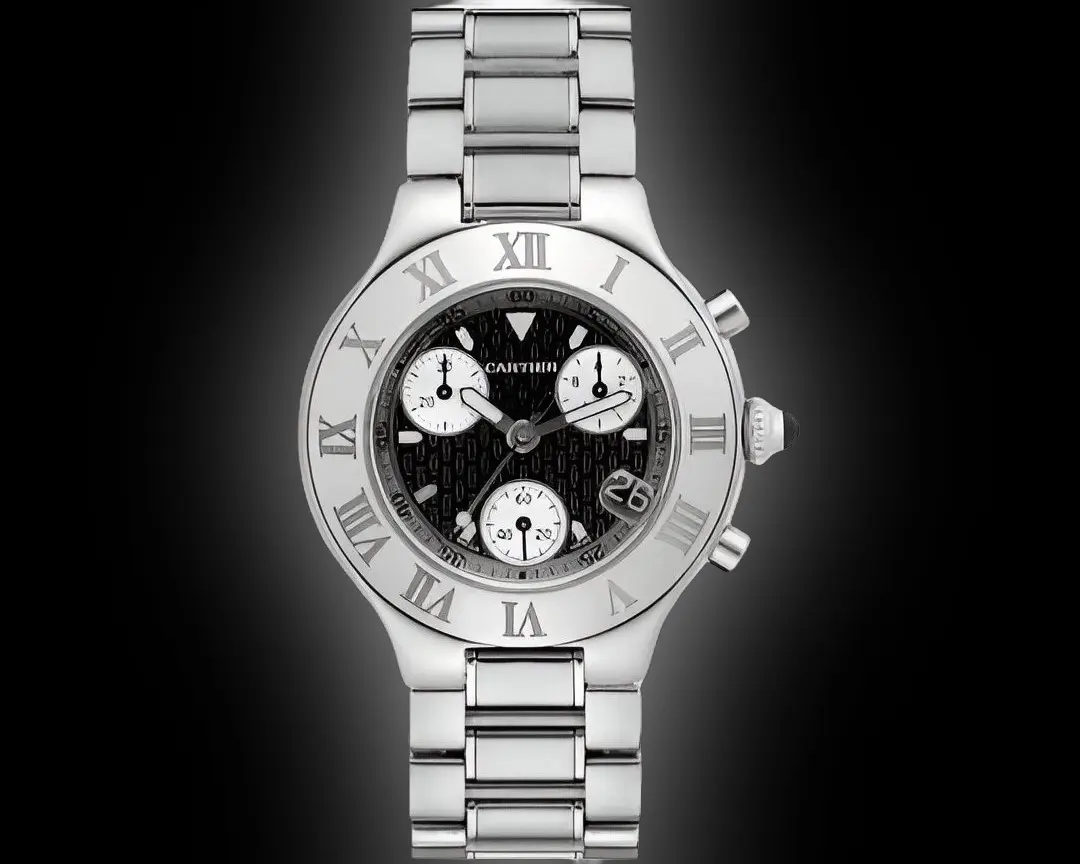
⛓️ The Tressage de Cartier (c. 2023): The Sculptural Weave collection is defined by its architectural, woven volumes and bold interplay of materials. It is a modern, high-jewelry-focused line that transforms the classic watch into a sculptural piece of wearable art, following in the footsteps of the Cartier Libre collection.
Circa 2023 (Launched first as jewelry, with watches added at Watches & Wonders 2025).
A contemporary release designed to showcase Cartier’s savoir-faire in high jewelry techniques, creating a “third kind” of timepiece that fuses watchmaking and sculpture.
Tressage (Weaving or Braiding). Refers to the central design motif of interlocking, twisted, or braided gold and diamond elements.
The collection draws heavily on the legacy of Jeanne Toussaint (Creative Director, 1933), honoring her influence in bringing bold, tactile textures and volumes to Cartier’s creations.
It is part of Cartier’s effort to continually redefine the watch’s boundary, presenting it as a primary jewelry item where the metalwork dominates the design.
The Tressage’s ingenuity is found in its dramatic volume, its blend of textures (smooth gold and pavé diamonds), and the way it exaggerates traditional watch elements.
Typically powered by a reliable Swiss Quartz movement. The choice prioritizes the watch’s slim profile, complex form, and jewelry function over mechanical complication.
Often highly minimalist or fully set with snow-set diamonds to maximize sparkle and allow the surrounding gold sculpture to take center stage.
Utilizes advanced techniques to set diamonds and stones into the curved, woven gold structure, emphasizing the complexity of the tressage texture.
The pieces are designed as “bangle” or cuff watches, making a bold, dramatic statement on the wrist.
Collectors of high-jewelry watches, patrons of the Cartier Libre philosophy, and those who seek dramatic, sculptural, and art-focused timepieces.
All Tressage watches are considered Fine Jewellery Watches and are produced in extremely limited quantities, making them highly exclusive.
The Tressage collection reaffirms Cartier’s position as a pioneer at the intersection of jewelry and watchmaking, demonstrating a restless imagination that continues to create entirely new forms.
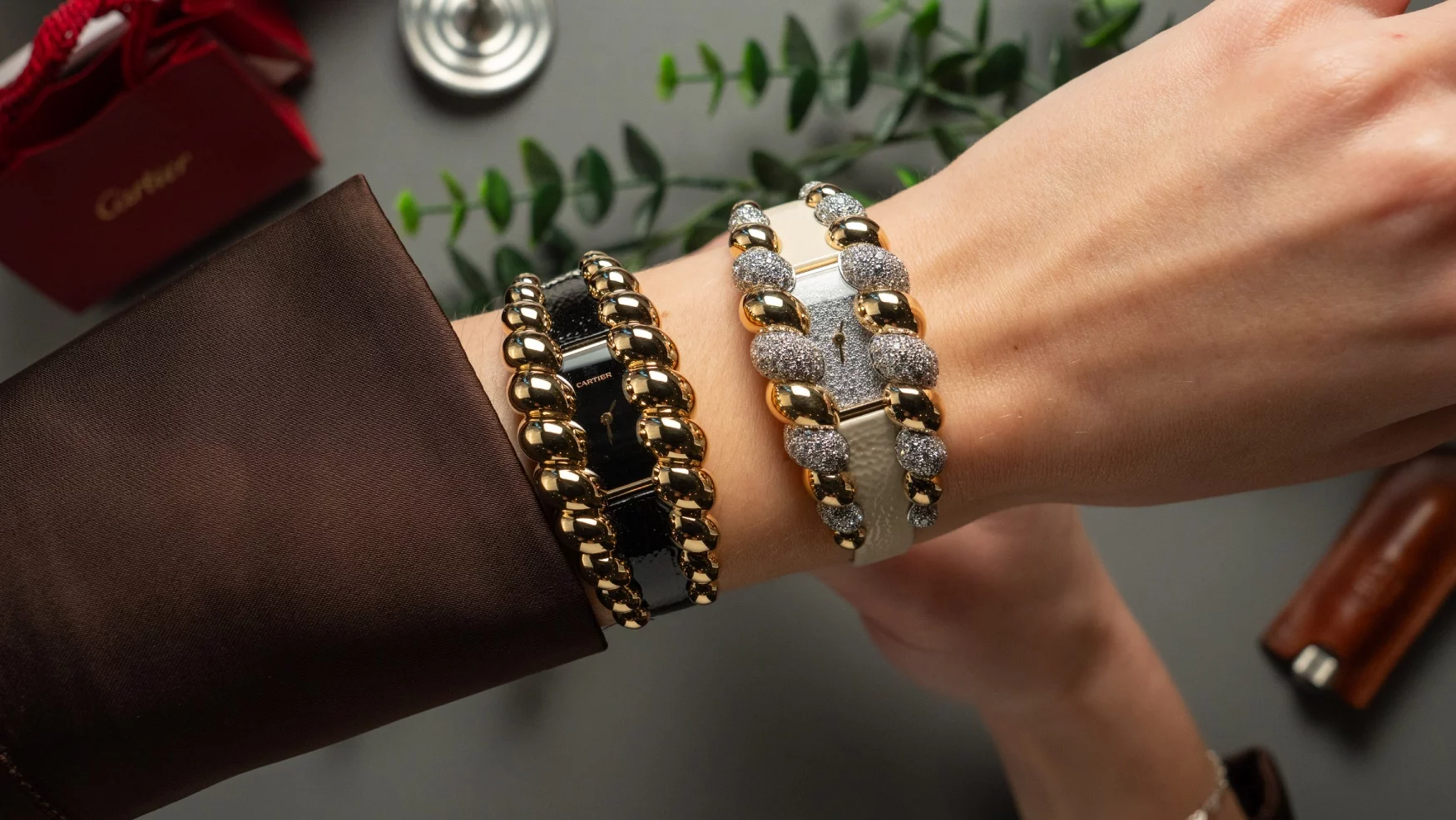
🪞 The Reflection de Cartier (c. 2024): The Mirror Effect; is a high-jewelry watch collection defined by its architectural, open cuff design and the striking use of a polished mirror surface positioned directly opposite the dial. The design creates an optical illusion where time and light are seemingly reflected and distorted.
Follows in the spirit of other conceptual, boundary-pushing designs like the Clash [Un]limited and Coussin de Cartier, demonstrating Cartier’s commitment to artistic and illusionary timepieces.
Reflection de Cartier (Cartier’s Reflection). The name directly describes the core design concept: the dialogue between the watch dial and its polished, mirrored twin.
The collection is inspired by the mystery and illusion of time and the visual fascination of architecture, blending fullness and emptiness with angularity and curvature.
It combines the savoir-faire of Cartier’s watchmakers and jewelers, using complex metalwork and setting techniques to create a piece of haute couture for the wrist.
The Reflection’s ingenuity lies entirely in its architecture and optical effects, using light, shadow, and polished surfaces to challenge the conventional presentation of time.
Powered by a reliable, thin Swiss Quartz movement. This is a functional choice to maintain the watch’s delicate dimensions and prioritize its sculptural nature.
Extremely minimalist, often featuring only sword-shaped hands (blued-steel or rhodium-finish) with no numerals, allowing the architecture and reflection to dominate.
Designed with a generous open architecture, the watch is engineered to be worn as a bangle/cuff, making it easily slipped on and off.
Available in multiple versions, including full diamond-set white gold, rose gold with sandblasted dials, and high-jewelry pieces adorned with vibrant colored stones like chrysoprase, obsidian, and emeralds.
The new Reflection de Cartier is closer in style to the more traditional take on high jewelry watch design than its Baignoire bangle cousin. But its essence is aligned with the same overall message: women have a voracious appetite for modern, sculptural and chunky gold jewelry with a time-telling twist.
The entire collection is positioned as Fine Jewellery, meaning production volumes are very limited and prices are accordingly high, making them highly exclusive.
The Reflection de
Cartier reaffirms the Maison’s legacy of using Art Deco-inspired geometry (angularity, contrast) and combining it with the mystery of time, continuing the tradition of creative, boundary-pushing design.

🎪 Le Cirque Animalier de Cartier (c. 2008): The Sculptural Menagerie; is an extremely limited-edition collection of fine jewelry watches. It is characterized by its use of large, three-dimensional, fully sculpted animal figures—such as the tiger, elephant, snake, and eagle—that interact with the dial, turning the timepiece into a miniature, wearable sculpture or “theatre.”
These pieces represent the apex of Cartier’s Métiers d’Art (Artistic Crafts), released in small, exclusive series to demonstrate the ultimate level of craftsmanship, distinct from the main commercial collections.
Le Cirque Animalier (The Animal Circus). Refers to the playful yet majestic parade of animals that dominate the watch face.
Cartier’s legacy of animal-themed jewelry, stemming from the iconic Panthère designs and the bespoke commissions made for patrons like the Duchess of Windsor and María Félix (see La Doña).
It is an expression of pure artistry, where the watch is less about timekeeping precision and more about showcasing three-dimensional ronde-bosse (sculpture in the round) figures crafted from precious metals and set with thousands of stones.
The ingenuity of Le Cirque Animalier lies in its fusion of horology with high sculpture, creating a visual narrative on the wrist.
-
The Animal Motif: Each piece features a different animal (Tiger, Eagle, Gecko, Snake, Lovebirds, etc.) meticulously sculpted in 18K white or yellow gold.
-
Gem-Setting: The animals are fully pavé-set with brilliant-cut diamonds and finished with colored gems for the eyes (e.g., emeralds, sapphires), creating a strikingly lifelike presence.
-
Dial Presentation: The functional dial is often off-centered (like at 3 o’clock) or small and discreet, made of materials like mother-of-pearl. In some cases, the animal sculpture serves as a “Secret Watch,” where the time is concealed until a latch is opened.
-
Case Structure: The case is typically a large, fully circular frame ($40\text{ mm}$ to $43\text{ mm}$), paved with diamonds, forming a stage for the main animal sculpture. Mostly utilizes high-quality, thin Quartz movements (e.g., Caliber 056) or thin Manual-Winding movements (e.g., Caliber 430 MC). Mechanical complexity is intentionally secondary to the exterior artistry.
Pieces are produced in extremely limited and numbered editions (typically 50 to 100 pieces worldwide), making them highly prized collector items.
These are among the most expensive timepieces produced by Cartier, with retail prices often well into the six figures, reflecting the hundreds of hours of gem-setting and sculpture work.

✨ Mysterious Hours: The Floating Illusion; complication is a horological marvel where the hour and minute hands appear to float in mid-air within a transparent section of the dial, seemingly disconnected from the rest of the movement. This mechanism is a direct transfer of the “mystery clock” concept—a cornerstone of Cartier’s history—into a wristwatch.
1912 (Debut of the first Cartier “Model A” Mystery Clock, designed by Maurice Coüet, inspired by the illusionist Robert-Houdin).
Circa 2013 (The complication was miniaturized and successfully launched in the Rotonde de Cartier Mysterious Hours watch).
Maurice Coüet (The original clockmaker) and the Cartier Fine Watchmaking Division (for the wristwatch adaptation).
Mysterious Hours/Mystery Dial. References the magical illusion where the mechanism driving the hands is entirely concealed.
It embodies Cartier’s unique philosophy of high horology, where mechanical complexity is used entirely in the service of aesthetic effect and visual drama, rather than just technical performance.
The ingenuity lies in the use of transparent materials and highly precise peripheral gearing, allowing the hands to move without a visible connection.
MovementCalibre 9981 MC (Manual Winding).The mystery display dominates the center of the dial, leaving the movement visible on the periphery or through the caseback.
Mysterious Double Tourbillon (Calibre 9454 MC), where the tourbillon itself floats on a sapphire disk, rotating every 5 minutes while spinning once per minute.
Considered a high complication. These watches are produced in limited quantities, especially the tourbillon versions, and are priced as significant collector pieces.
The Mysterious Hours is the ultimate expression of Cartier’s Art Deco influence and its long-standing commitment to magic and illusion in watchmaking. It is one of the most defining and recognizable complications in modern haute horlogerie.

The Architecture of Lasting Elegance
Endurance, as Cartier has proven over 175 years, is never a matter of static resistance; it is the art of shaping change without losing the self.
Our journey through the Cartesian Canon—from the pioneering geometries of the Santos and the unparalleled scope of the Tank universe, to the surrealist masterpieces of the Crash and the Baignoire—reveals that the Maison’s true Savoir-Faire lies not in complications, but in coherence. Every curve, tilt, and angle demanded that the mechanical heart serve the radical vision of the form. This is the ultimate lesson of the Tank, the Santos, and the Tortue: a strong design is one with the inherent capacity to evolve, allowing the shape to persist even as the world around it transforms.
A Cartier watch is thus more than an instrument for measuring time; it is a profound object of transmission, linking the wearer not just to a moment, but to an enduring lineage of design perfection. What endures is not the complexity of the machine, but the purity of the idea.
Cartier’s geometric genius has fundamentally altered the wristwatch. Its legacy is the ultimate proof that the most coherent, the most audacious, and the most pure design is what truly defines The Geometry of Endurance.