Blog
The Lederer Triple Certified Observatory Chronometer


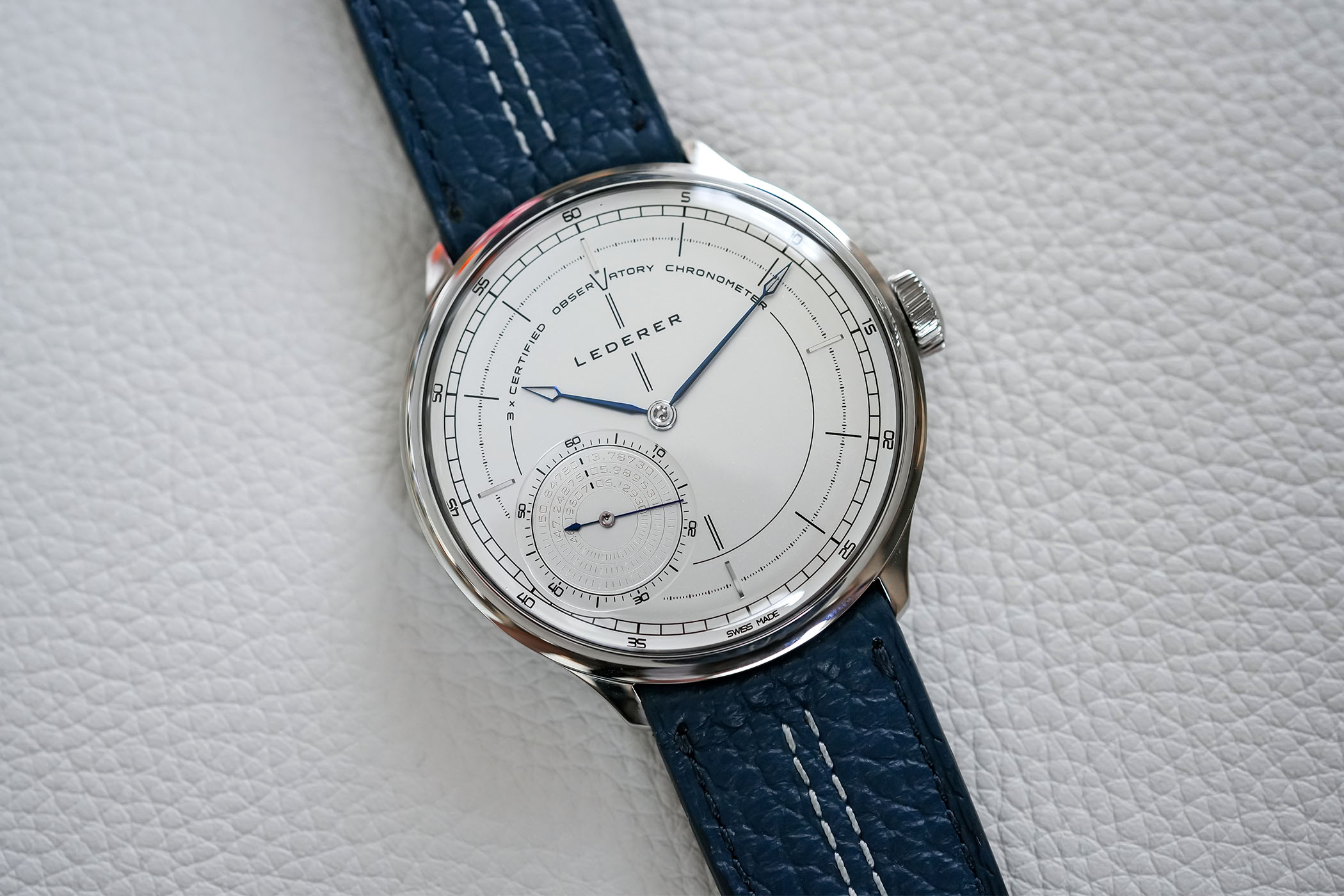
The Lederer Triple Certified Observatory Chronometer is a 44mm watch in polished stainless steel with a handmade sterling silver dial.
It also features a blued handset with skeletonized tips on the hour and minute hands. Large sapphire crystals on both sides of the case provide a clear view of the dial and movement.
The case measures 12.2mm thick, and despite its large size, this isn’t a sports watch, which explains the 30m water resistance rating.
A blue calfskin strap with a stainless steel pin buckle completes the package.
An innovative timepiece bearing exceptional provenance, the Lederer Triple-Certified Observatory Chronometer Watch by independent master watchmaker Bernhard Lederer is presented in a limited edition of only 8 pieces.
A veritable tribute to the pursuit of timekeeping accuracy, the model is powered by the in-house Calibre 9012 manual winding movement with Patented Lederer Chronometer Escapement, certified and validated by three respected independent Observatories.
Housed within a 44mm stainless steel case, paired with a pristine white in-house dial crafted from sterling silver, this unprecedented timepiece is characterised by refined elegance and is beautifully executed throughout with the immaculate detailing and finishing that is a signature feature of this prestigious atelier.

From a distance, the Triple Certified Observatory Chronometer resembles many Bauhaus-inspired watches.
However, closer examination and an understanding of why this watch exists reveals a very different kettle of fish. Essentially, Lederer has created eight watches that withstood chronometer tests from four institutions.
After receiving a COSC certification, each piece then traveled to the Observatory in Besançon, France, the Observatory in Glashütte, Germany, and the “Observatory Chronométrique” in Geneva, Switzerland.
Each watch passed a battery of tests at the three observatories.
This watch is a gateway, with each element linking to long-established sources of knowledge – much like dictionaries, encyclopedias, scientific reviews, and historical essays – and other watches.
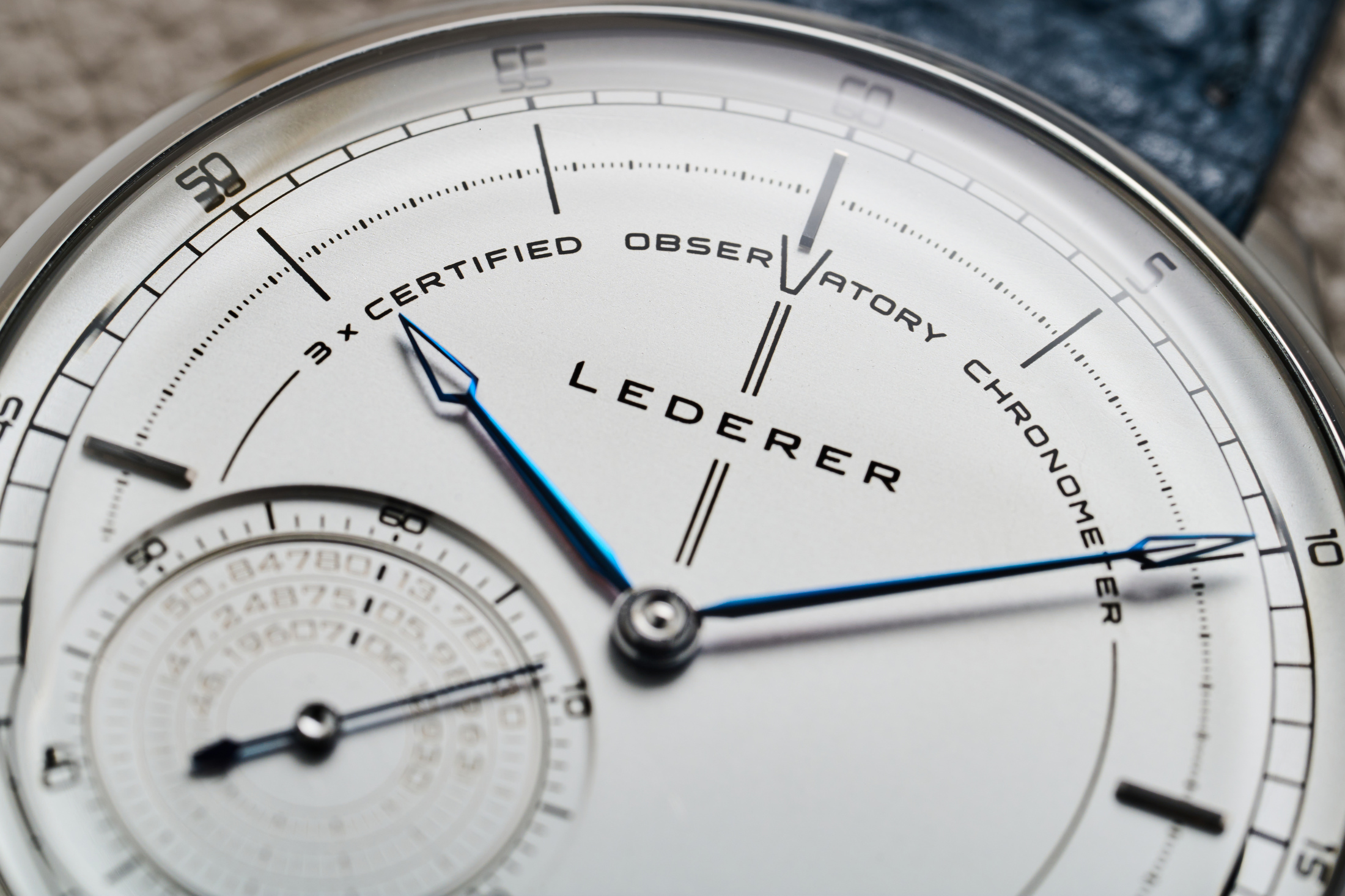
In keeping with the intent, the Lederer Triple Certified Observatory Chronometer looks like an instrument.
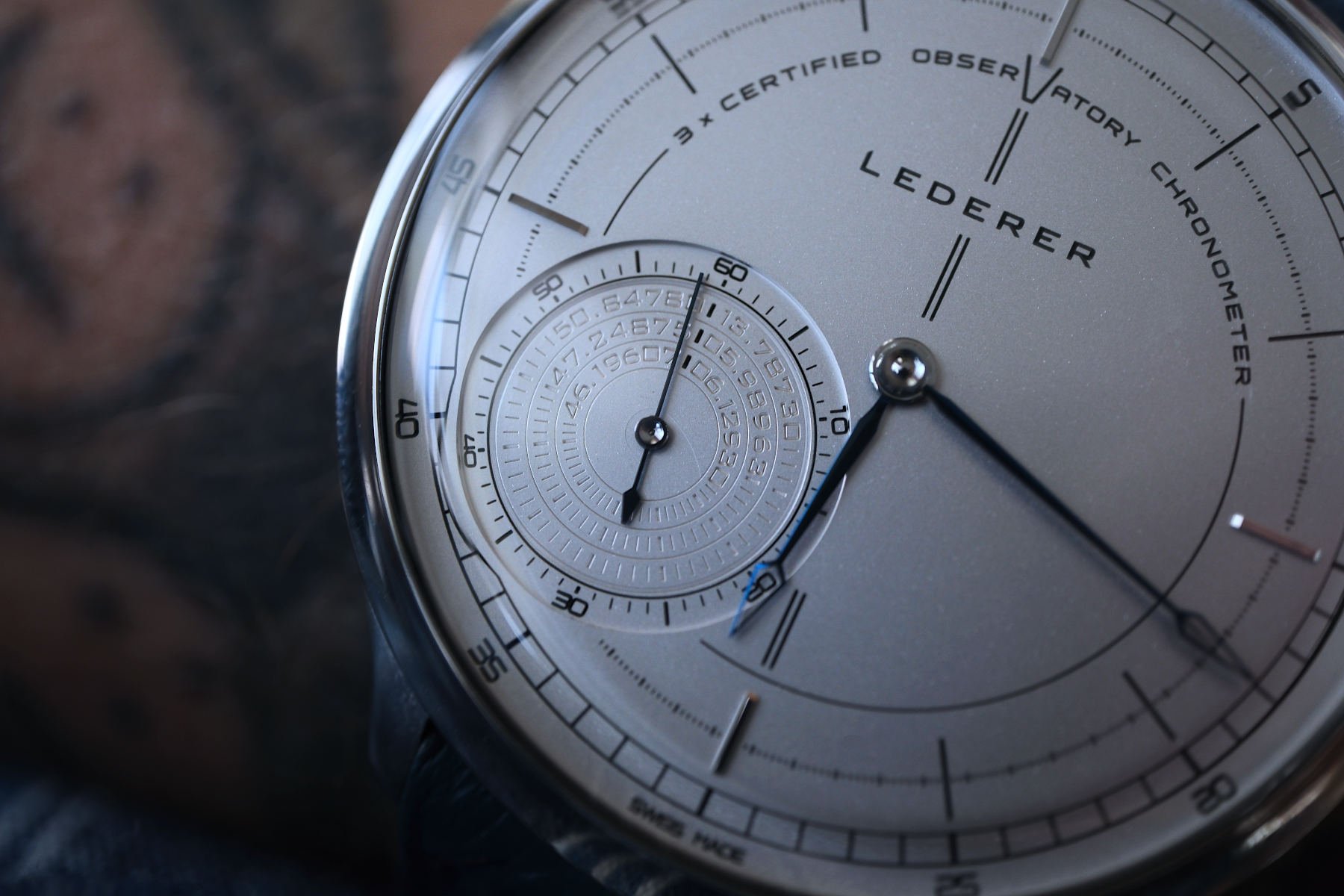
However, serious watchmaking chops are at work. The hand-finished sterling silver dial displays a matte surface.
A sub-seconds register indicates the longitude and latitude of each of the three observatories.
Then, the glorious blued hands house a secret. In particular, the minute hand has a small needle within the skeletonized tip. Under a loupe, it’s possible to see this hand move in line with the watch’s remontoir every 10 seconds along the printed track. It’s mesmerizing, and I enjoyed watching it.
Aside from this, note the vertical line running through the dial’s center. This line continues on the strap and signifies the Prime Meridian.
While the underlying horology that makes Lederer so great remains unchanged, it’s refreshing to see a brand continue to push its aesthetics to something more cohesive – a design that I think will draw more people to the brand.
That being said, the new Lederer Three-Times Certified Observatory Chronometer will only be made in eight pieces, and the price tag is sizable: CHF 146,000. Slow and steady has been the theme for Lederer, and I’m hopeful this will be the start of a new generation of Lederer watches based on his decades of experience.
The Lederer Observatory Chronometer uses the in-house caliber 9012, a manual-winding movement with 45 jewels and 210 components.
It has a frequency of 21,600vph and a minimum power reserve of 38 hours.
The visual symmetry is impressive due to twin barrels, twin gear trains, two constant-force mechanisms, and two independent escapement wheels.
The thin bezel maximises the dial’s visibility, and the domed sapphire crystal ensures minimal distortion from side angles and virtually none when viewed head-on.
The fluted crown at 3 o’clock is well-proportioned to the case and easy to operate.
On the back, the sapphire crystal caseback features an anti-reflective coating and is attached to the case with adhesive rather than screws, ensuring the innovative movement is displayed in all its glory.
The base undergoes multiple processing steps to achieve the dial’s near-perfect white hue – reminiscent of freshly fallen snow, as the brand describes – and the result is captivating.
Complementing the dial’s purity are blued hands, applied faceted baton indices at 3, 6, 9, and 12, and crisp, black-printed minute tracks, all adding to its elegance and pure beauty.
The subdial features an outer seconds track with markings and Arabic numerals at 10-second intervals on its narrow upper level.
On the lower surface, three concentric decorative rings are engraved with the coordinates of the observatories where the watch will be tested for certification.
Nearest to the centre are the coordinates for the Observatoire Chronométrique in Geneva (46.19607 | 06.12930), followed by the French Besançon Observatory in the middle ring (47.24875 | 05.98963), and finally, the German Glashütte Observatory’s location (50.84780 | 13.78730) engraved closest to the edge.
The main dial also features a finely printed circular line, interrupted at the top by the “3 x Certified Observatory Chronometer” designation. The “V” in this text is particularly prominent, said to symbolize the meridian sign, highlighting the watch’s connection “to the legacy of chronometric excellence”.
However, I like to think of the “V” and the double line extending from it as resembling a metronome – a fitting metaphor, as Bernhard Lederer often explains his innovative mechanism using the word.
Technical specifications – Bernhard Lederer Observatory Chronometer